








How AI Automates Audio Visual System Design for Audio Visual (AV) Consultants

AI-powered audiovisual design tools play a major role in automating BOM generation, creating cable wiring diagrams and streamlining proposal formatting and the necessary project documentation for AV consultants. According to research by McKinsey, generative AI can automate up to 60-70% of the time spent on knowledge-work tasks, which mainly include documentation-heavy workflows. This approach allows teams to focus on system planning and client requirements, ensuring successful project delivery.
One of the main reasons for AV project slowdowns is design revisions, continuous updates to drawings and equipment schedules, and changes in scope. Even minor modifications can lead to manual rework, timeline shifts and increased overall effort required to keep projects aligned.
Furthermore, these inefficiencies are the primary cause of budget gaps, procurement mismatches, labor costing errors and project coordination challenges, which affect overall client expectations. In this guide, we will explore how can AV consultants use AI for system design. Also, discover how XAVIA and X-DRAW help in reducing project turnaround time by automating CAD drawings and diagramming workflows.
Boost Productivity: Automate AV Drawings, Schematics, and Proposals with XTEN-AV
The all-in-one solution for your AV needs
Transform your audio-visual experience with XTEN-AV.
No Credit Card required
Key Takeaways
- AI transforms AV design by converting room requirements and equipment data into wiring diagrams, BOMs, signal flow and client-ready proposals, which minimizes manual design effort.
- X-DRAW by XTEN-AV is a cloud-based AV design and diagramming platform that automatically generates accurate wiring diagrams, rack layouts, signal flow and system schematics directly from project inputs.
- XAVIA by XTEN-AV is the AV industry’s first AI agent that creates designs, BOMs, proposals, and project plans through simple voice or chat-based prompts, accessible on both desktop and mobile devices.
- Bill of materials creation becomes faster and more dependable as AI synchronizes product selection with structured equipment data and reduces manual errors.
- AV proposal creation shifts from manual document assembly to a connected workflow in which design outputs, pricing, and project scope converge into a polished, client-ready proposal.
- Overall, AI improves speed, accuracy and delivery efficiency across the AV project stages, enabling consultants to focus more on design intelligence, client strategy and project outcomes.
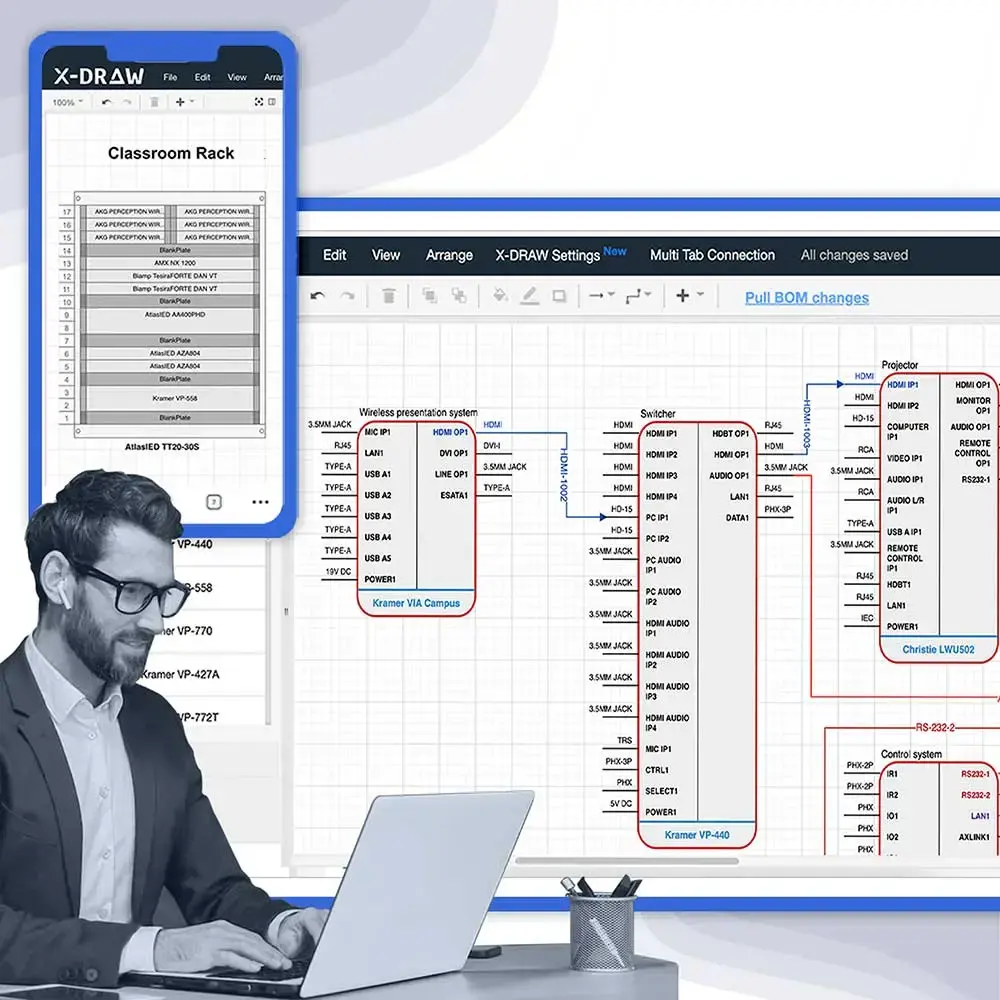
AV Design Mastery + Winning Proposals = 10x Productivity!
- Automatic Cable Labeling & Styling
- 100+ Free Proposal Templates
- Upload & Create Floor Plans
- 1.5M Products from 5200 Brands
- AI-powered ‘Search Sense'
- Legally Binding Digital Signatures
No Credit Card Required
What is AI-Powered AV System Design Automation?
AI-powered AV design automation is the modern workflow that uses machine learning algorithms and generative AI techniques to produce audio-video system documentation without relying on manual input. This process can be executed using AV design automation software, which streamlines the process by connecting equipment databases, room specifications and client-based requirements to generate desired outputs automatically.
The AV system design process involves choosing, configuring and properly documenting audiovisual equipment for residential and commercial needs. System design can be implemented manually or through an automated workflow.
Let’s discover the difference between Manual AV Design Workflow and AI-Automated AV Design Workflow through the given comparison table below:
Manual AV Design Workflow vs. AI-Automated AV Design Workflow
Design Parameter | Manual AV Design Workflow | AI-Automated AV Design Workflow |
Documentation Time | Manual creation of wiring plans, rack elevations, and project deliverables | AI-generated outputs based on project requirements |
Error Rate | Mismatches between specifications, layouts, and equipment schedules | Connected project data maintains consistency across deliverables |
BOM Accuracy | Manual equipment selection and quantity verification | Automated BOM creation using equipment databases |
Proposal Turnaround | Multiple updates required across schedules, pricing, and client documents | AI-assisted proposal generation from synchronized project data |
Revision Cycles | Scope changes require rework across multiple files | Project updates automatically reflected across layouts, BOMs, and proposals |
Want to reduce repetitive design tasks? Discover how AI-powered AV design automation can simplify your workflow.
How AI Generates AV Wiring Diagrams and System documentation for Audio Visual (AV) Consulting Firm?
AI Wiring diagram generation involves using equipment specification data, which is further used to automate AV design process by creating signal flow diagrams, system schematics, rack layouts and proper engineering documentation. While handling AV installations in conference rooms, training rooms, boardrooms and classrooms, the biggest challenge is not creating the first schematic diagram but handling the necessary design revisions. Even a single equipment change can affect the bill of materials, rack elevations and project deliverables.
Many Audio visual (AV) consulting firms rely on generic CAD design platforms like AutoCAD or Microsoft Visio to create these drawings, but device connections, signal paths, labeling and interconnectivity still need to be mapped manually. Manual wiring diagram creation is a time-consuming process, whereas AI-powered generation turns wiring diagrams around in minutes!
After creating a wiring diagram in X-DRAW, designers can run AI Connection Check to review the schematic before documentation. It flags invalid connections, double-check warnings and identifies loose cables, helping AV engineers fix connection errors before it becomes costly on-site mistakes.
AI-Powered AV Design automation starts with mentioning the room specifications, occupancy needs and technology objectives. The system identifies compatible AV equipment, establishes the corresponding signal routing paths, clearly defines the equipment interconnections, and automatically generates the required project documentation.
Want to create wiring diagrams with less manual effort? Discover how AI-powered AV wiring automation simplifies documentation.
AI Workflow for Generating AV Drawings and Documentation
1. Room Requirement Analysis
Properly define the room type, user needs, capability and overall performance objectives.
2. AV Equipment Selection
Identify the compatible displays, microphones, DSPs, cameras, amplifiers and critical control systems.
3. Signal Flow and System Architecture Creation
Establish the important signal routing, device interconnectivity and network architecture for better clarity.
4. Documentation Generation
Cable wiring diagrams, floor plans, rack layouts, signal flow, schematics, CAD drawings and BOMs are generated.
Struggling with time-consuming drafting tasks? Explore AI tools that solve AV CAD challenges and improve design efficiency.
5. Revision Management
Apply scope changes across the connected deliverables automatically through a centralized project data.
AV Designers can prefer platforms like X-DRAW by XTEN-AV, a cloud-based AV design and diagramming platform used to automate cable labeling, AV schematics, BOMs, rack elevation diagrams, signal flow diagrams, floor plans, etc. It has a 1.6M+ product library with 5,200+ brands to support AI-generated AV BOM creation and structured system planning.

How AI Reduces Manual BOM Creation and Pricing Errors in AV Projects For Audio Video Consultant?
A Bill of Materials in AV projects helps define all equipment, quantities and overall costs needed for system delivery. When we discuss traditional workflows, BOM creation relies on manual product selection, and spreadsheets are used for validation. This increases the risk of mismatched specifications and pricing inconsistencies across the AV estimates.
AI enhances this process by properly aligning project requirements by using organized equipment intelligence and real-time pricing updates. By using AI-Powered AV systems can reduce manual intervention by keeping AV designs, cost estimation and equipment selection in sync. According to Open BOM insights, manual BOM errors can result in costing, procurement and planning mismatches when data is managed through disconnected tools, which directly impacts AV project accuracy and execution reliability.
To solve these modern challenges, AV professionals can use XAVIA, an AI powered Audio visual (AV) design, proposal & project management agent specifically designed for the AV industry, which operates through chat or voice-based prompts. It provides BOM recommendations, automates AV design processes, generates client-ready proposals, and offers real-time project visibility. With simple prompts, AV integrators can turn them into field-ready deliverables.
Upload and Structure External BOMs with XAVIA AI
AV designers, estimators or pre-sales engineers receive BOMs from clients, consultants and architects in spreadsheets, PDFs or Word documents. Teams spend hours manually re-entering product lists from these formats.
With Improved BOM Upload through XAVIA, users can upload any BOM file directly through the AI chat interface without using a predefined template. XAVIA automatically extracts product data and organizes them into a structured, reviewable BOM in X-DRAW while suggesting complementary products that may be missing. Users have an option to either accept or decline AI recommendations before moving forward with system design, helping reduce the time from receiving a client BOM to creating a complete AV design.
Discover XAVIA real-life AI Prompt Examples for BOM generation and Updates.
- “Design Auditorium room for 200 members with Samsung Products, also create a BOM.”
- “Generate a complete AI Powered AV BOM for a 12-seater Microsoft Teams conference room with a 65-inch Samsung display, ceiling beamforming microphones, Dante-enabled DSP and integrated AV control system.”
- “Update the existing BOM by replacing the display system with dual 75-inch screens and recalculating amplifier load, DSP input channels, and power distribution requirements accordingly.”
- “Revise the current AV system BOM for a training room expansion from 20 to 30 seats, adding additional speakers, extending cable runs and updating rack equipment and power specifications.”
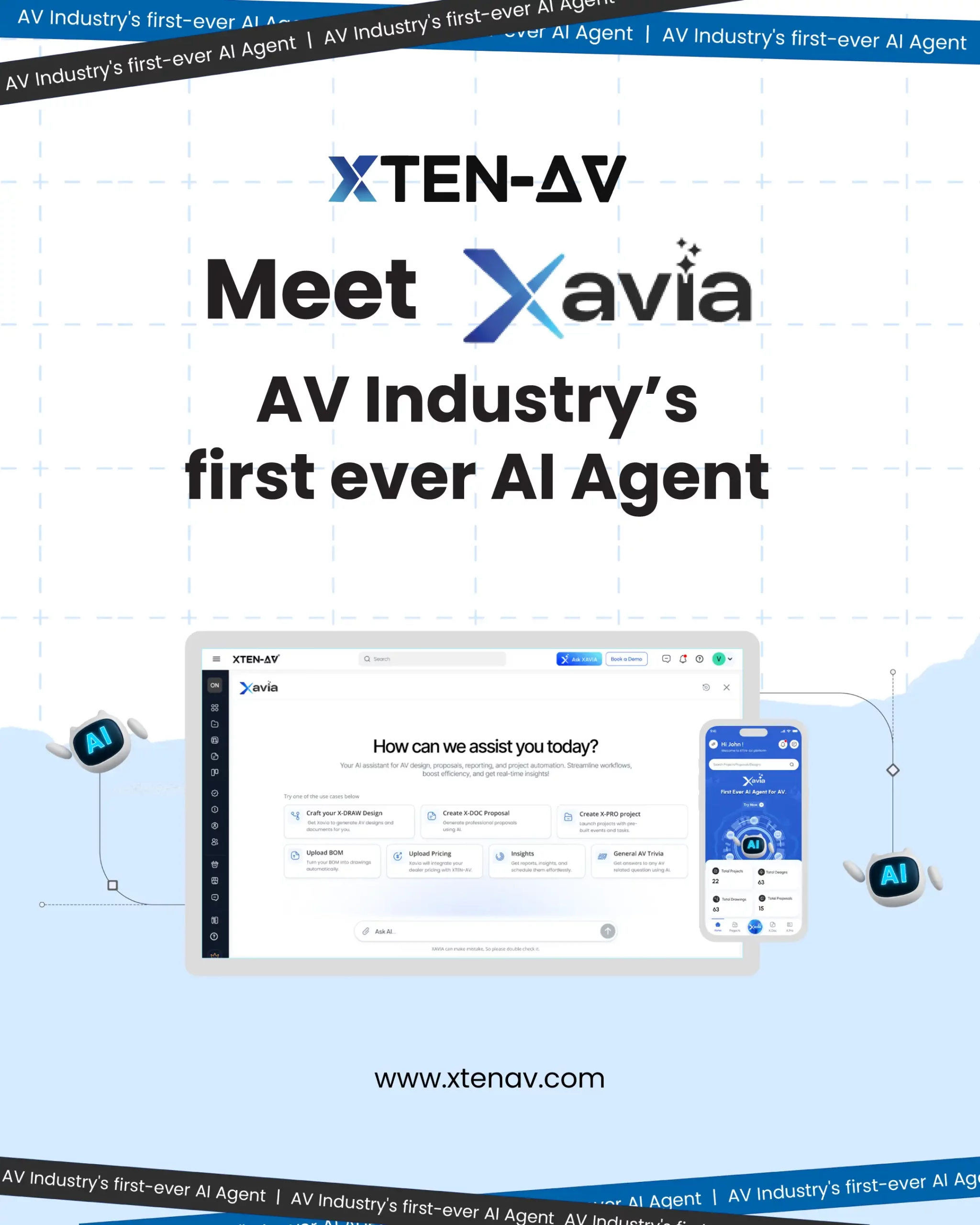
AV Automation with XAVIA = From Hours to Seconds!
- Automate AV Drawings, Proposals & Reports in Seconds
- AI-Powered Search, Dealer Pricing & Task Suggestions
- Auto-Generate Rack Layouts, Cable Schedules & Diagrams
- Get Smart Product Recommendations from 1.5M+ Items
- Chat or Speak to XAVIA — Your AI Assistant for AV
- Works with X-DRAW, x.doc & Project Management Tools
How AI Simulation Optimizes Audio-Visual System Performance?
Designing an audiovisual system involves more than selecting equipment. System behavior, room acoustics, signal flow, and coverage requirements must be evaluated before installation to avoid costly adjustments later in the project.
Here are the keyways in which AI simulation allows in optimizing AV system performance:
- AV system simulation is the computational modeling of equipment configurations to predict system performance before physical installation. It enables consultants to assess design scenarios and verify system requirements during the planning stage.
- Acoustic modeling is the analysis of sound propagation within a room to determine optimal speaker placement, coverage angles, and SPL distribution. Necessary key inputs include room dimensions (m²), RT60 reverberation time, coverage angles (degrees) and target SPL levels (dB).
- Latency testing in AV design involves evaluating signal-processing delays across multiple signal paths to uncover synchronization issues among audio, video, and control systems.
- Simulation tools allow consultants to review multiple equipment layouts and compare coverage results before equipment procurement begins.
- Potential issues such as uneven sound coverage, signal path conflicts, and processing limitations can be addressed during system design rather than during commissioning.
- Simulation-driven planning reduces onsite commissioning time by exposing configuration issues before equipment is physically installed. This helps minimize rework, streamline deployment, and improve project execution.
By evaluating acoustics, signal timing and equipment interactions early, audiovisual consultants can make more informed design decisions and deliver systems that align more closely with project requirements.
How AI Improves Audiovisual Proposal and Quote Generation Process For AV Consultants
An AV proposal is a formatted client-facing document that specifies AV system components, installation scope, pricing and project timeline. For many audiovisual consultants, the challenge is not creating a proposal itself but converting completed system designs into client-ready documents before project opportunities lose momentum. Delays between engineering, pricing and proposal development often slow the sales cycle and impact response times.
AI proposal generation automatically assembles client information, system design data, equipment costs and the scope of work into a formatted document. As audiovisual AI tools become more integrated into AI-powered audiovisual design workflows, consultants can reduce manual document preparation and improve proposal consistency. Many firms also rely on standardized AV proposal templates to maintain quality across multiple projects while simplifying revisions.
Many AV firms are turning to AI agents such as XAVIA to reduce the manual effort involved in proposal development. Because equipment selections, system documentation, dealer pricing and project requirements already exist within the project workflow, XAVIA can automatically assemble these details into client-ready proposals. This allows consultants to respond more quickly to opportunities while maintaining consistency across system designs, project documentation and commercial deliverables.

Creating estimates and proposals manually often slows project momentum and increases the risk of inconsistencies. Discover how Generative AI for AV Project Estimation & Proposals is helping teams work faster and more accurately.
Comparison of AI Tools for audiovisual Design Automation
As AI in audio visual industry gains wider adoption and is getting integrated into the daily AV engineering process, the key differentiator no longer is the designing capabilities but how efficiently technical details are created, updated and maintained. Some tools assist with individual tasks, while others focus on simplifying schematics, layout and documentation.
The following is the comparison table showing how these solutions support different levels of AV design automation:
Tool Name | Primary Function | AI Capability | Best Suited For | Limitations |
XAVIA by XTEN-AV | AI Copilot for AV Professionals | Advanced AI AV Agent. | Design, BOMs, proposals, project tracking and task automation | Requires project inputs and requirements |
X-DRAW by XTEN-AV | Cloud-based AV design platform | AI-Assisted | AV Schematics, signal flow, rack layouts & floor plans. | Primarily focused on AV design and diagramming functions only. |
AutoCAD | CAD drafting | No Native AV AI | Custom engineering drawings | Manual updates and documentation |
Microsoft Visio | Diagram creation | Limited AI Features | Basic diagrams and workflows | No AV-specific automation |
Crestron Toolbox | Control programming | No Design AI | Device configuration and diagnostics | No design or proposal automation |
Note:
Tools such as AutoCAD, Microsoft Visio and Crestron Toolbox focus on specific drafting, diagramming or configuration tasks. X-DRAW is a cloud-based AV design platform, while XAVIA is a voice and chat-driven AI agent suitable for a range of AV project requirements.
How to Implement AI in AV Consulting Workflow in 7 Steps
A structured approach is required for properly integrating AI into AV consulting workflows. Properly following the step-by-step process helps reduce manual effort across design, documentation and project management. It enables consultants to introduce automation in a controlled sequence, thereby enhancing overall delivery efficiency.
Here are the 7 steps that need to be followed for implementing AI in AV consulting workflows:
Step 1: Audit current AV delivery process
Start identifying inefficiencies across the AV project execution. Map repetitive work across equipment selection, system documentation, cable wiring layouts and proposal preparation. This serves as a baseline for identifying where AI has the greatest operational impact.
Step 2: Align automation tools with workflow stages
AV tool alignment plays a major role in connecting automation capabilities to the specific stages of AV delivery. AV integrators may prefer XAVIA to automate their AV project workflow and X-Draw to meet their design and diagram creation requirements. This ensures smoother execution across planning, design and documentation stages of commercial AV projects.
Step 3: Structure the room and system inputs
Proper input structuring enables standardization of project data before processing begins. Important parameters, including room dimensions, display requirements, audio coverage, control needs and budget constraints, are defined in an organized format. This enhances overall output precision and reduces the downstream correction effort.
Step 4: Produce an AI-assisted system draft
An initial AV design is produced by system drafting using structured inputs. System architecture, rack logic, equipment configuration and signal flow are examples of outputs. Before being approved, these outputs serve as engineering drafts that require expert verification.
Step 5: Examine the technical accuracy and equipment list
The accuracy of the resulting bill of materials and system dependencies is ensured by equipment evaluation. Consultants confirm pricing structure, margin alignment, accessory inclusion and compatibility. This preserves commercial uniformity and technical accuracy before client-facing documents.
Step 6: Convert design into client proposal
Validated system design is transformed into a structured client document through proposal generation. The scope, equipment specifications, cost, and terms of delivery are all given in a single format. To comply with project specifications, branding and commercial modifications are implemented.
Step 7: Transition into project execution flow
The approved design is transferred into delivery management at execution handoff. The project process assigns tasks, milestones, procurement requirements, and installation checkpoints. This prevents data fragmentation and guarantees continuity from design approval to onsite deployment.
ROI of AI Automation in AV Design for Consultants: Cost Savings, Time Efficiency and Revenue Impact
ROI in AV automation is evaluated as a complete package, with efficiency gains achieved across design, documentation, proposal creation and project management. The XTEN-AV ecosystem integrates AI-driven automation (XAVIA), AV drawing capabilities (X-DRAW), smart proposal tools (x.doc), and project management software (X-PRO), including a service and installation module. This centralized structure removes disconnected processes, reduces manual effort and accelerates end-to-end AV project delivery with measurable operational impact.
The following table highlights the business impact of AI-powered AV design automation :
ROI Category | Measurement Framework | Business Impact |
ROI Calculation Formula | ROI = ((Time Saved Per Project × Hourly Rate × Projects Per Year) − Ecosystem Cost) ÷ Ecosystem Cost × 100 | Converts engineering efficiency into quantifiable financial return. |
Annual Value Generation | 10 hours saved per project × $75/hour × 50 projects/year = $37,500 capacity gain. | Direct conversion of time savings into billable value. |
Documentation Time Reduction | 35–40% of project effort → 10–15% with automation. | Major reduction in repetitive design and documentation workload. |
Proposal Turnaround Acceleration | 3 days → 3 hours for RFP response cycles | Enables faster bidding and higher response volume. |
Win Rate Expansion Effect | More proposals were submitted within the same timeframe. | Increases deal coverage and conversion probability. |
Ecosystem Efficiency Gain | Unified workflow across design, BOM, proposal and project management. | Eliminates fragmentation, rework loops and tool-switching overhead. |
What happens when AV designs, proposals, and documentation can be generated in seconds instead of hours? Explore how AI for AV design is changing the way AV professionals work.
Conclusion
AI-powered AV design automation is reshaping how AV consultants create schematic design, documentation and client proposals. It replaces manual methodologies and time-consuming processes with streamlined, automated design generation. Instead of relying on rebuilding wiring diagrams, BOMs and project documentation from scratch, automation consolidates these tasks into faster, standardized deliverables. This results in greater precision, fewer revisions and offers improved design accuracy. This method shortens turnaround time and strengthens proposal quality. AV professionals can then focus more on client requirements, system performance and project delivery rather than repetitive engineering work.
Schedule your demo and see XTEN-AV in action!
Frequently Asked Questions
It is a process that uses AI to generate AV schematics, signal flow diagrams, rack layouts, and BOMs from equipment data, improving speed, accuracy and reducing overall documentation errors.
No, AI supports the automation process, but AV consultants are still needed to conduct site assessments, make system design decisions and fulfill critical client requirements.
Setting up an AI AV design tool usually takes around 2-4 hours, including importing equipment libraries and configuring project templates.
Large commercial AV projects with multi-zone systems, complex integrations and frequent design revisions benefited the most through AI automation.
Yes, Xavia is a cloud-based AI agent designed specifically for the Audio visual (AV) industry and suitable for independent integrators and small AV consulting firms alike to automates av design, proposal & project management workflow through chat prompts or voice.