How to Estimate AV Project Costs Accurately

How to Estimate AV Project Costs Accurately

Author Image

Sahil Dhingra

Published 24 April 2026

Step-by-step AV project cost estimation process covering scope, labor, procurement, and contingency
Table Of Content

Determining cost estimates in project management is not as simple as it seems, especially when system requirements move beyond the early planning stages. Many AV teams still rely on spreadsheets and generic templates in their workflows because they are accessible, familiar and practical for smaller or similar deployment setups.

As system design expands, budgeting moves across multiple phases, including procurement, labor estimation and ongoing expenditure tracking. This introduces variations in pricing data and labor estimates that are updated at different intervals. Over time, these inconsistencies make it difficult to maintain reliable cost visibility and keep budgets aligned with changing delivery needs.

In this blog, we explore a structured approach for finding out how to estimate costs in AV project management. It strengthens financial accuracy, improves clarity and supports better control across complex deployments.

Key Takeaways

AV cost estimation is most accurate when it is driven by defined scope boundaries, structured WBS, and design-led planning instead of informal estimation practices.

Cost accuracy improves when all key inputs are identified early, including system hardware, engineering effort, procurement timelines, installation logistics, and site readiness.

Choosing the right estimation method based on project maturity, such as top-down, bottom-up, analogous, or parametric, improves predictability and financial control.

Cost governance strengthens when estimated and actual spend are continuously compared, supported by contingency planning and variance tracking across execution.

ROI improves when estimation and execution data are connected, enabling better margin visibility, forecasting accuracy, and commercial decision-making.

The top 5 Project Cost Estimating Software for AV Integrators include XTEN-AV (X-PRO), Jetbuilt, D-Tools, ProjX360 and Specifi.

The all-in-one solution for your Audio Visual (AV) Project Design & Documentation needs

Transform your audio-visual experience with XTEN-AV.

No Credit Card required

5 Steps to Estimate Costs in AV Project

AV project cost estimation begins with past data and familiar tools. Early figures may appear accurate. Scope changes and design revisions quickly reduce reliability. Multi-area deployments add complexity. Maintaining accuracy and financial visibility becomes challenging. A structured approach aligns estimates with defined scope, system design and installation requirements. It strengthens cost control and enables predictable outcomes. 

The steps below outline a practical framework to estimate and manage costs more effectively:

Step 1: Define Project Scope and Assumptions

Start by clearly defining the scope of work, including room types, system design, signal flow and performance requirements. Document assumptions, exclusions and third-party dependencies early.

Step 2: Create a Structured Work Breakdown (WBS)

Break the project into smaller components using an AV project cost breakdown structure. Include equipment, cabling, racks, display, audio and control systems. Add phases such as drawing, design, installation and commissioning to streamline costs at each stage of the project.

Step 3: Estimate Labor by Role and Effort

Map labor across key roles such as project manager, AV designer, installer, integrator, and commissioning engineer. Estimate effort based on actual site complexity, not ideal conditions. Include all associated costs such as tools, travel and project execution support to ensure precise project costing.

Step 4: Include Procurement, Logistics and Site Readiness

Plan how the equipment will be sourced and delivered. Validate procurement and delivery timelines early. Include rack layouts, staging, and pre-configuration in the estimate. Also review site readiness, including access hours, power availability, and alignment with on-site teams. These factors can impact both budget and schedule.

Step 5: Add Contingency and Track Cost Performance

Include a contingency provision to address risks such as AV design changes, missing details, or delivery delays. As execution progresses, compare planned costs with actual spend for labor and equipment. This ensures budgets remain on track and improves accuracy in future estimates.

Cost Estimation in AV Projects: Why It’s Not the Same as Budgeting or Quoting

Cost estimation in AV projects defines the actual system scope, labor effort, integration complexity and procurement inputs needed to deliver a solution. Budgeting sets internal financial limits, while quoting translates those limits into the final price shared with the client. Each operates at various stages of planning and decision-making.

Estimation starts with incomplete design clarity and evolving technical inputs, making early figures uncertain. As installation progresses, site conditions, labor demands and vendor coordination reshape cost assumptions. The AV project budget estimate and final quote lost alignment with real delivery conditions, leading to cost variance, approval delays and reduced financial control during execution.

Struggling with inaccurate AV cost estimates and project overruns? Explore the Best Cloud-Based Audio Visual (AV) Project Cost Estimating Software and improve accuracy, speed, and control in AV project planning.

AV Cost Estimate Checklist: What to Include for Accurate Projects

A structured AV project cost estimation checklist enables AV integrators to capture cost inputs early and reduce scope gaps. It strengthens financial predictability across design, procurement and deployment phases.

Here is the cost estimation checklist mentioned below for ensuring accurate projects:

1. Discovery and System Scope Definition

Begin requirement gathering during discovery. Define clear system boundaries across AV design, control architecture, and integration scope to prevent unclear requirements later in delivery.

2. Engineering AV Design and documentation

Convert requirements into clear engineering outputs. Include signal-flow diagrams, schematic drawings, a BOM and technical specifications to support accurate costing.

3. Equipment and Direct Cost Mapping

Map all hardware and material costs with precision. Include displays, AV processors, DSP systems, speakers, control interfaces, racks, mounts, structured cabling, connectors and shipping costs.

4. Labor Planning and Role Allocation

Define effort by role and responsibility. Include AV designers, CAD engineers, project managers, installation technicians, programmers and commissioning engineers.

5. Site Conditions and Installation Readiness

Review site conditions early to avoid onsite risks. Verify access routes, structural constraints, cable pathways, power availability and AV interface readiness.

6. Integration and Commissioning Scope

Plan workload for programming, device integration, calibration, testing, and final commissioning to ensure complete system validation.

7. Procurement and Logistics Planning

Include vendor pricing variations, delivery timelines, staging requirements, rack build activities, warehouse handling and logistics coordination across deployment stages.

8. Indirect Cost Considerations

Cover operational overheads beyond direct installation scope, such as travel, access equipment, coordination meetings, documentation updates and drawing revisions.

9. Risk and Contingency Planning

Factor uncertainties such as evolving scope, design changes, site readiness delays, vendor dependencies and tight project timelines.

10. Financial Validation and Alignment

Cross-check assumptions against internal financial expectations to ensure alignment between estimated cost and actual project delivery conditions, reducing gaps during implementation.


Best Cost Estimation Methods for AV Projects and When to Use Them

In AV delivery, cost estimation methods in AV project management are used to translate system design into reliable financial planning. The goal is not just to calculate cost, but to control risk across design, procurement and execution stages.

The following methods are applied based on the design stage and engineering detail available:

Top-Down Estimation

Ideal for early-stage AV planning where system design is still evolving. A total budget is defined first and then distributed across AV areas such as audio, video, control, and networking. This approach helps establish quick commercial alignment but remains a high-level estimate.

Bottom-Up Estimation

Best suited for detailed design and final execution planning. Cost is developed from individual elements, including installation, cabling, configuration, integration and testing. Each component is evaluated based on actual effort and material requirements, resulting in highly accurate pricing.

Analogous Estimation

Effective when speed is a priority and historical data is available. Current project requirements are compared with similar past AV deployments, then adjusted for differences in scale, complexity and site conditions. It performs well in repeatable or standardized environments.

Parametric Estimation

Built for scalable AV deployments and structured forecasting, this approach calculates cost using measurable drivers such as cost per seat, per endpoint or per square meter. It ensures consistency across large or multi-site implementations while maintaining planning efficiency.

How XTEN-AV (X-PRO) Strengthens AV Cost Estimation and Budget Control?

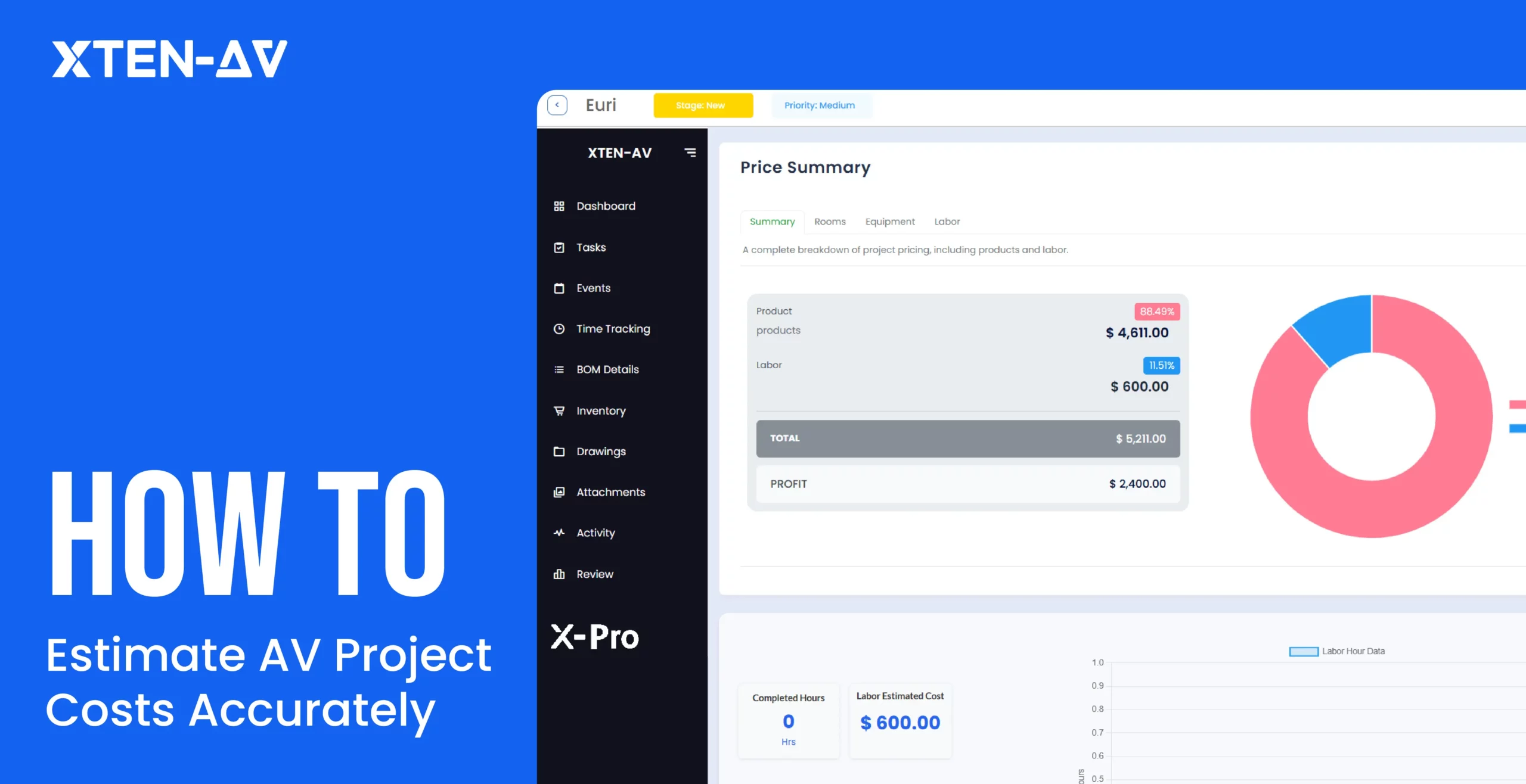
An inaccurate AV project cost estimate often leads to budget overruns when real site conditions, labor needs and procurement timelines shift during execution. As the project scope evolves, these gaps widen, impacting profitability. Modern Audio visual (AV) project management platforms like X-PRO by XTEN-AV streamlines the process by connecting estimation, budgeting and tracking in one workflow, allowing teams to improve accuracy, stay aligned and maintain control over costs with clear ROI visibility.

Let’s discover how XTEN-AV strengthens AV Cost Estimation and Budget Control:

  1. Early Cost Structures Lose Relevance Over Time

Teams often begin with a clear project cost breakdown structure to map scope and resources. It provides direction during planning, but doesn’t always reflect what happens onsite.

How X-PRO by XTEN-AV addresses this
Task creation tied to project timelines helps keep activities aligned with actual progress. The cost structure stays relevant as work advances.

  1. Labor Planning Lacks Ground-Level Visibility

Estimating effort for installation, configuration, and commissioning is rarely precise. Small inefficiencies or delays can impact the overall AV labor cost estimation.

How X-PRO by XTEN-AV addresses this
Onsite teams can log their work hours directly. This creates a clearer picture of effort spent and improves cost awareness during execution.

(clock-in & clock out )

  1. Material Costs Shift During Procurement

An initial project budget estimate includes equipment and materials, but supplier timelines and availability often change mid-cycle. These shifts can affect cost accuracy.

How X-PRO by XTEN-AV addresses this
Inventory tracking and purchase workflows stay connected to project activity. This helps teams stay aware of material movement and related costs.

Overspending on AV projects or losing visibility on costs? Read Maximize Your AV Budget: Smart Audiovisual Spending Tips to make smarter spending decisions and improve project efficiency.

  1. Cost Estimates Shift as Scope Evolves

As projects progress, differences can emerge between planned numbers and approved values. This often leads to confusion across teams handling delivery and finance.

How X-PRO by XTEN-AV addresses this
Project updates flow through a unified system, helping teams stay aligned as requirements change.

  1. Cost Visibility Comes Too Late

Many teams only review financial performance after key phases are complete. By then, it’s harder to correct deviations or protect margins.

How X-PRO by XTEN-AV addresses this
Mobile App Access and real-time insights provide a steady view of progress and cost position, enabling earlier decisions.

(X-PRO Mobile App)

The all-in-one solution for your AV needs

Transform your audio-visual experience with XTEN-AV.

No Credit Card required

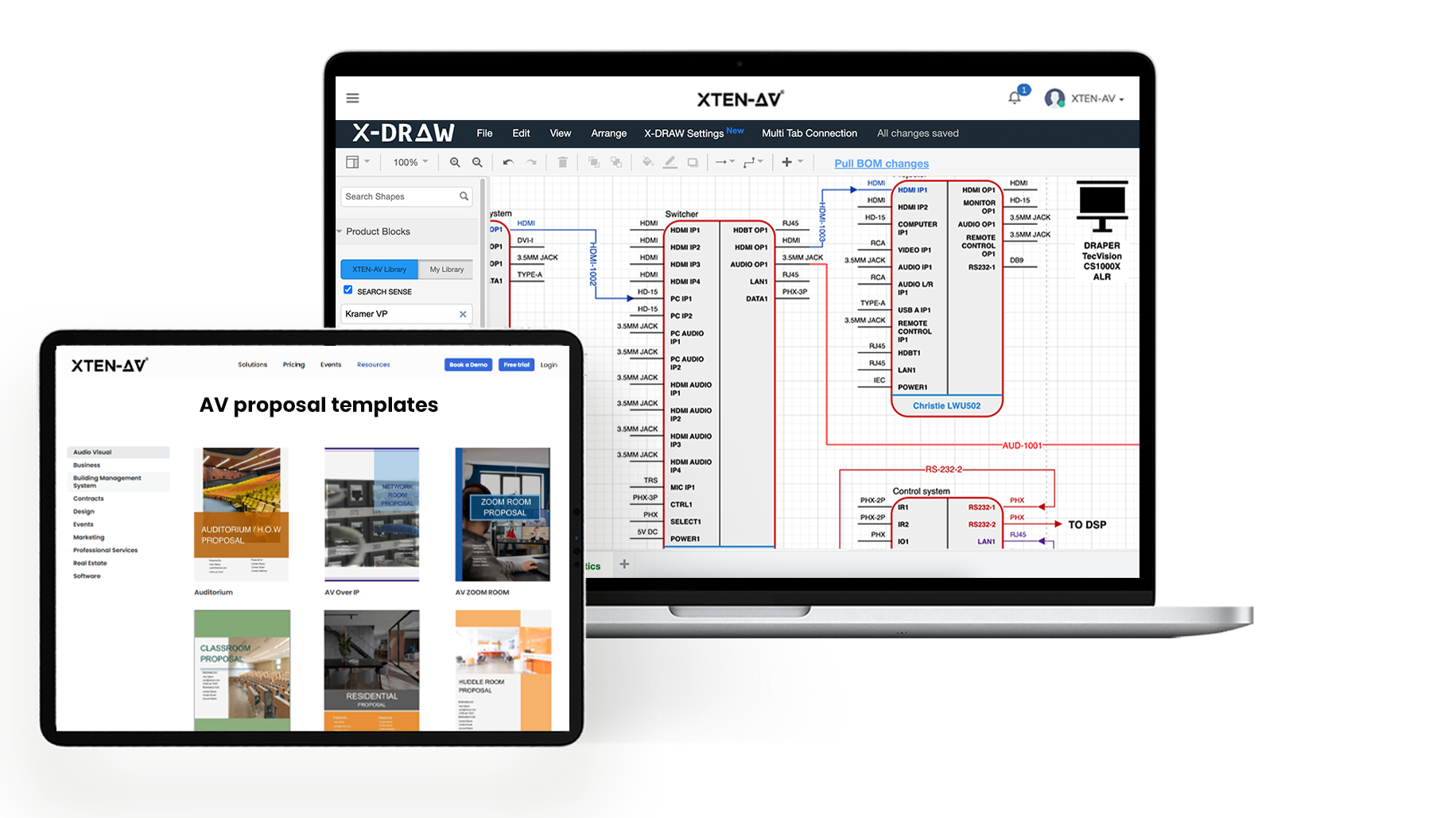
Audio Visual System Design Mastery + Winning Proposals = 10x Productivity!

  • Automatic Cable Labeling & Styling
  • 100+ Free Proposal Templates
  • Upload & Create Floor Plans
  • 1.5M Products from 5200 Brands
  • AI-powered ‘Search Sense'
  • Legally Binding Digital Signatures
Laptop Mockup

Conclusion

AV projects lose financial control when the estimate vs proposal vs AV project budget is not clearly separated and system requirements begin to shift from pre-sales intent to execution level decisions. An estimate supports early cost estimation during feasibility and system design development. A proposal defines committed client pricing and scope alignment. A project budget governs approved spend for procurement, labor allocation and onsite coordination.

When these layers overlap, inaccurate labor costing, procurement delays and weak cost control lead to budget overruns and reduced profit margins across complex integrations. XTEN-AV’s X-PRO connects estimation, proposal and project budget in one structured workflow, enabling AV teams to maintain financial clarity and control from pre-sales through project delivery.

Still relying on spreadsheets for your AV project cost estimate? Discover a smarter way to manage scope, labor and budgets in one place.

Schedule Your Free Demo

FAQ's

It is a structured approach to define the total cost of an AV system before work begins. It accounts for equipment, labor effort, engineering, installation and coordination requirements.

Variations occur when early assumptions do not reflect real-site conditions. Scope adjustments, vendor pricing shifts and installation challenges often influence final cost.

Labor is planned by mapping effort to specific installation and integration activities. It considers system complexity, engineering scope and site readiness.

Procurement strengthens estimated reliability by validating vendor quotations, checking availability and confirming lead times before final purchase decisions.

It establishes a dependable financial baseline for planning and execution. It improves cost control, reduces uncertainty and supports smoother project delivery.

Explore more by topic

AV Design Mastery + Winning Proposals = 10x Productivity!

No Credit Card Required

Related Blogs
  • Sahil Dhingra
  • Posted by Sahil Dhingra
April 24, 2026

Audio Visual How to Estimate AV Project Costs Accurately Sahil Dhingra Published...

AV proposal follow-up workflow showing proposal tracking, reminders, and faster digital approvals
  • Sahil Dhingra
  • Posted by Sahil Dhingra
April 17, 2026

Audio Visual AV Proposal Follow-Up: Track, Remind & Close Faster Sahil Dhingra...

Sports Bar TV Layout Guide: Screen Placement, Viewing Distance & AV Zones
  • Sahil Dhingra
  • Posted by Sahil Dhingra
April 15, 2026

Audio Visual Sports Bar TV Layout Guide: Screen Placement, Viewing Distance &...

Sahil Dhingra
Sahil Dhingra
A software developer, business analyst & people’s manager, Sahil Dhingra has over 10 years of experience working for tech giants such as Apple, HP, and Cisco. With his deep understanding of the Software Development Life Cycle, Sahil strives to expand the horizon for SaaS-based products for AV professionals while also implementing the latest technologies such as AI, ML, VR, and Blockchain.

This website stores cookies on your computer. Cookie Policy