




Estimated vs Actual Cost in AV Projects: How to Track Budget Variance Before It Hurts Your Margin
Sahil Dhingra
Published 22 May 2026
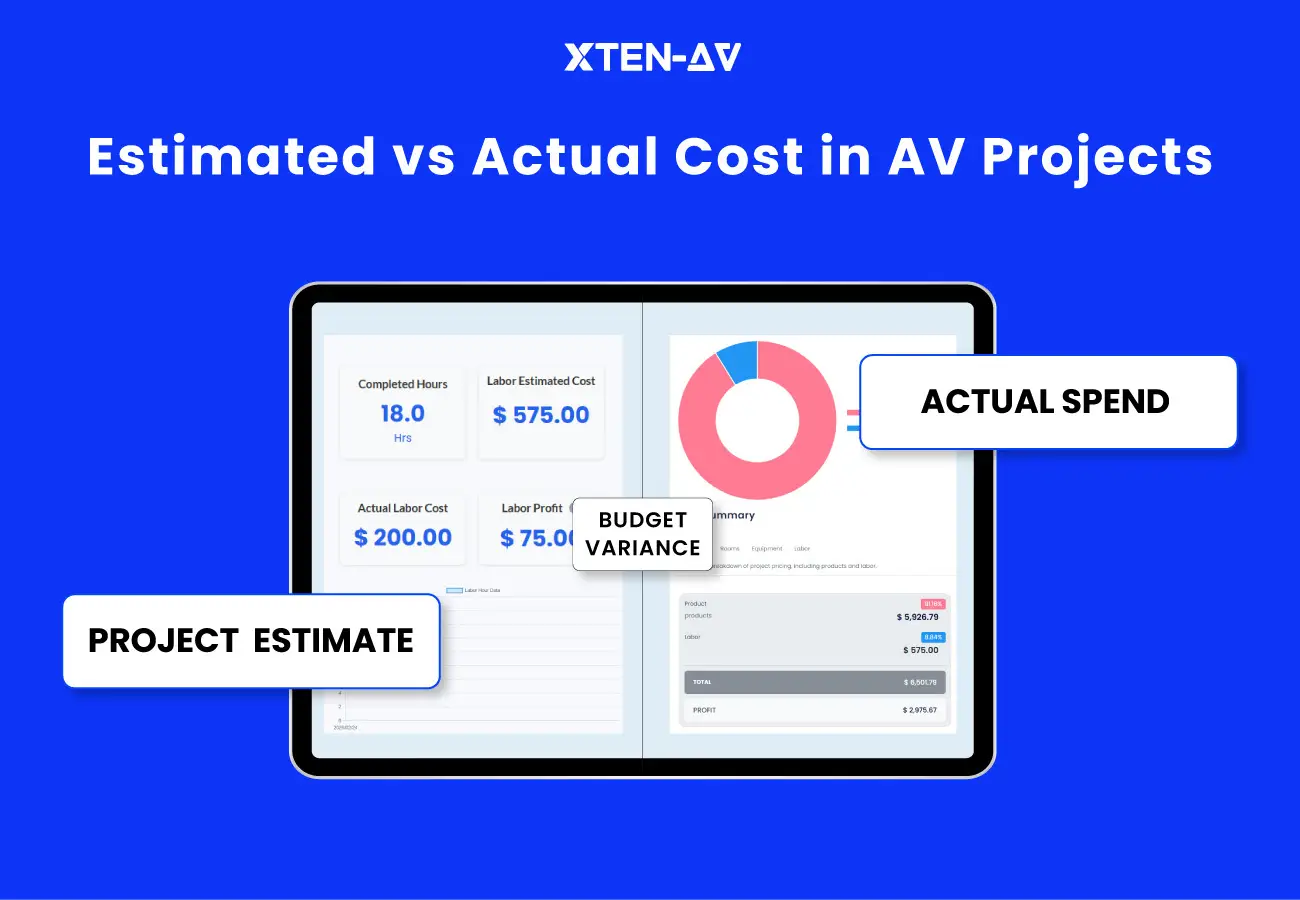
Estimated vs actual cost in AV projects represents the gap between initial budget predictions and the actual cost incurred during project execution. For AV system integrators, this comparison helps track whether equipment, labor, procurement, change orders and site conditions remain within the planned budget or lead to cost overruns during implementation.
The eternal question for any AV project is what holds more value, cost or quality? While many would argue that both are significant, the outcome ultimately lies in how wonderfully an organization defines and plans for both aspects often with the help of Audio visual (AV) project cost estimation software. Talking about the audio-visual industry, where acquiring the right balance between quality and cost is critical for determining the success for AV projects.
Collaborating with AV designers is beneficial as they can help in identifying cost effective solutions without compromising on quality standards. While, most AV integrators are known as the experts in planning a budget for AV. They are well-aware of design requirements and timelines of AV projects. Also, they can help you with estimated vs actual cost in AV projects. Making them an ideal partner to help build a realistic, customized budget tailored to your project needs.
The emergence of a platform like XTEN-AV enables AV professionals to streamline the entire workflow, from design and proposal creation to project execution and cost tracking: everything within a single, cloud-based environment.
In this blog, we break down how estimated and actual costs impact AV project profitability, discuss the common causes of budget variance and outline practical ways on how AV teams can stay in control of budgets from planning to execution.
Key Takeaways
Tracking estimated vs actual cost helps in improving future estimates and protecting profit margins for AV projects.
Review of estimated and actual cost should be done on a continuous basis and not just at project closeout to identify variances early and improve future proposals.
Missing accessories, extra cabling, product substitutions and site readiness gaps need to be anticipated so that actual cost is not impacted.
XTEN-AV connects estimation and execution, paving the way for real-time tracking of labor, materials, and budget changes.
The all-in-one solution for your Audio Visual (AV) Project Design & Documentation needs
Transform your audio-visual experience with XTEN-AV.
No Credit Card required
What does estimated vs actual cost mean in an AV project?
Estimated vs actual cost is referred to as the crucial financial comparison. It directly impacts profits, accuracy and pricing forecasting.
Estimated Cost
In AV projects, the estimated cost is the predicted, approximate cost to complete the AV project that has a huge impact on profitability, pricing accuracy, and project forecasting, especially when you’re managing BOMs, labor, and change orders. This crucial financial projection is prepared during the planning phase based on assumption and available project data.
In AV Projects, estimated Cost usually includes:
- Equipment needs (displays, DSPs, microphones, cameras, speakers, cables)
- Labor hours (installation, programming, design)
- Mounting hardware and infrastructure
Actual Cost:
In AV projects, the actual cost is the verified, real-world expense incurred for the work completed, showcasing the true financial outcome rather than an estimation. It plays a crucial role when things change on site, when unexpected problems come up and when you use less resources than you thought. You figure out the cost while the project is happening and when you are keeping track of it by using real expenses, like invoices, payroll and procurement records.
In AV projects the actual cost includes:
- The price we pay for the equipment
- The actual hours our labor team works
- The extra materials we use
- Variations, in shipping costs
- The cost of reworking or fixing issues
- Change orders that come up
- Delays that happen at the site
Why does estimated vs actual cost matter for Audio Visual (AV) profitability?
Estimated vs actual cost is one of the biggest drivers to calculate AV profitability. An estimate will show what the project should cost based on the defined scope, labor plan, BOM and site assumptions. However, actual cost shows how much cost is incurred during installation, programming, commissioning, and delivery.
- Baseline can be established: Estimated cost gives the baseline and it is a significant factor for AV profitability because when there is no clear estimate, the team will have no reliable baseline to measure profit ratio. Whereas, with actual cost, they can know what is happening across labor, material procurement and delivery.
- Track labor overruns: It is one of the biggest causes of cost variance in AV projects. A project may be estimated for 40 installation hours, but sometimes that actual work may take more hours due to cable routing issues, rack changes, programming delays, or commissioning problems and this will ultimately increase the cost. However, comparing both the costs will help the team quote the future projects in an accurate way.
- Real workflow can be formed: AV integrators may estimate a training room project with 2 displays, ceiling speakers, rack equipment, microphones, DSP and labor hours. However, during execution the field team may find that cable pathways are not ready or extra mounts are needed, thus the original estimate doesn’t match the actual cost anymore. When estimated vs actual cost is compared during the project, budget variance can be identified and corrective action can be taken.
- Improves future estimates: Every project gives useful cost data for future quoting. If the team carefully compares estimated cost with the actual cost, they can certainly understand where they are underquoted or overestimated. This will improve future proposals, labor planning, pricing decisions and project forecasting.
- Helps Identify Hidden AV Cost Drivers: They often include hidden costs that are not easily available in the first estimate. These may include accessories, extra cable runs, change orders, site-readiness gaps or last-minute equipment substitutions. Tracking estimated vs actual cost helps identify what all can increase actual cost.
Last but not the least, tracking estimated vs actual cost helps AV integrators reduce budget overruns, protect margins and avoid surprises. Over time, this leads to more accurate proposals, better labor planning, and improved profitability across multiple AV projects.
What causes budget variance in AV projects?
Budget variance in AV projects happens when the cost that was estimated differs from the actual cost of the project during or after execution. In AV integrations, this difference is almost certain to happen unless it is carefully controlled.
Labor variance
Labor hours variance happens when during the estimation, a simple installation is assumed but the actual site needs extra cable pulling, rack layout, DSP programming or testing. Talking about the workflow, a training room may look simple at the time of quoting, but issues related to ceiling, cable routing can add hours. If these extra hours are not mentioned in the project budget, the result is lower project margin or delayed delivery
Incomplete scope during the initial estimate
When key requirements are not properly understood during the planning stage, then the problem of incomplete scope begins. The estimation includes a standard AV setup, but factors like additional input sources, integration with existing infrastructure, acoustic treatment or control system are overlooked and these gaps are not revised, quote accuracy is not achieved. The result includes increased workload and diminished project margin often accompanied by timeline extensions due to added scope.
Change orders not tracked properly
It usually begins when scope changes during execution but is not updated in the project budget. For example, a client may request additional AV inputs, extra display endpoints or may need a more control system after beginning the work, but are not logged in the revised scope. This results in project budget variance and reduced profitability.
Design revisions not updated across the project
When drawings, proposals, BOM and AV project designs are not connected properly, budget gaps occur. For example, the design team may update the room layout or equipment selection, but the proposal or budget may still reflect the older version. This will result in misunderstanding as the team may miss required accessories.
Product substitutions and pricing changes
Budget variance in AV projects also occurs when products are not available or discontinues to name a few. The team may need to choose a substitute or pay higher supplier pricing. In AV projects, even one product change can affect cabling, rack space, installation time and many more, leading to AV cost variance.
How often should AV teams review estimated vs actual cost?
AV teams need to review estimate vs actual cost on a continuous basis throughout project execution, not only at the time of project closeout. This is especially helpful when there is any scope change, product substitution, labor overrun or change order. Regular cost reviews help teams catch budget variance early.
Project Stage | Review Frequency | AV Teams Should Check |
Proposal / Estimation | Before proposal submission | The team should review equipment pricing, labor cost assumptions, scope inclusions and proposal budget. |
Design and BOM Finalization | After every major design or BOM revision | If there is any change, BOM should be updated against the original estimate. Also check product changes, cables and mounts. |
Procurement | Whenever purchase orders are updated | Review pricing, inventory availability, purchase orders, invoices, product substitutions, freight impact, and material movement. |
Installation | After any major update | Compare estimated labor hours with actual technician hours, any delays and change order. |
Closeout | Once after the completion of project | Teams need to check estimated vs actual cost, labor variance, material variance, change order impact, and final profitability. |
When teams have continuous insight into cost components such as BOM accuracy, pricing changes and labor allocation to name a few then this system plays a pivotal role in supporting proactive cost control throughout the AV project.
How XTEN-AV helps AV teams compare estimated vs actual costs with more clarity?
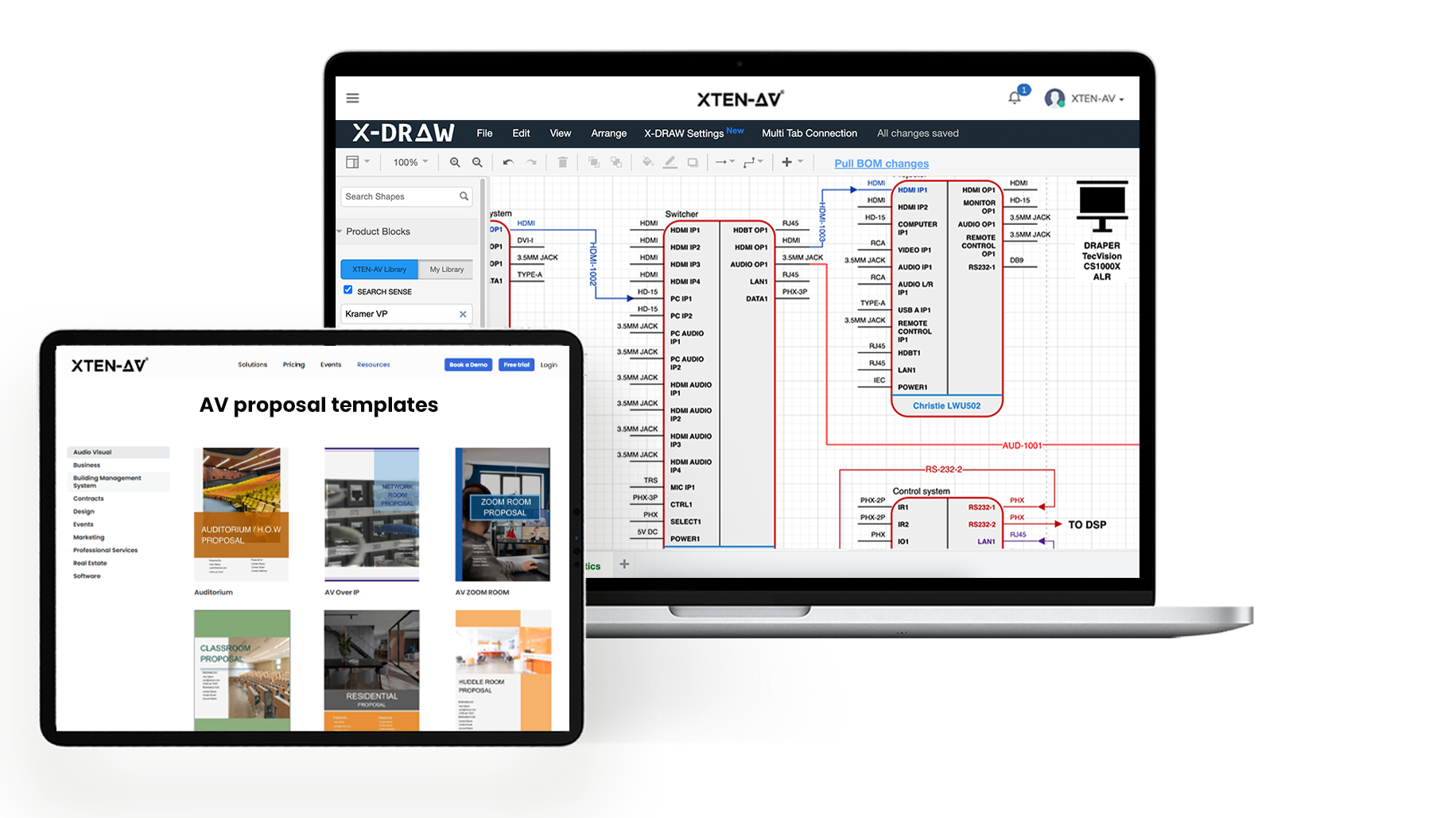
XTEN-AV helps AV teams compare estimated vs actual costs by connecting estimation and execution through its integrated platform which includes X-Doc and X-Pro.
How Cost Clarity is Built
With Audio Visual (AV) proposal software like X-Doc teams can:
- Create proposals using 100+ proposal templates
- Access a library of 1.5M products and brands
- Use multiple methods of cost and and labor calculations for accuracy
- Track the proposal at every stage of your project cycle.
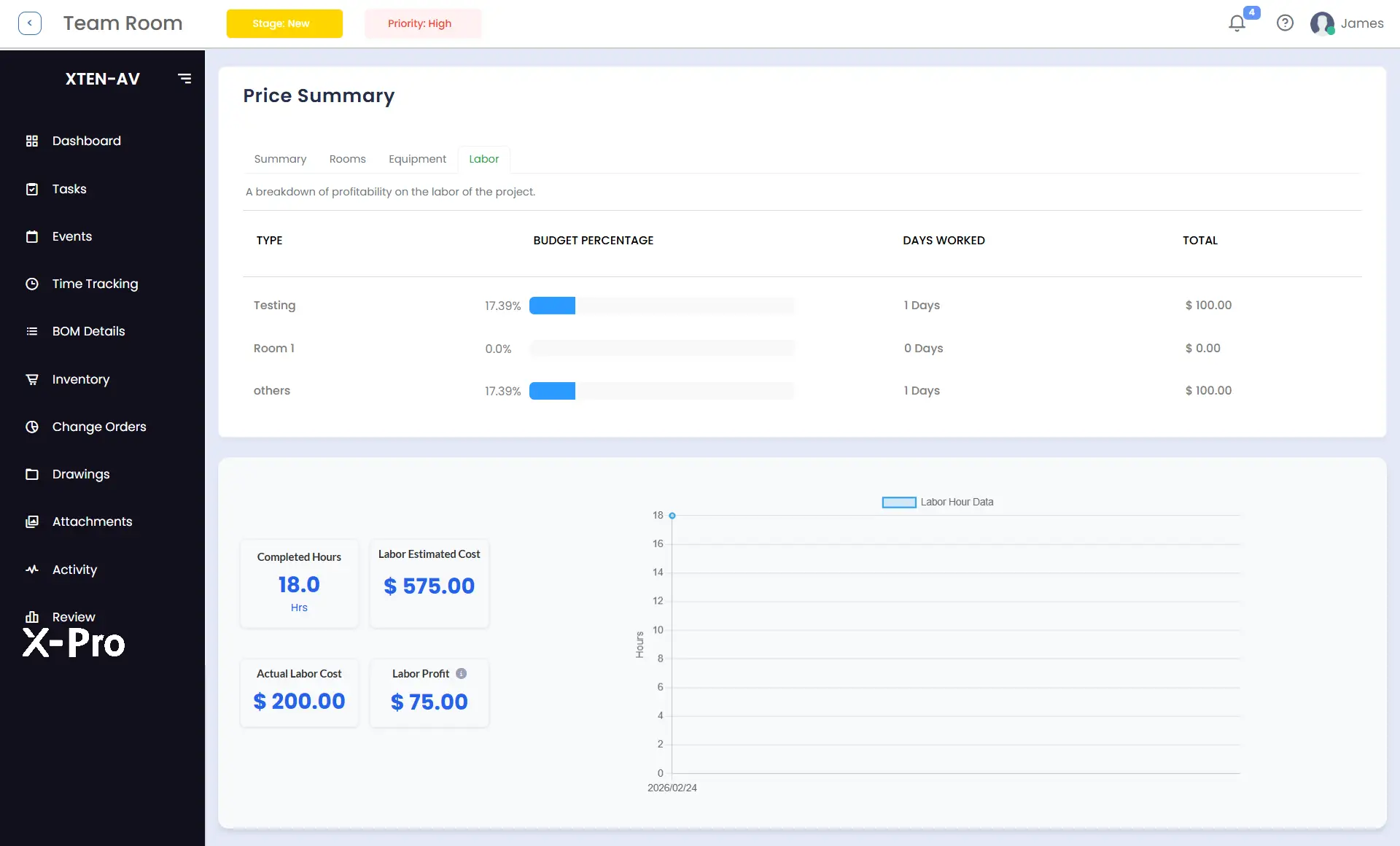
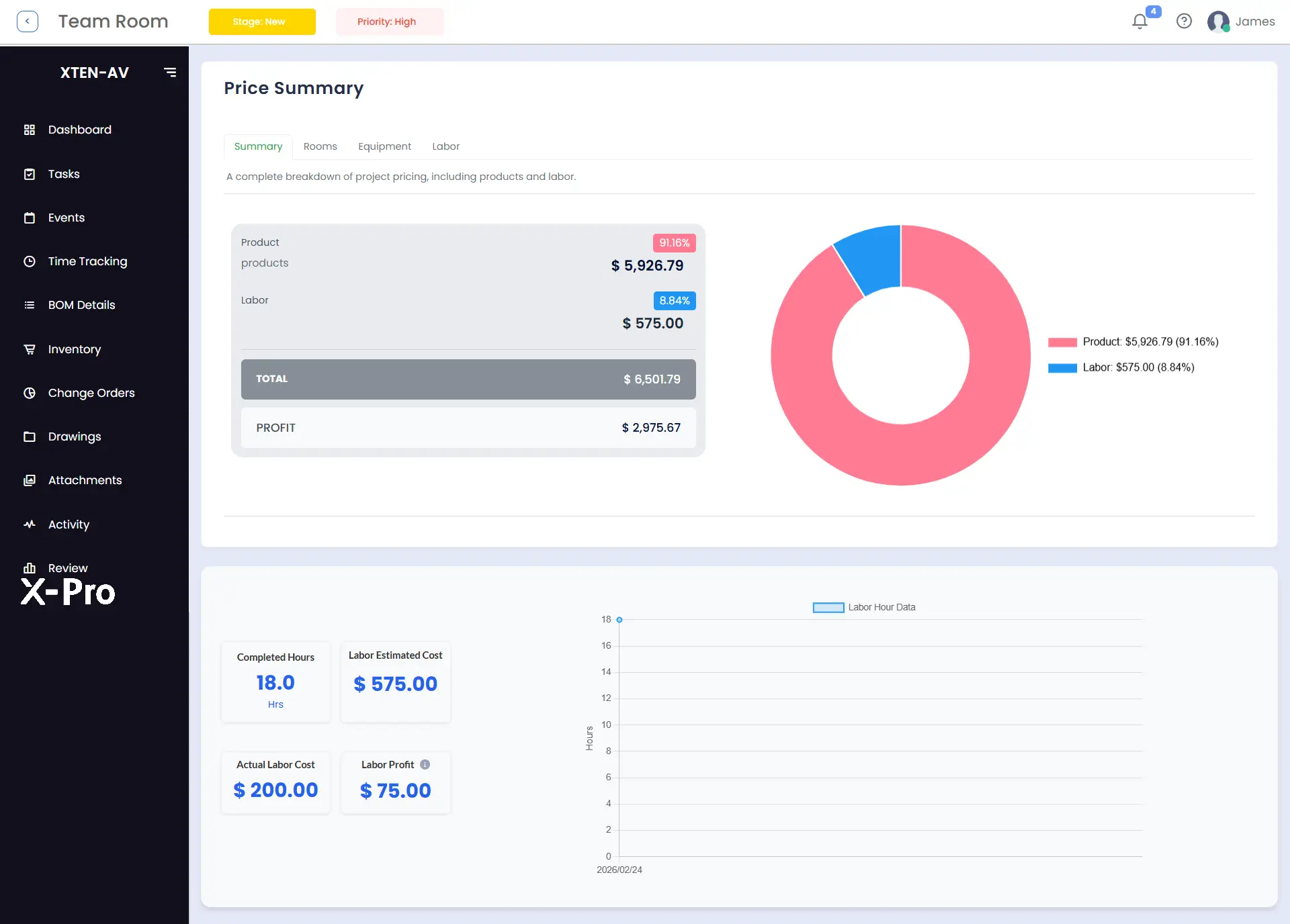
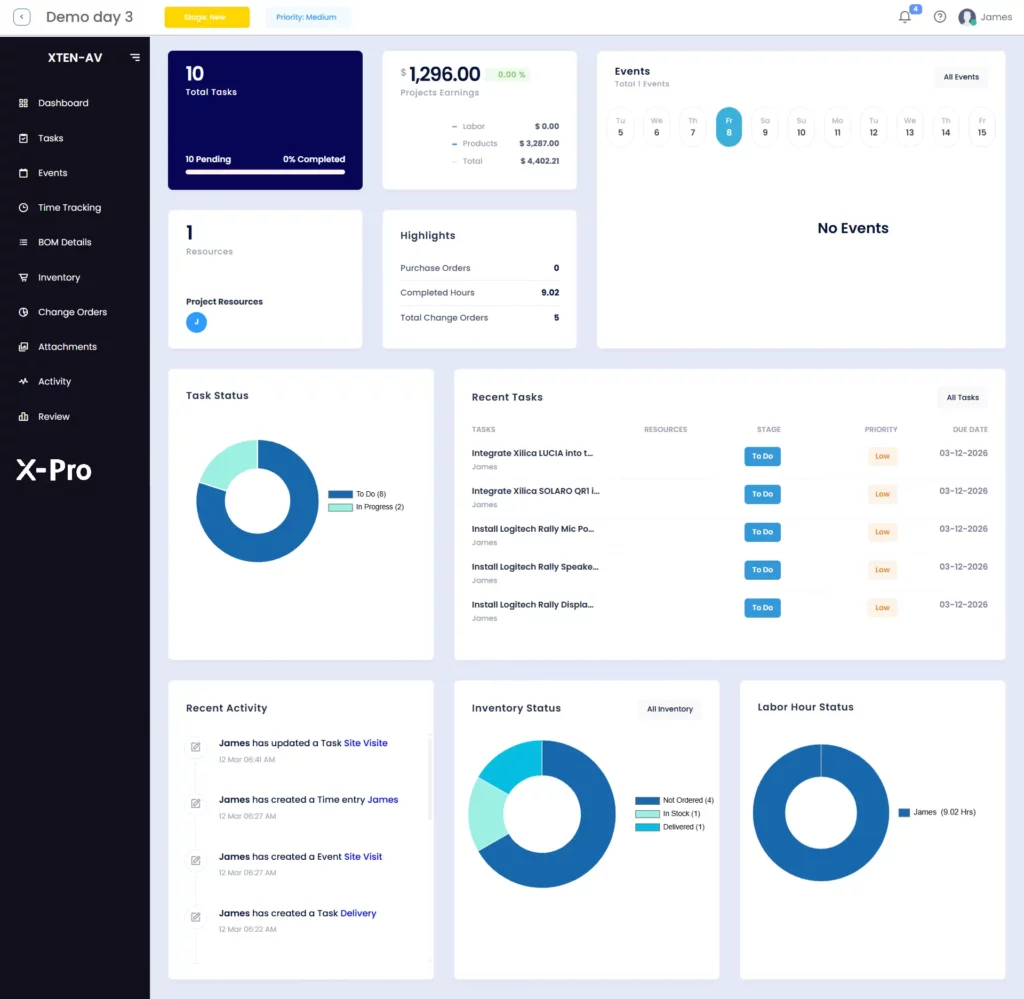
After the project moves into execution, the team can use Audio visual (AV) project management software, X-Pro for:
- Tasks can be assigned and tracked in real time.
- Technicians are able to log hours from the job site
- Task stages can be defined, and labor types can be categorized with smart templates
- Project status can be monitored through dashboards
Problem Case
Without an AV workflow for estimating and managing projects:
- Proposal estimates can be disconnected.
- Actual field hours and procurement are not properly tracked.
- Project managers may understand cost changes when it’s too late.
With these tools, AV teams gain:
- Clearer visibility into cost deviations during execution
- Accurate labor tracking against original estimates
- Improved control over project profitability
- Fewer surprises at project closeout
- Better alignment between sales estimates and field execution.
XTEN-AV connects proposal estimates with execution visibility through proposal/quoting software and project management/reporting software, helping teams track labor, material movement, budget changes, and incurred costs across the project lifecycle.
The all-in-one solution for your AV needs
Transform your audio-visual experience with XTEN-AV.
No Credit Card required
Audio Visual System Design Mastery + Winning Proposals = 10x Productivity!
- ✔ Automatic Cable Labeling & Styling
- ✔100+ Free Proposal Templates
- ✔ Upload & Create Floor Plans
- ✔1.5M Products from 5200 Brands
- ✔ AI-powered ‘Search Sense'
- ✔Legally Binding Digital Signatures
Conclusion
Tracking estimated cost vs actual cost is unavoidable for AV professionals to understand where the budget is changing and why. You can start the project with a proper and clear estimate but labor overruns, need of product substitutions, site delays and untracked change orders can increase the actual cost of the project. When these changes are reviewed throughout the project lifecycle, teams can catch budget issues early instead of discovering them at closeout. This can help in improving future estimates and protecting profit margins.
Want better control over AV project cost? Without further ado, check XTEN-AV that offers real-time cost tracking, labor allocation and BOM generation for better cost visibility.
FAQ's
Estimated cost is the expenditure calculated during the planning stage, while actual cost is the sum of expenses that have been incurred at the time of executing the project.
It quantifies the difference between estimated cost and actual project cost. Understanding the variance is important because in case of under or over budget, corrective measures can be taken.
Project variance should be reviewed continuously and in real time to eradicate budget overruns, impacting overall AV profitability.
It is driven by several factors such as incomplete scope, labor overruns, pricing fluctuations and no proper alignment between design and budget to name a few.
Labor overrun has a direct impact on the project’s timeline and profitability. This is because profits are eroded by extra working hours, inefficiency and overtime.
Approved change orders should be documented in the revised budget. On the other hand, pending or unapproved changes need to be tracked separately to avoid affecting operational performance.
XTEN-AV improves cost visibility by integrating dealer pricing so that it can have real-time, accurate cost data, allowing them to build accurate BOMs and close more projects without going over budget.
Explore more by topic
AV Design Mastery + Winning Proposals = 10x Productivity!
- Automatic Cable Labeling & Styling
- 100+ Free Proposal Templates
- Upload & Create Floor Plans
- 1.5M Products from 5200 Brands
- AI-powered ‘Search Sense'
- Legally Binding Digital Signatures
No Credit Card Required
Related Blogs
-
- Posted by Sahil Dhingra
Audio Visual Estimated vs Actual Cost in AV Projects: How to Track...
-
- Posted by Sahil Dhingra
Audio Visual Boardroom AV Equipment: What You Need for a Modern Executive...
-
- Posted by Sahil Dhingra
Audio Visual Training Room AV Design Guide for Hybrid Learning Sahil Dhingra...