








How to Write an AV Service Contract for Ongoing Support

An AV service contract is an official agreement between an integrator and a client that defines how an AV system will be maintained, supported and managed throughout the operational lifecycle. It clearly defines the service coverage, response commitments, maintenance responsibilities, support expectations, pricing conditions and service delivery needs.
However, the contract itself does not deliver the service. AV professionals required an organized process to deliver the support and service commitments outlined in the agreement. This is where service management plays an essential role. Many integration firms use AV service management software to streamline technician scheduling, documentation, client requests and maintenance workflows within a structured, centralized system.
In this blog, we will explore AV service contracts and the operational practices needed to support long-term client management effectively.
Key Takeaways
An AV service contract is not just a legal agreement. It is the operational foundation for delivering post-installation support.
The best contracts define more than maintenance coverage. They should clearly state expectations for service calls, response times, technician visits and renewal details.
Preventive AV maintenance procedures help in minimizing unexpected failures, while structured support workflows enhance overall service consistency.
Service history, documentation and project context are critical for resolving issues efficiently and maintaining long-term client relationships.
As service operations grow, platforms like X-PRO Service Management by XTEN-AV allow AV integrators to connect contracts, service delivery and renewals within a centralized workflow.
What Is an AV Service Contract?
An AV Service Contract serves as a post-installation agreement that clearly defines how an AV system integrator will maintain, support, troubleshoot, document and repair the installed AV systems over a defined period of time. It describes the service commitments between the integrator and the client. The agreement also highlights the necessary covered sites, rooms, systems, support scope and overall response expectations.
The contract simplifies ongoing support after deployment. It describes how maintenance procedures and service calls are managed. Also, outlines the necessary renewal terms, which help the client maintain a structured approach to ongoing AV support and system reliability standards.
Imagine a scenario in which a corporate boardroom experiences an audio issue before an important meeting. With a service contract in place, the issue is logged, and service coverage is properly verified. After that, a technician is assigned in accordance with the agreed-upon response terms. The repair process is documented, and the service history is updated to ensure that the system is restored with minimal disruption to critical meetings.
Why Should AV Integrators Offer Service Contracts After Installation?
AV integrators need to offer service contracts as the installed AV system requires proper maintenance, support, troubleshooting, updates and better technical support. Meeting rooms, boardrooms, training rooms and collaboration spaces heavily rely on technical integrations after the installation process is complete. Service contract operates with an organized approach to efficiently handle service calls, maintenance, technician visits and ongoing client support.
As per the commercial integrator, the recurring sales revenue contributes around an average of 14.2% of integrator revenue and rises up to 17% for larger firms. This shows how the growing needs for service contracts, maintenance agreements and managed services play an important role in creating recurring revenue opportunities for AV professionals.
What Types of AV Service Contracts Can You Offer?
AV Teams can provide corrective maintenance support, preventive service plans, offer remote monitoring, managed services or onsite support contracts. The right model depends entirely on the client’s AV environment, which includes uptime requirements, overall service expectations and budget constraints.
The most common types of AV service contracts are listed below:
AV Service Contract Type | Service Coverage | Ideal Use Case |
Corrective Maintenance Support | Fault diagnosis and repair services are provided after an issue is reported. | Small AV environments with occasional support requirements. |
Preventive Maintenance | Scheduled inspections, system testing and firmware updates. | Organizations prioritize uptime and system reliability. |
Hybrid Service Model | Combines the issue-resolution procedure with scheduled maintenance to improve uptime. | Standard approach for most commercial AV deployments. |
Remote Support Agreement | Faster remote diagnostics, monitoring and technical assistance services. | Distributed or multi-site AV environments. |
Managed Service Contract | Continuous system monitoring, optimization and proactive support. | Enterprise AV systems require high availability. |
Onsite Support Contract | Dedicated onsite technician support for the repair and maintenance process. | Campuses, venues, and mission-critical AV spaces. |
What Should an AV Service Contract Include?
An AV service contract must clearly define the contracting parties, covered locations, AV systems and devices included under the support. It should properly mention the supported model, SLA responses, pricing details and exclusions and define the part-handling rules. To ensure reliable AV service delivery, the documentation practices, renewal cycles, termination conditions, and authorization requirements need to be specified.
The following is the required checklist that an AV service contract must include:
AV Service Contract Requirements Checklist | Post-Installation Service Structure |
Stakeholders & Authority | Must clearly mention the AV integrator and client, along with escalation contacts and approval authority for making service-related decisions. |
Site Coverage Definition | Cover all important locations such as rooms, buildings, campuses or multi-site AV deployments. |
System Coverage Scope | Identify necessary AV environments, including meeting rooms, classrooms, auditoriums, signage systems and control rooms. |
Device Coverage Scope | List all essential supported AV equipment, such as displays, cameras, microphones, speakers, DSPs and control systems, properly. |
Service Delivery Model | Describes how support is delivered through remote assistance, onsite service, scheduled maintenance or a hybrid delivery method. |
Service Request Lifecycle | Highlights the complete workflow from ticket logging to prioritization, technician assignment, resolution and closure. |
Service Level Agreement (SLA) | Establishes response times, support availability, priority handling and escalation pathways. |
Preventive Maintenance Plan | Mention scheduled inspection cycles, system health checks and performance validation to ensure system reliability. |
Parts & Warranty Governance | Clarifies warranty coverage, included components, exclusions and necessary chargeable replacement rules. |
Commercial Structure | Includes pricing approaches such as annual contracts, recurring billing, tiered plans or usage-based service models. |
Service documentation Standards | Ensures structured recording of service logs, technician notes, system updates, evidence images, and client approvals. |
Renewal & Continuity Framework | Provide details such as contract renewal cycles, approval flow and mechanisms for uninterrupted service continuity. |
Termination & Exit Terms | Specifies notice period, exit conditions and structured handover of service responsibility and records. |
Authorization & Sign-off | Confirms formal acceptance through approved signatories and contract execution workflow. |
How is an AV Service Contract Different From an SLA, Warranty and AVaaS?
An AV service contract is used to define the post-installation support framework between an AV integrator and the client. Within this structure, SLAs are used to set measurable service performance commitments, warranty covers product or manufacturing defects, and AVaaS represents a subscription-based model in which AV systems are delivered and consumed as an ongoing service rather than a one-time capital investment.
The following comparison table describes how an AV service contract differs from an SLA, warranty and AVaaS:
AV Service Models Comparison
Type of Service Model | Definition | Main Focus | Coverage Scope | Role in AV Operations |
AV service contract | End-to-end agreement governing post-installation AV support. | Full lifecycle support relationship. | Maintenance, service calls, technician visits, documentation, renewals. | Core operational framework for managing ongoing AV services after installation. |
AV maintenance agreement | Structured agreement focused on preventive upkeep and system reliability. | Preventive maintenance and system stability. | Scheduled inspections, diagnostics, testing, updates and performance checks. | Reduces failures and improves long-term system uptime. |
Service level agreement | Defined performance commitments within a service contract. | Response time and service performance standards. | Response times, escalation paths, support availability and resolution targets. | Establishes measurable accountability for service delivery. |
Warranty | Time-bound protection against defects in hardware or artistry. | Product defect protection. | Repair or replacement of faulty components within a defined period. | Limited scope protection, not a continuous support model. |
AVaaS (Audio Visual as a Service) | Subscription model delivering AV systems as an ongoing service. | Recurring service consumption model. | Hardware, software, support, upgrades, and lifecycle management. | Converts AV delivery into an operational expense-based model. |
What Happens After an AV Service Contract Is Signed?
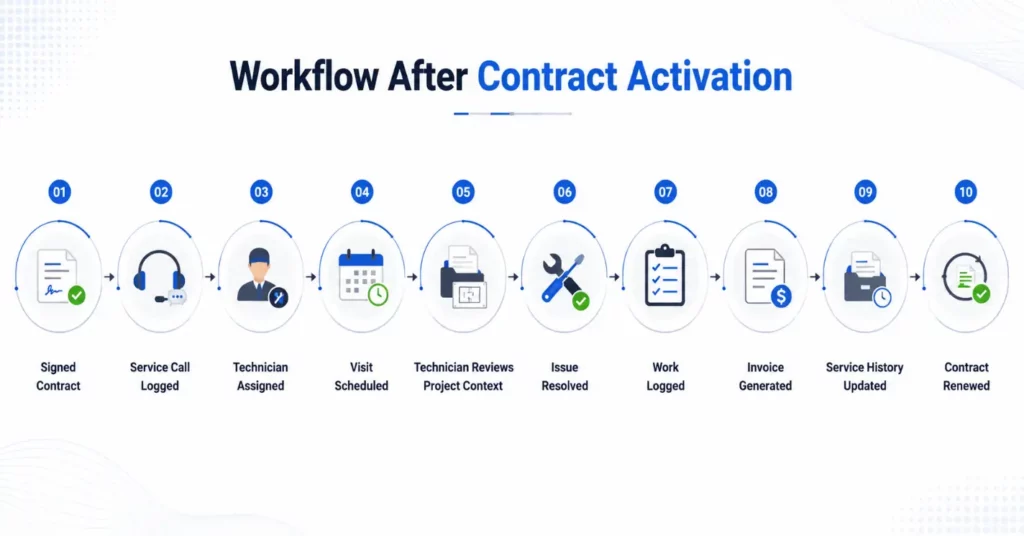
Once an AV service contract is successfully signed, it serves as the operational reference for post-installation support. It governs how service calls are raised, AV technicians are assigned, onsite visits are scheduled, proper documentation is maintained, invoices are generated, service history is updated, and renewals are managed so that they can be easily tracked whenever required.
Imagine a scenario in which a boardroom display and conference system fails before an important corporate meeting. A service call is logged immediately and linked to the contract, coverage is verified, and an AV technician is assigned promptly. After that, the issue is diagnosed and resolved onsite with proper documentation. Finally, the job is closed, and the invoice and service history details have been updated successfully.
How Do AV Service Agreements Improve Client Relationships?
The AV service agreement must improve client relationships through a structured, reliable post-installation support methodology. By this method, it minimizes downtime and enhances user experience by following a faster problem-resolution approach, implementing planned maintenance and maintaining consistent system performance.
According to key insights from Data Projections, a service agreement must help enhance overall system reliability, performance and user adoption through proper support and maintenance procedures. This also includes remote assistance, onsite support, preventive maintenance and warranty handling.
How Can AV Integrators Manage Service Contracts Without Spreadsheets and PDFs?
AV integrators and installers can efficiently manage service contracts by unifying all agreements in a single centralized system. In a disconnected methodology, contract renewals and invoices are managed in separate PDFs, spreadsheets and disconnected tools, which reduces overall visibility and slows down final execution. In a connected workflow, critical elements such as service call details, client records, technician scheduling and service history are linked on a centralized platform to enable faster speed control and maintain operational consistency.
Let’s look at the difference between the Disconnected Method and the Connected Workflow in AV service contract management.
Disconnected Method | Connected Workflow |
Contracts stored as static PDF files. | Centralized repository with instant search and retrieval |
Renewals are monitored through spreadsheets. | Automated tracking with real-time status and reminders |
Service requests received through email threads. | Structured service pipeline linked to client data. |
AV Technician scheduling is handled across separate tools. | Unified calendar with assigned jobs and time windows |
Field updates are shared through calls or the chat method. | Real-time mobile-based service updates. |
Time entries captured after work completion. | Live job level tracking with accurate logging capabilities. |
Invoices created manually after service closure. | Automated billing is generated from completed service records. |
AV Project drawings are stored in multiple locations. | Single system access to all AV project documentation. |
Turn static AV service contracts into actionable workflows. Explore X-PRO Service Management by XTEN-AV to manage contracts, service calls, technicians, invoices and renewals in one connected platform.
How Does X-PRO by XTEN-AV Service Support AV Service Contracts?
X-Pro by XTEN-AV is a cloud-based AV contract management software which allows system integrators to centralize service contracts, handle service calls with ease, create & track service agreements, assign technicians, schedule site visits and generate invoices. It also provides service analytics and helps keep after-sales support connected to the original AV project documentation. Also, it has X-PRO Service, the latest dedicated after-sales module that unifies service contracts, service calls, service agreements and service analytics on a centralized platform. It is useful for obtaining service analytics and for keeping the after-sales support connected to the original AV project records.
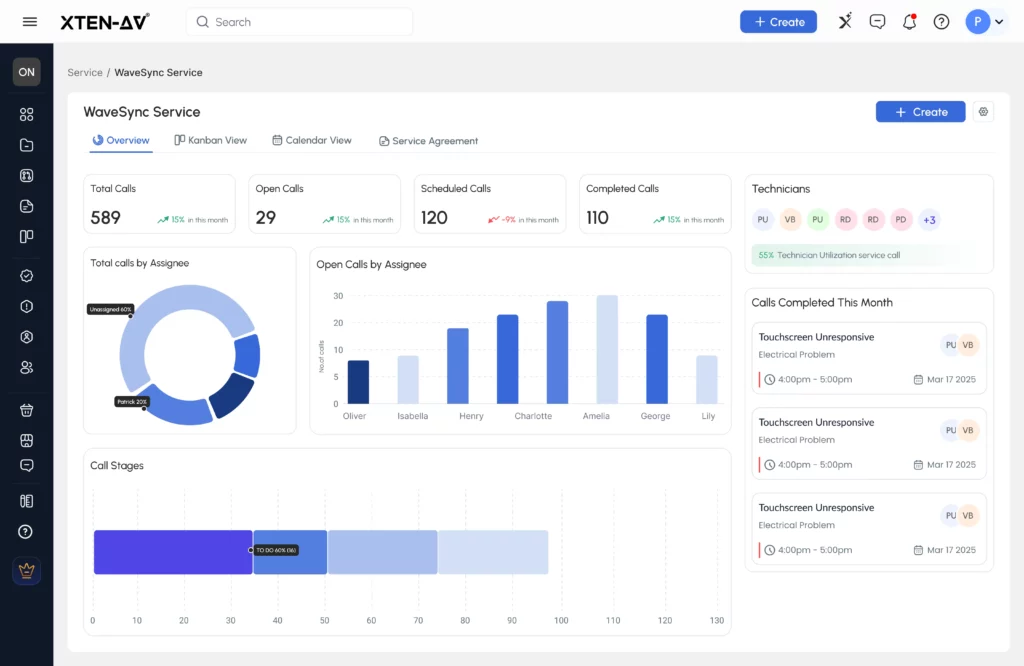
Key X-PRO Service Capabilities for AV Service Contract Management are given below:
Centralized Contract Visibility
Easily store AV maintenance contracts and agreements in one unified repository. This allows AV teams to simplify tracking of coverage, status and renewal dates.
Manage Service Calls Efficiently
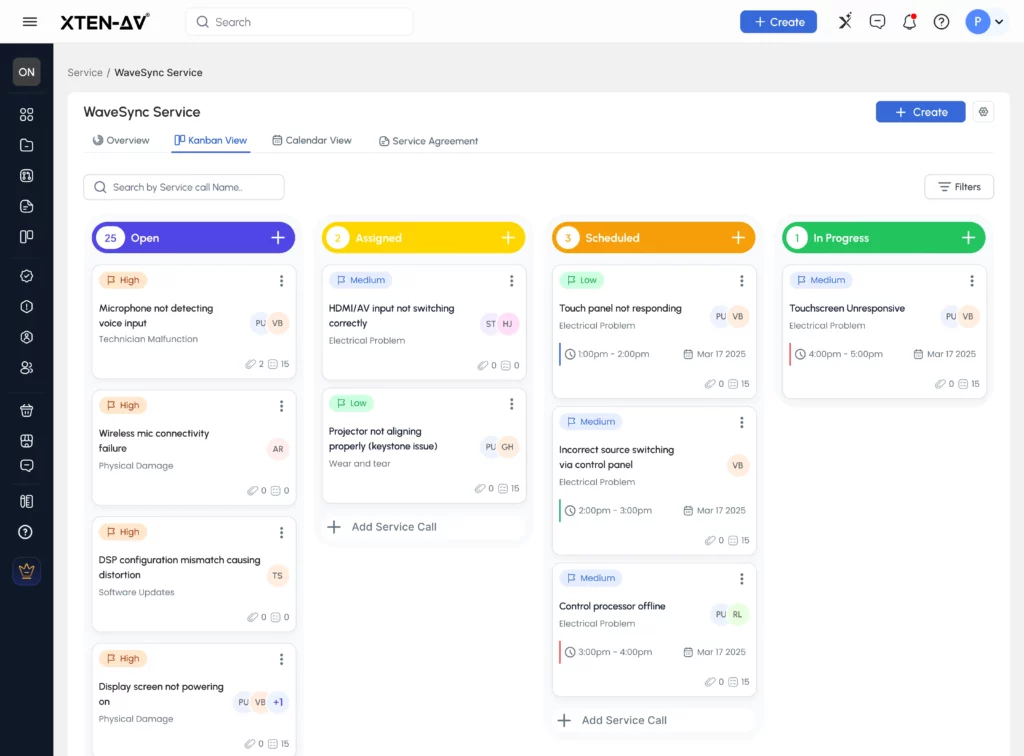
Managing each service call from intake to completion becomes streamlined through the Kanban Workflow (Open → Assigned → Scheduled → In Progress → Completed). This approach keeps work summaries, schedules, invoices and service history in one connected workflow.
Create and Track Service Agreements
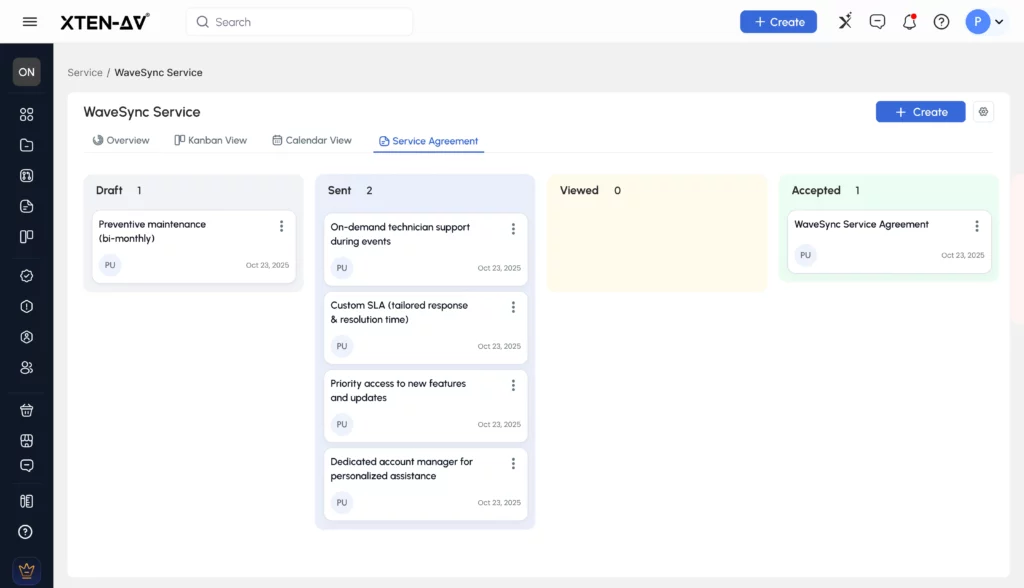
Users can use X-DOC by XTEN-AV, which is a smart proposal and documentation platform to create professional AV maintenance agreements with pricing details, digital signatures support and various ready-to-use templates for various scenarios. X-DOC streamlines the drafting and approval process and helps monitor the agreement effectively across various stages. (Draft → Sent → Viewed → Accepted)
Schedule Technicians and Maintenance Visits
Assign technicians, coordinate for site visits and properly plan preventive AV maintenance through a centralized calendar. This enhances scheduling accuracy and resource allocation process.
Learn how leading AV integrators streamline technician scheduling and field operations with the best field service scheduling software for AV integrators.
Support Field Teams Anywhere
To offer a reactive AV support workflow, X-Pro provides dedicated mobile support, helping AV technicians view the necessary checklist, maintain visit logs, capture images and record time entries through clock in and clock out capabilities.
Connect Service Work to Billing
Generate invoices from the completed work details while managing accurate labor and service records.
Monitor Real-time Performance and Recurring Revenue
AV project managers and integrators can easily track revenue, close rate, utilization and critical operational trends. This helps improve visibility, which is generated through annual maintenance contracts (AMCs) and managed service revenue.
Access Original AV System Design Data
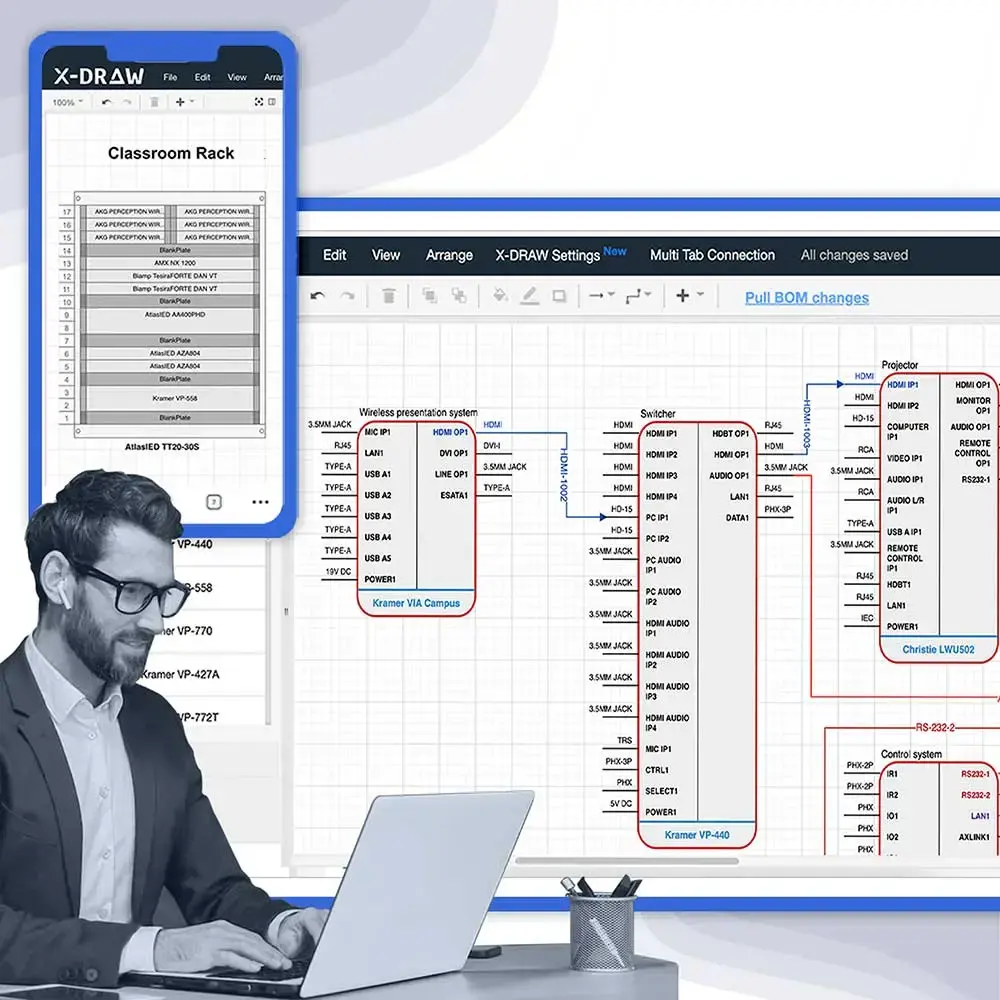
To offer valuable project insights and allow technicians to troubleshoot faster, X-Draw by XTEN-AV can be beneficial as an AV Design and Diagramming platform for accessing schematic diagrams, BOMs, rack elevation diagrams and get cable labeling details throughout the service activities.
How Can You Write a Better AV Service Contract?
To write a better AV service contract, it is necessary to clearly define how post-installation support will operate once the system is deployed and in active use in real-world AV environments. A well-organized contract should minimize uncertainty regarding the necessary scope, responsibilities and service expectations. It must clearly define how support will be delivered, tracked and managed through service calls and onsite visits. With this approach, the service contract becomes consistent, predictable and accountable throughout the contract lifecycle.
The following is the checklist given below, which helps AV professionals to write a better AV service contract:
Define AV Coverage Clearly
There is a need to list all sites, rooms, systems and AV equipment properly in the contract for better clarity.
Select the Supporting model.
Choose among the reactive, preventive and proactive support methodologies and define the remote and onsite assistance.
SLA Terms and Service Call Management Rules
Add the necessary SLA terms, including response expectations, escalation details and service availability, to ensure stable and predictable service delivery.
Structure service and pricing rules
Define how replacement parts and the warranty handling process will work. Also, define the required service documentation and reporting.
Governance and approval process
Set necessary renewal and termination terms, use digital signatures and ensure legal counsel reviews the agreement before final approval to fulfill industry standards compliance requirements.
AV Design Mastery + Winning Proposals = 10x Productivity!
- Automatic Cable Labeling & Styling
- 100+ Free Proposal Templates
- Upload & Create Floor Plans
- 1.5M Products from 5200 Brands
- AI-powered ‘Search Sense'
- Legally Binding Digital Signatures
Close Deal with Audio Visual (AV) Service Contract Template
We have over 10+ AV proposal templates that you can use and close clients 10X faster.
- Legally binding digital Signatures.
- Industry-best styling features.
- Efficient document tracking.
- Single-page scrollable document.
- Automation with ‘variables’.
- Library of 1 Million+ products.


10x Your Service Contract Closing Rate With Pre Defined Template
Conclusion
When we talk about an AV service contract, it is more than a support agreement. Providing clear service expectations, following a structured maintenance process, documenting service history and ensuring timely renewals allow AV teams to provide a better support experience after installation. As service operations grow, firms usually adopt AV service call management software to manage contracts, service calls, technician visits and client records within a connected workflow.
Streamline after-sales support, technician scheduling and contract management with X-PRO Service Management by XTEN-AV.
Frequently Asked Questions (FAQ's)
An AV service contract is an official agreement which defines how an AV system is supported, maintained and handled throughout its operational lifecycle.
It must define the scope of support, SLA commitments, response timelines, maintenance terms, exclusions, pricing structure, escalation scenarios and renewal conditions.
A service contract covers in-depth details about operational support, whereas a maintenance agreement is limited to scheduled upkeep and routine system health checks.
An SLA sets measurable performance benchmarks such as response time, resolution time and system uptime expectations.
Preventive maintenance is commonly included, but it depends on the selected service tier and the level of coverage defined in the agreement.
A warranty is manufacturer-backed and usually covers product defects, while a service contract is integrator-led and focuses on ongoing system performance and support.
No, A service agreement focuses on support and maintenance, while AVaaS is a subscription-based model that includes hardware, software and lifecycle services under one framework.
AV Integrators can monitor contract timelines, track system performance data and engage clients ahead of expiry to ensure uninterrupted service continuity.
XTEN-AV enables structured service contract management through X-PRO Service by centralizing assets, tracking renewals and improving visibility across AV installations.
Yes, legal review helps simplify SLA terms, liability clauses and compliance requirements, ensuring they are clearly defined and aligned with both parties.