








Best System Integration Software for Audio Visual (AV) Integrators

Sahil Dhingra
Published 06 May 2026


AV system integration software helps AV integrators manage design, BOMs, proposals, documentation, project execution, and service workflows in one connected platform. Instead of using separate tools for signal flow diagrams, rack layouts, pricing, quotes, and project updates, AV teams use system integration software to keep project data synchronized from design to client approval and installation.
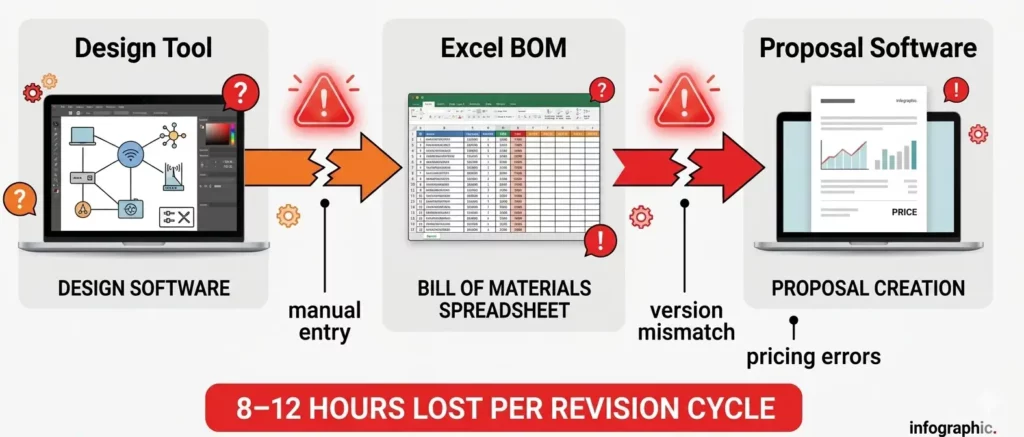
Every AV project revision that touches Visio, Excel, and a proposal tool costs 4-6 hours of unbillable time. On a mid-size project, that’s an entire day lost before installation even begins.
The problem isn’t lack of tools. It’s that your tools don’t talk to each other. A signal flow diagram lives in one file, the BOM in a spreadsheet & the AV proposal in another platform entirely. When the client requests a substitution on a DSP or a control processor, that one change ripples into three separate manual updates: each one a chance for version mismatch, pricing error, or a wrong revision landing in the client’s inbox.
Integrators who win projects through faster bidding and better execution record fewer mistakes after adopting a unified system which enables them to handle design work together with documentation and proposal tasks.
This guide covers the leading AV workflow software options: XTEN-AV, D-Tools, Jetbuilt, Portal.io, Stardraw, and Specifi with an honest read on AV-specific features, real-world strengths, limitations, and which type of firm each is actually built for.
Key Takeaways
Disconnected tools: Excel BOMs, standalone CAD, separate proposal builders are the #1 source of rework and missed bid deadlines in AV firms.
Most AV software solves one layer of the workflow well (proposal OR design OR project management) but leaves the rest disconnected.
Platforms like XTEN-AV are designed to connect design, BOM, proposal, and project workflows in a single environment, reducing the manual overhead that disconnected tools create.
D-Tools SI is the established choice for engineering-heavy firms needing deep CAD integration but carries significant cost and complexity.
Jetbuilt and Portal.io are strong for sales-led teams focused on proposal speed, but require supplementary tools for design documentation.
The right choice comes down to where your firm loses the most time and which platform eliminates that bottleneck without creating new ones.
The all-in-one solution for your Audio Visual (AV) Project Design & Documentation needs
Transform your audio-visual experience with XTEN-AV.
No Credit Card required
Why AV System Integrators Lose Time with Disconnected Tools
AV workflows break at the same points, on every project, for every firm still running a disconnected tool stack:
- Design lives in one tool
- BOM lives in spreadsheets
- Proposals live somewhere else
- Changes require manual updates everywhere
No single person owns this synchronization, which means errors are inevitable, not accidental.
Disconnected AV tools carry hidden costs that rarely show up on a single project — our whitepaper on the hidden cost of disconnected AV tools breaks down where the money actually leaks.
Many AV firms report 8-12 hours of rework per revision cycle on mid-sized projects. That’s non-billable time spent recreating data that already exists somewhere else in the system.
Integrators winning bids faster and delivering with fewer errors have replaced that stack with a single platform where design, documentation, and proposals live in the same workflow.
Best System integration software for Audio Visual (AV) System integrators
Not all AV platforms solve the same problem. Some focus on proposals. Others on design or documentation. A newer category is emerging that attempts to connect the full AV workflow: design, BOM, proposal, and project execution in one system. The real differentiator is not features; it’s how much of your workflow the platform actually owns.
1. XTEN-AV
Designed to connect AV design, BOM, proposal, and project execution end to end
XTEN-AV is a cloud-native AV workflow platform built from the ground up for professional AV integrators, not adapted from generic construction, IT, or CRM software. It is one of the few platforms in this comparison where AV system design, automated BOM generation, signal flow diagrams, rack elevation drawings, and proposal generation all operate within a shared data environment. A change made anywhere in the system propagates everywhere else automatically.
Key AV Features
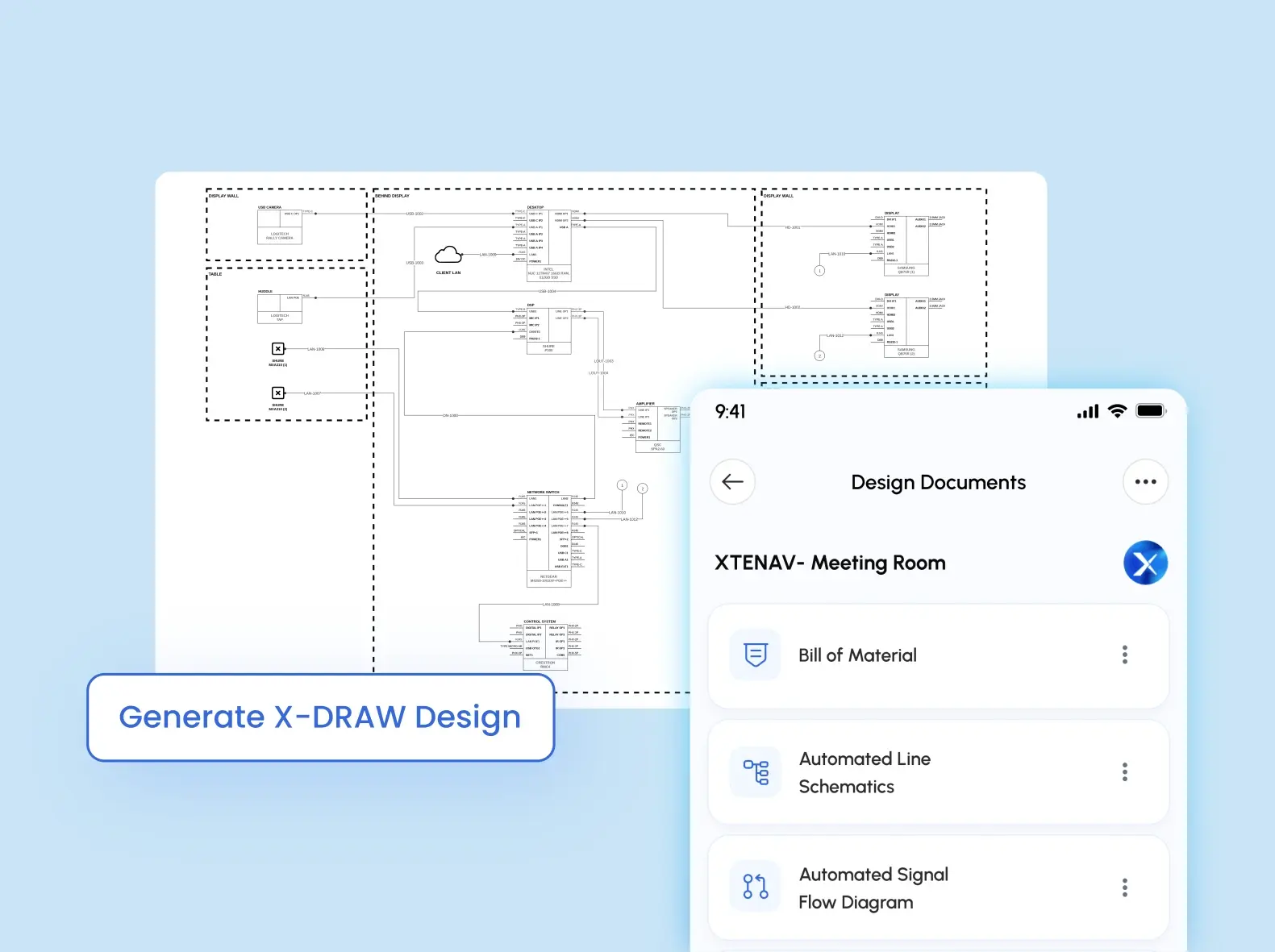
AI-assisted AV system design with signal flow and rack layout generation
Automated BOM that updates live as the design changes without manual rebuild
Cloud-based proposal builder with client approval, digital signatures, and version control
AV-specific product catalog with structured device data and integrator pricing
Real-time collaboration across design, sales, and project management roles
Documentation automation: schematics, interconnect diagrams, and equipment schedules generated from design data
Strengths
XTEN-AV’s core advantage is architectural: it treats system design as the single source of truth for everything downstream.
When a change happens in the design: BOM updates automatically, proposal reflects changes and documentation stays aligned
This eliminates the most expensive class of AV workflow errors: the gap between what was designed, what was quoted, and what was ordered.
The AV-specific product taxonomy means the platform speaks the language of signal routing, rack units, and device connectivity, not generic project line items.
For firms managing multiple concurrent projects with distributed teams, the cloud-native model removes the friction of local software installation, shared drives, and version-controlled file chaos.
The integrated AV workflows used by teams produce two main benefits which include faster proposal delivery and reduced mistakes throughout the review process particularly in multi-room commercial projects.
Unlike legacy platforms that bolt cloud features onto on-premises architecture, XTEN-AV was designed cloud-first, meaning real-time collaboration between sales engineers, design engineers, and project managers is built into the workflow, not added as an afterthought.
Limitations
Third-party integration ecosystem is still expanding compared to legacy platforms
Firms with deeply embedded Visio or AutoCAD workflows will face a transition period
Enterprise ERP integration and advanced BI reporting are areas continuing to mature
Ideal Use Case:
Growing AV firms that have outgrown Excel and disconnected tools but want to avoid the cost and complexity of legacy enterprise platforms.
Pricing:
XTEN-AV offers a 15-day free trial with no credit card required. Paid plans start at $104.25/user/month when billed annually, making it a lower-entry cloud option for teams that want AV design, proposals, and project workflows without the five-user minimum associated with D-Tools SI.
2. D-Tools
Established enterprise documentation platform, powerful, but built for a different era.
D-Tools is one of the most established names in AV business software, with over 7,000 companies across 90+ countries using it. It offers two distinct products: D-Tools System Integrator (SI), a deep on-premise solution for large AV firms, and D-Tools Cloud, a lighter web-based platform for smaller teams. Both have been the default choice for many commercial AV integrators for over two decades.
Key AV Features:
D-Tools SI: deep Visio and AutoCAD integration for engineering drawings, rack elevations, wiring diagrams, and floor plans linked to a live BOM
D-Tools Cloud: interconnect diagrams, visual quoting, multimedia proposals, project and service management, embedded payment collection
Integrated product library: 1.6 million products from 1,200+ brands with integrator-level pricing
Scheduling, Gantt charts, field mobile access, and service contract management
Strengths:
For firms with strict CAD deliverables, D-Tools SI remains one of the most reliable solutions in the market.
The BOM-to-drawing synchronization via Visio and AutoCAD is mature and battle-tested.
The installed user base means strong community knowledge and third-party integrations.
For firms already invested in Microsoft-based workflows, the transition cost is often a key factor.
Limitations:
The pricing for D-Tools SI begins at $1,800 which covers one user for one year but requires a minimum purchase of five users.
The software requires Windows operating systems for its functionality because it needs IT systems for installation and upkeep while its complex operation makes it difficult for small businesses to master.
The proposal output is functional but dated compared to modern client-facing platforms, a real disadvantage in competitive bid situations where presentation quality influences perception.
D-Tools Cloud is more accessible but trades away the engineering documentation depth that makes SI worth its complexity.
It also lacks the seamless design-to-BOM-to-proposal automation that newer platforms provide natively.
Many D-Tools users end up maintaining a hybrid workflow: SI for documentation, other tools for proposals, which recreates exactly the disconnection problem they were trying to solve.
Bottom Line:
It is a proven choice for large firms with dedicated engineering teams and formal documentation requirements. But for most growing AV integrators, the cost, complexity, and dated UX make it harder to justify against more modern alternatives.
3. Jetbuilt
Best for: Sales-led AV integrators prioritizing proposal speed
Jetbuilt is a cloud-based AV project platform launched at InfoComm 2015. It covers the commercial AV project lifecycle from lead management and quoting through installation tracking and post-sale service. It is widely used across AV, IT, security, and structured cabling integrators, particularly in North America.
Key AV Features:
Product database of 3.4 million+ AV SKUs with dealer pricing.
Room-by-room project organization with professional proposal and RFP output
Client portal with ACH/credit card payment processing
Jetbot AI: AI-generated schematics (approximately 10 seconds per schematic), AI scope-of-work drafting, AI service desk
Installation task management, calendar sync, and field technician updates
Inventory management across warehouses and vehicles with QR code tracking
Strengths:
Jetbuilt’s product catalog depth is genuinely impressive: 3.4 million+ SKUs with dealer pricing is one of the strongest foundations for fast, accurate proposal building in the industry.
Jetbuilt has expanded its AI drawing capabilities with Jetbot Drawings, including AI-generated schematics, rack elevations, and floor-plan-related drawing support. However, AV firms should still evaluate whether Jetbuilt’s drawing workflow provides the same level of design-to-BOM-to-proposal synchronization, engineering control, and documentation depth required for complex commercial projects.
Proposal-to-payment workflow is well integrated for firms that want to streamline client acceptance and collections.
Limitations:
The AI-generated schematics function as an initial resource. But schematics together with their associated BOM and proposal components require a design environment that maintains real-time data synchronization across all three elements.
Jetbuilt needs additional tools because its basic system does not provide the required rack elevation drawings and interconnect diagrams and CAD-level documentation that clients need.
The platform works best for residential projects and light commercial projects which generate many proposals but need only basic engineering documentation.
The project gaps become more pronounced when projects reach larger scale and higher technical complexity..
Bottom line:
A solid sales platform for high-volume integrators. The AI tools are genuinely useful for proposal acceleration, but firms scaling into complex commercial work will hit the documentation ceiling quickly.
4. Portal.io
Fast proposal tool, but the workflow stops at acceptance
Portal.io (originally SupplyStream, founded 2011) operates as a cloud-based platform which enables AV security and IT integrators to create proposals and manage their sales processes. The system enables sales teams to generate precise professional proposals which they can present to clients for rapid acceptance and payment processing.
Key AV Features:
AI Proposal Builder with voice input (Speak It feature): generate a proposal draft from spoken project description
Digital signatures, proposal expiry controls, client-selectable options, and version history
Integrated payment processing via Stripe, Square, and QuickBooks
Change order management linked to original proposals
CRM integrations: Zoho, d-tools, Google sheets, iPoint, projX360
Strengths:
Portal.io is one of the fastest tools available for building client-ready proposals from scratch.
The voice-to-proposal capability is a genuine differentiator for field-based sales engineers who need to capture scope on-site and turn it into a formatted proposal before the drive back to the office.
The proposal-to-payment workflow is tightly integrated and reduces the typical friction between sales and collections.
Limitations:
Portal.io excels at proposal speed, but does not extend into design documentation or full project execution workflows.
There are no signal flow diagrams, rack elevation tools, BOM-to-design synchronization, or meaningful installation tracking capabilities.
What you gain in proposal speed, you give up entirely in technical documentation depth and post-sale workflow.
For firms that handle design documentation through separate tools, Portal.io can work as a front-end sales layer.
But that means maintaining two systems with no data bridge between them which is a version of the same disconnected workflow problem the industry is trying to move away from.
Community feedback also notes friction with purchase order workflows and a product positioning that skews more residential than commercial.
Bottom Line:
Excellent for proposal speed and client experience. Not a system integration platform, more accurately, a sales acceleration tool that requires other platforms to complete the workflow.
5. Stardraw
Best-in-class AV drawing tool, but only a drawing tool
Stardraw is a specialized AV drawing and documentation tool designed for producing professional, standards-compliant AV system documentation: signal flow diagrams, rack layouts, floor plans, and equipment schedules. It is built for AV consultants and design engineers whose primary output is a drawing package, not a client proposal or a project plan.
Key AV Features:
AV-specific symbol libraries for signal flow and interconnect diagram creation
Rack elevation drawing tools with equipment scheduling
Industry-standard documentation output formats for formal submission
Floor plan integration with AV equipment placement
Strengths:
Within its defined scope, Stardraw is excellent.
Its AV-specific symbol set and documentation structure reduces setup time significantly compared to adapting generic CAD tools for AV work.
For consultants producing formal drawing packages as primary deliverables particularly on specification-driven commercial or government projects, it is a focused, capable tool.
Limitations:
Stardraw is a drawing tool, full stop.
It does not handle proposals, BOMs, CRM, project management, procurement, or any other business workflow.
Every firm using Stardraw still needs separate platforms for sales, quoting, and project execution.
For integration firms (as opposed to pure consultants), this is a significant limitation.
Bottom Line:
These tools are best suited for consultants, not integrators managing end-to-end project delivery.
6. Specifi
AV specification platform for consultants, narrow scope by design
Specifi is an AV design and specification platform built to help consultants and design engineers produce formal specification documents from system design data. It connects design workflows to manufacturer product data and generates specification documentation for commercial AV projects typically in hospitality, healthcare, and corporate environments where formal specs are required deliverables.
Key AV Features:
System design tools integrated with manufacturer product data and specifications
Specification document generation directly from design content
Access to AV product data ecosystems for accurate specification
Project documentation workflows for specification-driven delivery
Strengths:
Specifi serves a specific and real need: AV consultants working on specification-driven projects where the primary output is a formal spec document, not a client proposal or a business quote.
The manufacturer data integration is a genuine time-saver for consultants who would otherwise manually look up product specifications for every device in a system.
Limitations:
Specifi’s scope is deliberately narrow, and that is both its strength and its limitation.
Proposal generation, BOM automation, project execution tracking, and financial management are all outside its design intent.
It is a tool for a specific role in a specific type of project not a platform for running an integration business.
| Software | Best For | Strength | Limitation | Design Tools | BOM Automation | Proposal Tools | Project Management | Service Workflow | Best-Fit Team |
| XTEN-AV | End-to-end AV workflow | Unified platform | Growing ecosystem | Strong | Strong | Strong | Strong | Emerging/Strong if service module is included | Small to enterprise AV teams |
| D-Tools SI | Enterprise documentation | CAD integration | Complex + expensive | Very strong | Strong | Moderate | Strong | Strong | Large firms |
| Jetbuilt | Sales-led teams | Fast proposals | Limited design depth | Improving | Strong catalog | Strong | Moderate | Moderate | Sales-heavy teams |
| Portal.io | Proposal speed | Easy + fast | No design tools | Limited | Catalog-led | Strong | Limited | Limited | Residential/light commercial teams |
| Stardraw | AV drawings | Documentation quality | No business workflow | Strong | Limited | No | No | No | Consultants |
| Specifi | Consultants | Spec generation | Narrow scope | Moderate | Product-data led | No | No | No | Consultants/spec writers |
How to Choose the Right Audio Visual (AV) System Integration Software
Organizations must choose a suitable platform based on four specific factors which include their company size, their documentation needs, workflow entry points and their system requirements.
Criterion | Small Firm (1–5 users) | Mid-Market (5–20 users) | Enterprise (20+ users) |
Primary workflow | Proposal speed and catalog accuracy | Proposal + design + project tracking | Full lifecycle + engineering docs + ERP integration |
AV schematics needed? | Basic or none required | Interconnect diagrams, basic rack layouts | Full CAD-integrated drawing packages |
BOM automation priority | High, reduce manual entry | High, sync design to proposal | Critical, link to procurement and inventory |
Cloud vs. on-premise | Cloud preferred (low IT overhead) | Cloud or hybrid | On-premise or enterprise cloud |
Best-fit tools | XTEN-AV, Portal.io, Jetbuilt | XTEN-AV, Jetbuilt, D-Tools Cloud | D-Tools, XTEN-AV |
Beyond firm size, identify your single biggest workflow failure point:
- Losing time on proposals → prioritize catalog depth and AI-assisted proposal generation
- Revision cycles killing margins → prioritize live BOM-to-design synchronization
- Installation errors from bad documentation → prioritize schematic and interconnect diagram automation
- Teams working off different versions → prioritize cloud-native collaboration and single source of truth
One pattern worth noting: most firms that start with a point solution: proposal tool only, or drawing tool only, end up back in the market within 18 months looking for something that connects more of the workflow. Buying for where your firm will be in two years is usually more efficient than buying for today’s bottleneck alone.
Why Audio Visual (AV) Integrators Are Using XTEN-AV for System Integration?
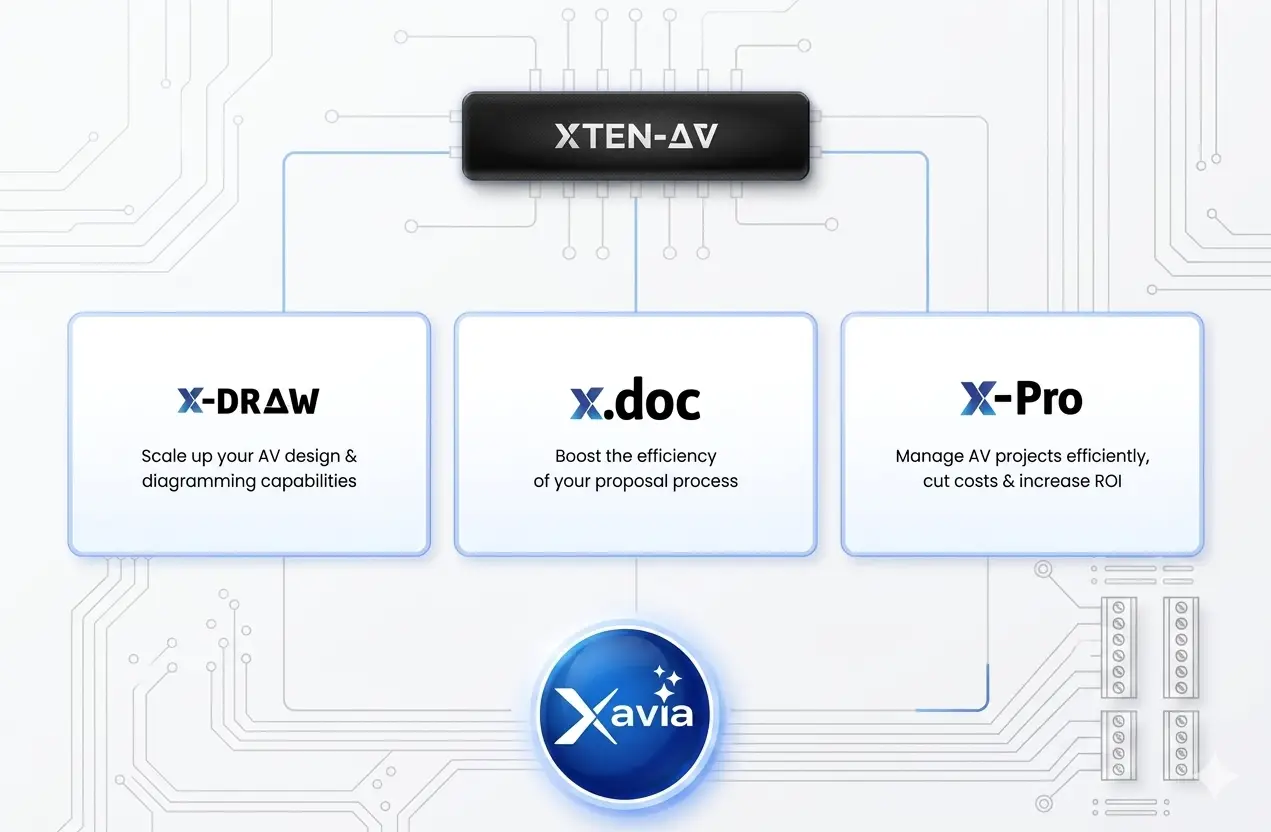
The AV integration industry is moving away from disconnected tool stacks toward integrated platforms. XTEN-AV is built around exactly that shift, every module shares the same dataset, so a change made anywhere updates everything downstream automatically.
What XTEN-AV replaces:
- Manual BOM creation and rebuilds
- Disconnected design and drawing tools
- Proposal rework after every design change
- Version mismatches between design, quote, and order.
The all-in-one solution for your AV needs
Transform your audio-visual experience with XTEN-AV.
No Credit Card required
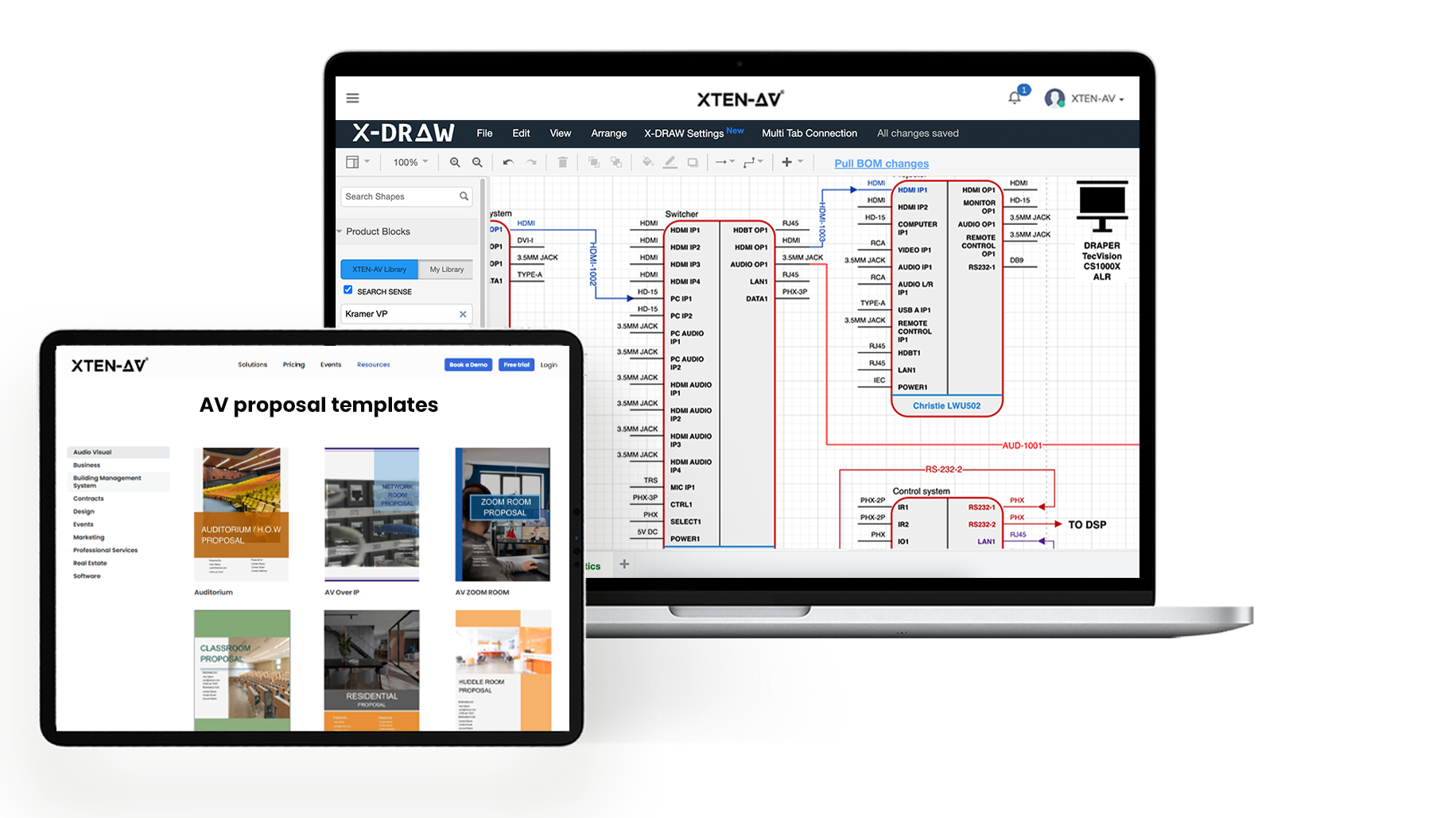
Audio Visual System Design Mastery + Winning Proposals = 10x Productivity!
- ✔ Automatic Cable Labeling & Styling
- ✔100+ Free Proposal Templates
- ✔ Upload & Create Floor Plans
- ✔1.5M Products from 5200 Brands
- ✔ AI-powered ‘Search Sense'
- ✔Legally Binding Digital Signatures
Conclusion
The AV integration industry has reached a tipping point. The complexity of modern AV systems spanning IP-networked audio, software-defined video transport, cloud-managed control, and converged IT infrastructure has outpaced the capacity of disconnected, manual-workflow tools to keep up.
The firms that win more bids, deliver projects with fewer errors, and scale their operations more efficiently are the ones that have replaced their tool stacks with integrated AV workflow platforms. Whether that means D-Tools SI for engineering-heavy documentation, Jetbuilt for high-volume sales workflows, or XTEN-AV for a cloud-native design-to-proposal environment the direction of the industry is clear.
The gap between firms using disconnected tools and those using integrated AV platforms is widening fast. The question isn’t whether to upgrade your workflow. It’s how long you can afford not to.
Interested in exploring XTEN-AV? Book a Demo or start your 15 day free trial today.
FAQ's
AV system integration software is a business platform built for companies that design, sell, and install professional audio-visual systems. It combines AV-specific functions: signal flow diagrams, rack elevation design, BOM automation, product catalog access with dealer pricing, and proposal generation in one connected workflow so design data flows directly into proposals without manual re-entry.
AV design software covers technical documentation only: signal flow diagrams, floor plans, rack layouts, and interconnect drawings. AV system integration software is broader, it connects design to BOM automation, proposal generation, client approvals, project execution, and service management. Platforms like XTEN-AV, D-Tools, and Jetbuilt are system integration tools; Stardraw and Specifi are design-only tools.
XTEN-AV– best all-in-one for firms wanting cloud-native design, BOM, and proposal in one platform
D-Tools SI– best for large firms with CAD-integrated engineering documentation requirements
Jetbuilt / Portal.io– best for sales-led teams focused on proposal speed and client engagement
Stardraw / Specifi– best for consultants with formal technical documentation requirements
For most AV firms, yes. The cloud based system enables users to work together in real time while accessing the system from mobile devices and reducing operational costs through its VPN-free design. The cloud-first platforms provide small-to-mid-market firms better value because they deliver superior capabilities at every cost point.
A signal flow diagram shows the path which audio, video and control signals take when they travel between devices that receive signals from cameras or media players and process them through DSPs and switchers to produce output through displays and speakers. It serves as the technician’s installation reference, a required deliverable on many commercial projects, and the primary tool for catching signal routing errors before equipment is purchased.
Most AV integrators use a combination of tools spanning design, BOM management, and proposal generation. Common platforms include D-Tools, Jetbuilt, Portal.io, and XTEN-AV. The industry currently progresses toward using integrated platforms which enable all three project stages to work together in one continuous process, which helps to minimize manual rework and mistakes throughout the entire project duration.
For most small AV firms, D-Tools SI is difficult to justify. It comes with an annual price of $1,800 for a minimum of five users. The software needs Windows systems for operation and has a difficult learning process. Cloud-native platforms like XTEN-AV or Jetbuilt provide better value to smaller firms because they enable faster onboarding while reducing costs and maintaining similar proposal capabilities without requiring IT support.
The best AV software for small integrators exists within cloud-based platforms which include XTEN-AV, Jetbuilt or Portal.io. The system provides rapid implementation processes together with affordable initial expenses while decreasing dependency on technical resources, enabling users to create proposals and conduct fundamental design operations.
Explore more by topic
AV Design Mastery + Winning Proposals = 10x Productivity!
- Automatic Cable Labeling & Styling
- 100+ Free Proposal Templates
- Upload & Create Floor Plans
- 1.5M Products from 5200 Brands
- AI-powered ‘Search Sense'
- Legally Binding Digital Signatures
No Credit Card Required
Related Blogs

-

- Posted by Sahil Dhingra

Audio Visual Auditorium Sound System Design: Complete Guide to Acoustics, Speakers &...
-
- Posted by Sahil Dhingra
Audio Visual 7 Best Wiring Diagram Software for AV System Integrators Sahil...
-
- Posted by Sahil Dhingra
Audio Visual Sound Masking System Installation Checklist for AV Integrators Sahil Dhingra...