








7 Best Rack Diagram Software for AV System Integrators

Sahil Dhingra
Published 25 SEPT 2026
AV rack layouts can appear complete during the design phase but reveal critical issues during the installation stage. Incorrect rack-unit planning, limited cable access, poor service clearance or late equipment changes can require engineers to revise rack elevations, drawing schematics and AV CAD design documents.
According to the survey by Commercial Integrator, 47.6% of respondents selected rack dressing as an important competency for AV technicians. Detailed rack diagrams support this task by showing equipment placement and cable routes before installation.
In this guide, we evaluate the best rack diagram software for audiovisual (AV) system integrators. The comparison covers rack planning capabilities, equipment support, documentation features, pricing and free access so professionals can select the right tool for their projects.
Key Takeaways
- Leading rack diagram software options for AV integrators include XTEN-AV (X-DRAW), draw.io, Lucidchart, SmartDraw, Microsoft Visio, AutoCAD and Creately, offering different approaches to rack layouts, AV design and system documentation.
- These AV platforms help professionals visualize equipment placement, create rack elevations, develop system diagrams and organize design information for proper installation planning.
- Key evaluation factors include equipment libraries, diagramming capabilities, AV-specific features, collaboration options, pricing, integrations, and scalability.
- Some applications support quick diagram creation, while others enable advanced workflows with signal flow diagrams, system schematics, CAD-based drawings and detailed AV project deliverables.
- The right rack design tool depends on project complexity, documentation requirements and its ability to support accurate engineering, installation, and maintenance processes.
What Is Rack Diagram Software?
Rack diagram software gives AV professionals a structured way to plan how amplifiers, DSPs, switches, processors and other rack-mounted devices will be arranged inside a cabinet. It shows U-space allocation, equipment position, dimensions and labeling before installation begins, giving design engineers and installers a clear reference for assembly.
For AV projects, AV rack design software can also support cable identification, manufacturer-based sizing, ventilation planning, and related technical documentation. This makes it easier to coordinate installation requirements and keep cabinet layouts consistent as system needs change.
Why Do AV System Integrators Need Rack Planning Tools?
Designing an AV rack requires careful planning of equipment placement, rack units, cable pathways, power requirements, ventilation and service access before installation begins. An audio rack planner allows integrators to visualize rack-mounted components, create accurate layouts, develop rack elevations and organize AV system design details for smoother coordination and deployment.
Following are the key areas where rack planning tools help AV integrators:
| Key Requirements | How It Helps AV Professionals |
| Space Allocation and Device Arrangement | Helps position amplifiers, DSPs, processors, switches, and other rack-mounted hardware within available cabinet space. |
| Elevation View Creation | Provides visual front and rear views to communicate mounting positions and cabinet organization. |
| Cable and Connection Planning | Supports cleaner signal paths, port identification, and connectivity documentation. |
| Design Revision Management | Simplifies updates when equipment selections or system requirements change. |
| Installer Communication | Provides clear visual references for accurate field execution and coordination. |
| Future Service Planning | Makes troubleshooting, equipment identification, and expansion planning easier. |
Looking for a faster way to plan AV racks? Try the free audio visual rack diagram tool to visualize equipment placement, organize rack units and create clear AV layouts before installation.
Which Rack Design Software Fits Your AV Project?
Rack design software should match project complexity, cabinet capacity and installation requirements. Key considerations include U-space capacity, device dimensions, cable routing, ventilation, BOM support, file compatibility and scalability.
The table below compares popular AV platforms based on their strongest rack planning capabilities and practical limitations:
| Tool | Best-Fit AV Use Case | Free Access | Key Rack Capability | Main Limitation |
| XTEN-AV (X-DRAW) | Professional AV system engineering and field documentation. | 15-day free trial. | Creates rack elevations using exact equipment dimensions and AVIXA-standard symbols. Thermal analysis, airflow requirements and automatic cable labels help in preparing field-ready documentation. | New users may experience a learning curve while exploring its extensive features. |
| draw.io | Simple equipment placement for smaller installations. | Free version. | Adjustable cabinets, U-space numbering and snap-in shapes. | Lacks native BOM generation and heat analysis. |
| Lucidchart | Collaborative cabinet layouts and stakeholder reviews. | Limited free plan. | Front and rear views, custom shapes and shared editing. | Technical equipment data requires manual entry. |
| SmartDraw | Structured cabinet and network diagrams. | Free trial. | Scaled templates and standard infrastructure icons. | Provides limited AV-specific automation. |
| Microsoft Visio | Technical documentation within Microsoft environments. | Free trial. | Hardware stencils, component data fields and reusable templates. | Detailed configurations involve manual setup. |
| AutoCAD | Precise elevations and construction drawings. | Free trial. | Exact measurements, layer controls, reusable blocks and DWG coordination. | Requires CAD experience and substantial drafting. |
| Creately | Quick infrastructure layouts and team reviews. | Limited free plan. | Adjustable templates, equipment fields and collaborative editing. | Offers less engineering depth for complex systems. |
Managing technology across classrooms, labs and lecture halls? Explore how higher education AV software helps universities maintain consistent equipment standards and documentation across campus.
Top 7 Rack Diagram Tools for AV System Integrators
Rack Diagram Tools support cabinet planning, equipment placement, U-space allocation and installation documentation for AV projects. Available options vary in automation, drawing accuracy, collaboration and engineering depth.
Here are seven platforms AV integrators can compare based on project scope, usability and technical requirements:
XTEN-AV (X-DRAW)

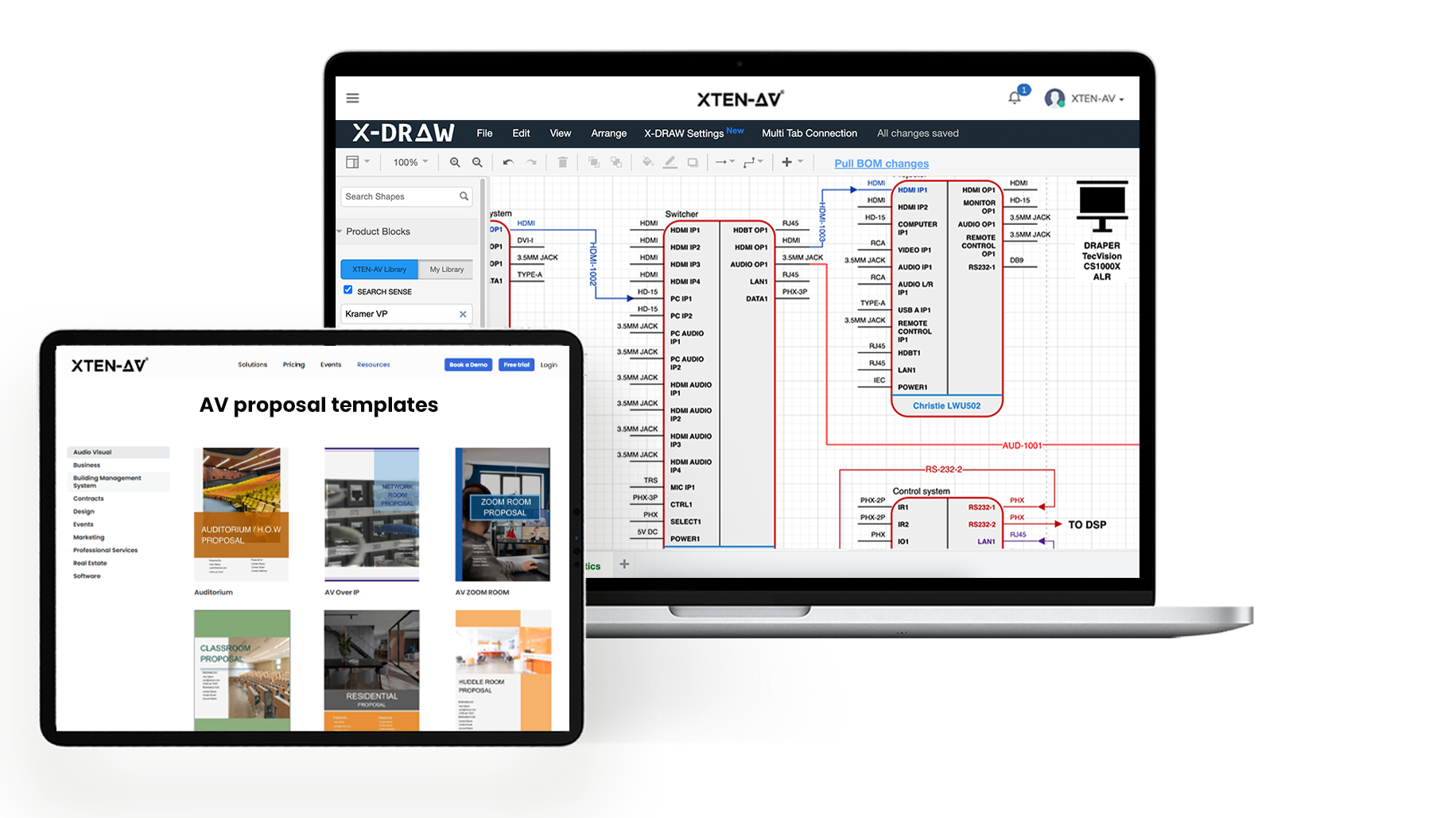
Built for AV design engineers and system integrators, X-DRAW by XTEN-AV is a cloud-based Audio Visual (AV) rack design software for creating structured system drawings within one unified platform. It supports automated rack elevations, pre-designed AV templates, line schematics, floor plans, ceiling speaker layouts and front elevation diagrams. This enables teams to prepare detailed project documentation with less manual drafting and fewer disconnected tools.
Best For:
A strong fit for AV design engineers, integrators, and installation teams who need automated schematics, rack elevations, floor plans, cable schedules and cloud-based collaboration in one unified platform.
Unique Features of X-DRAW:
- BOM-based rack planning for structured equipment placement.
- Manufacturer-accurate dimensions for precise cabinet fit.
- Thermal and ventilation checks for airflow and clearance planning.
- Automated rack layouts for faster elevation creation.
- 1.5M+ product library covering more than 5,200+ AV brands.
- Automatic cable IDs and numbering across audio, video, control, network and power.
- Cable schedules for organized installation references.
- Port-level connection details for clearer signal flow planning.
- Front elevations, floor plans and ceiling speaker layouts in one environment.
- AI-powered Search Sense for quicker equipment discovery.
- Multiple export formats for easier file sharing and handoff.
- Cloud-based access for review, updates and collaboration.
- Custom dealer pricing upload option via XLS or CSV for negotiated equipment costs.
Pros:
- Extends beyond a standard rack design tool with broader system documentation
- capabilities.
- Connects with XAVIA, the AV AI Agent, for automated BOM generation and AV line schematic creation through voice or chat-based prompts.
- Keeps AV design data aligned across drawings and BOMs, avoiding duplicate edits.
- Cloud access gives engineers, integrators and installers the latest project files.
- Saves drafting time while maintaining professional, client-ready AV deliverables.
Still unsure which AV single-line diagram software fits your needs? Compare the best AV single-line diagram tools to find the right option for your AV system designs.
Cons:
- New users may experience a short learning curve when transitioning from generic or basic diagramming platforms.
User Reviews:
Users appreciate XTEN-AV (X-DRAW) for its ease of use, intuitive automation and accurate AV drawings. Reviewers also value faster creation of professional schematics compared with traditional drafting methods.
XTEN-AV Pricing Plans:
- Free Trial
XTEN-AV offers a 15-day free trial. - Basic
$104.25/user/month, billed annually. - Business
$111.75/user/month, billed annually. - Enterprise
$126.75/user/month, billed annually. - X-PRO Add-On
$16.88/user/month, billed annually. Available as an optional add-on.
Source and Verification Date:
- Source:
https://xtenav.com/x-draw/ - Verification Date:
September 21, 2026
Create Detailed AV Rack Layouts Faster with Less Manual Effort.
draw.io
draw.io is a general-purpose diagramming application that can work as a free rack diagram tool for AV consultants, system integrators, and installers. Its rack libraries support cabinet layouts, numbered U-spaces, and hardware placement for straightforward equipment planning. The browser version is free, while the desktop app supports offline use.
Best For:
Best suited for smaller projects, quick cabinet elevations and network-focused layouts that do not require dedicated AV engineering automation.
Unique Features of draw.io:
- Dedicated Rack and Cabinet shape libraries.
- Resizable enclosures with automatic U-space adjustment.
- Ascending or descending rack-unit numbering.
- Components that snap into available cabinet slots.
- Ready-made cabinet and Arista templates for quicker diagram setup.
- Replace Shape option for swapping devices without repositioning them.
- Custom labels for identifying mounted hardware.
Pros:
- Free browser access with no account required.
- Desktop application supports offline drafting.
- Local and cloud storage options are available.
- Integrates with services such as Google Drive and Confluence.
- Provides common export formats for sharing technical diagrams.
Cons:
- Built for general diagramming rather than dedicated AV engineering.
- Complex files can feel slower, while some reviewers report spacing or alignment issues during export.
User Reviews:
Users like draw.io for its free access, broad shape library, and quick technical diagram creation. However, users also highlighted the alignment issues, a dated interface and slower performance with larger files.
draw.io Pricing Plans:
- Standalone Version
Pricing: Free
Includes online diagramming and a desktop app for offline use. - Confluence and Jira Integration
Pricing: Paid plans based on user count
Includes Atlassian integration and collaborative diagramming features.
Need more than basic diagramming for your AV projects? Read our draw.io vs. XTEN-AV comparison for a clear look at their capabilities.
Source and Verification Date:
- Source:
https://www.drawio.com/ - Verification Date:
September 21, 2026
Lucidchart
Lucidchart is a cloud-based diagramming platform that can serve as an AV rack design tool for consultants, system integrators and IT professionals. It offers rack templates, standard network symbols and scaled views for planning mounted hardware. Shared editing also supports review and coordination across multiple stakeholders.
Best For:
A practical choice for AV professionals who need collaborative cabinet planning, network visuals and equipment layouts without dedicated audiovisual automation.
Unique Features of Lucidchart:
- Pre-built 42U and 8U server rack templates.
- Industry-standard server and network symbols.
- Front and rear views for equipment placement.
- Custom shape libraries for reusable components.
- Shared editing with role-based access.
- Centralized storage for technical files.
- Template options for common infrastructure layouts.
- Import support for Visio, draw.io, Gliffy and OmniGraffle files.
Pros:
- Real-time co-editing supports faster technical reviews.
- Drag-and-drop controls keep setup straightforward.
- Reusable templates save time on recurring layouts.
- Browser-based access works across different devices.
- Integrations support broader project documentation needs.
Cons:
- Built for general diagramming rather than specialized AV engineering.
- Larger files may require extra connector management and manual cleanup.
User Reviews:
Users praise Lucidchart for its easy navigation, ready-made templates and real-time collaboration. Some report limited free features and slower performance with larger diagrams.
Lucidchart Pricing Plans:
- Free Trial
Lucidchart provides a 7-day free trial for paid plans. - Free Plan
Includes three editable documents and 60 shapes per document. - Individual
Starts at $9/month with unlimited documents and shapes. - Team
Starts at $10/user/month with collaboration and team management features. - Enterprise
Custom pricing based on business requirements.
Source and Verification Date:
- Source:
https://lucid.co/lucidchart - Verification Date:
September 21, 2026
SmartDraw
SmartDraw is a visual diagramming platform that can serve as a server rack diagram tool for AV integrators who need scaled cabinet elevations and equipment placement visuals. It includes rack templates, standard network symbols and editable layouts for planning mounted hardware before installation.
Best For:
Suitable for system integrators, consultants and AV installers who need structured rack elevations, network visuals and technical layouts without relying on full CAD software.
Unique Features of SmartDraw:
- Ready-made rack diagram templates.
- Standard symbols for servers, routers, switches, and related hardware.
- Scaled layouts for cabinet planning.
- Searchable symbol libraries for technical components.
- Labels for identifying devices and connections.
- Layers for organizing additional system details.
- Support for network and wiring diagrams.
- Export and sharing options for project documentation.
Pros:
- Simple interface shortens the learning curve for technical drafting.
- Templates provide a quick starting point for common layouts.
- Large symbol libraries cover multiple infrastructure categories.
- Integrates with Microsoft Office, Google Workspace and collaboration platforms.
- Suitable for creating clear visuals without advanced CAD knowledge
Cons:
- General-purpose functionality may not cover specialized audiovisual engineering needs.
- Precision drafting, advanced customization and 3D capabilities are more limited than dedicated CAD platforms.
User Reviews:
Users value SmartDraw for its web access, layer support and broad symbol library. Some mention limited engineering precision and less flexibility for detailed technical work.
SmartDraw Pricing Plans:
- Free Trial
Pricing: Free trial available.
Best for testing SmartDraw before purchasing an annual subscription. - Individual Plan
Pricing: $9.95/month (billed annually).
Includes diagram creation, templates, and drawing features for individual users. - Team Plan
Pricing: $8.95/user/month (billed annually).
Includes team collaboration, shared folders and administrative controls. - Enterprise Plan
Pricing: Contact Sales.
Includes enterprise features such as SSO, multiple shared folders, and organization-level support.
Source and Verification Date:
- Source:
https://www.smartdraw.com/ - Verification Date:
September 21, 2026
Microsoft Visio
Microsoft Visio is a professional diagramming application for AV integrators who need rack elevations, network layouts and structured equipment documentation. Its dedicated rack template uses industry-standard hardware shapes that snap into position for more precise cabinet planning.
Best For:
Suitable for AV integrators, engineers, consultants who need detailed rack layouts and already use Microsoft tools for technical documentation.
Unique Features of Microsoft Visio:
- Dedicated Rack Diagram template in Visio Professional.
- Industry-standard equipment shapes with precise snap placement.
- Shape Data fields for serial numbers, locations, and device details.
- Equipment reports generated from stored component information.
- Grids, layers, and containers for organizing detailed drawings.
- AutoCAD file support for existing technical plans.
- Custom templates and reusable stencils for recurring projects.
Pros:
- Fits naturally within organizations already using Microsoft 365.
- Supports information-rich visuals through data-linked shapes.
- Handles network, electrical, AV floor plan and engineering documentation.
- Broad import and export support makes file sharing easier across different applications.
Cons:
- Professional features come with a steeper learning curve than simpler diagramming apps.
- Some useful templates and shapes require higher-tier or paid versions.
User Reviews:
Users value Microsoft Visio for creating structured, professional technical diagrams and its close integration with Microsoft 365. Meanwhile, some mention time-consuming connector adjustments and a dated interface when working on detailed layouts.
Microsoft Visio Pricing Plans:
- Free Trial
Pricing: 1-month free trial.
Best for users who want to test Visio Plan 1 or Plan 2 before subscribing. - Visio Plan 1
Pricing: $5/user/month (paid yearly).
Includes web-based diagram creation and collaboration features. - Visio Plan 2
Pricing: $15/user/month (paid yearly).
Includes desktop and web applications with advanced diagramming capabilities. - Visio Standard 2024
Pricing: $309.99 one-time purchase.
Includes desktop diagramming tools with standard templates and shapes. - Visio Professional 2024
Pricing: $579.99 one-time purchase.
Includes advanced diagramming features and professional templates.
If Visio no longer meets your AV diagramming needs, the next choice does not have to be difficult. Use our Microsoft Visio substitutes guide to compare practical options with confidence.
Source and Verification Date:
- Source:
Microsoft Visio official website - Verification Date:
September 21, 2026
AutoCAD
AutoCAD is a professional drafting platform used by AV design engineers and consultants to create precise equipment elevations, floor plans and installation drawings. Its 2D drafting tools, reusable blocks, layer controls, dimensions and native DWG support provide detailed control over technical documentation. As a CAD-based rack design tool, it fits projects that require exact measurements and coordination with architectural or engineering plans.
Best For:
Suitable for experienced AV designers who need highly customized rack elevations, detailed construction drawings and precise CAD documentation.
Unique Features of AutoCAD:
- Precision 2D drafting with exact dimensions and annotations.
- 3D modeling for visualizing complex equipment arrangements.
- Dynamic Blocks for reusable device and cabinet components.
- Layer controls for separating equipment, cabling, notes and architectural details.
- Native DWG support for sharing files with architects and engineering consultants.
- External references for coordinating multiple technical drawings.
- Panel layout tools for placing component footprints and equipment details.
Pros:
- Provides high drafting accuracy for dimension-sensitive technical work.
- Allows extensive customization through reusable blocks and layer standards.
- DWG compatibility supports coordination with architects, engineers, and contractors.
- Handles detailed 2D documentation alongside 3D modeling.
- Specialized toolsets extend its use across electrical, MEP and related engineering tasks.
Cons:
- Requires more CAD knowledge than template-based diagramming applications.
- Detailed rack layouts often need custom blocks, manual setup, and ongoing drawing management.
- Large or complex files can place heavier demands on system resources.
User Reviews:
Users consider AutoCAD reliable for detailed 2D layouts, customization and coordination across architectural and engineering files. Some point to high licensing costs and an interface that can feel heavy for less experienced users.
AutoCAD Pricing Plans:
- AutoCAD Subscription
Pricing: $2,095/year.
Includes 2D and 3D CAD tools, specialized toolsets, and desktop, web, and mobile access. - AutoCAD LT
Pricing: $540/year.
Includes essential 2D drafting and documentation features. - Free Trial
Pricing: Available.
Lets users explore AutoCAD features before subscribing.
Finding a suitable drafting platform for commercial AV projects can be challenging. Explore the best AutoCAD alternatives to compare features, pricing and use cases.
Source and Verification Date:
- Source:
https://www.autodesk.com/products/autocad/overview - Verification Date:
September 21, 2026
Creately
Creately is a web-based diagramming platform that can serve as a free network rack diagram tool for AV integrators planning servers, switches, cabling and supporting infrastructure. It offers editable templates, standard rack symbols and a flexible canvas for arranging equipment without the complexity of full CAD software.
Best For:
Best suited for integrators and AV consultants who need quick rack layouts, shared editing, and network infrastructure documentation.
Unique Features of Creately:
- Ready-made server, network, and data center rack templates.
- Dedicated shape library for common infrastructure hardware.
- Adjustable cabinet size, scale, and structure.
- Data fields for equipment specifications and power requirements.
- Notes for documenting cable connections and device details.
- Links, images, and references attached directly to components.
- Version history for reviewing earlier changes.
- Export options including PNG, SVG, PDF, and CSV.
Pros:
- Drag-and-drop controls make initial setup easy to learn.
- Infinite canvas provides room for larger infrastructure maps.
- Reusable templates suit recurring network and cabinet planning tasks.
- Browser-based access makes diagrams available without desktop software.
Cons:
- Focuses on general visual diagramming rather than specialized audiovisual engineering.
- The interface can feel crowded for new users as more features and objects are added.
User Reviews:
Users find Creately useful for its smart canvas, automated connectors and data-linked visuals. Some mention slower performance with complex diagrams and limitations in the free plan.
Creately Pricing Plans:
- Free Plan
Pricing: Free
Includes basic diagramming and limited workspace features. - Starter Plan
Pricing: $5/month, billed annually
Includes premium templates, exports and 5 GB of storage. - Team Plan
Pricing: $5/user/month, billed annually
Includes advanced collaboration and account management. - Business Plan
Pricing: $89/month, billed annually
Supports unlimited users with advanced integrations and project tools. - Enterprise Plan
Pricing: Contact Sales
Includes advanced security, administration and dedicated support.
Source and Verification Date:
- Source:
https://creately.com/ - Verification Date:
September 21, 2026
Which Rack Diagram Software Should You Choose for Your AV Projects?
Selecting rack diagram software requires comparing more than drawing tools. AV professionals should assess rack-specific automation, equipment libraries, documentation outputs, file formats and compatibility with their existing AV ecosystem.
The following table compares these factors to help you choose the right rack diagram software for your AV projects:
| Software | Rack Layout Capabilities | Libraries and Automation | Best Suited For |
| XTEN-AV (X-DRAW) | Creates automated rack layouts and front elevations using true device dimensions. Accounts for thermal output and ventilation requirements. | 1.5M+ AV product library, AI Connection Check capabilities and 12 AV design documents. | Complete AV design and diagramming platform. |
| draw.io | Creates template-based equipment layouts. | General shape libraries with manual editing. | Free, basic planning. |
| Lucidchart | Builds online layouts with custom shapes. | Data linking and automatic formatting. | Collaborative reviews. |
| SmartDraw | Creates template-based rack elevations. | Technical symbols and auto-formatting. | Quick technical drawings. |
| Microsoft Visio | Uses standard rack frames and equipment shapes. | Stencils, data linking and reports. | Microsoft 365 users. |
| AutoCAD | Provides precise 2D and 3D drafting. | Custom blocks and manufacturer files. | Advanced CAD drawings. |
| Creately | Builds basic visual equipment layouts. | General shapes and smart formatting. | Early-stage planning. |
General diagramming tools often require manual rack planning and separate documentation. To address these limitations, AV professionals can prefer XTEN-AV (X-DRAW) for complete design and diagramming requirements.
Want to compare your options with confidence? Explore our rack elevation diagram guide to learn what an installation-ready layout should include.
Conclusion
Choosing the right rack diagram software depends on drawing complexity, collaboration needs and documentation requirements. General tools can handle cabinet layouts and equipment placement. For design engineers who need automated rack elevations, line schematics, BOMs, floor plans, and cable schedules, book a demo with XTEN-AV to explore X-DRAW. It brings these AV design and diagramming capabilities into one cloud-based platform.
Audio Visual System Design Mastery + Winning Proposals = 10x Productivity!
- ✔ Automatic Cable Labeling & Styling
- ✔ 100+ Free Proposal Templates
- ✔ Upload & Create Floor Plans
- ✔ 1.5M+ Products from 5200 Brands
- ✔ AI-powered 'Search Sense'
- ✔ Legally Binding Digital Signatures
FAQs
Rack diagram software is an AV design tool used to create rack layouts with equipment placement, rack units, signal routing and cable labeling.
AV integrators use these tools to design rack configurations, document signal flow, arrange equipment placement and create installation-ready rack drawings.
Yes, you can create rack diagrams without AutoCAD using AV drawing tools like XTEN-AV (X-DRAW), which support rack layouts and equipment placement.
AV system integrators use rack diagram tools such as XTEN-AV (X-DRAW), Microsoft Visio, AutoCAD, Lucidchart, SmartDraw and draw.io to plan equipment placement, rack layouts and system connections.
Yes, some tools offer free plans, trials, or limited features. XTEN-AV (X-DRAW), draw.io, and other platforms support basic rack layouts, while AV-specific tools offer specialized equipment libraries and design features.
A rack diagram tool creates visual layouts, while AV rack design software includes equipment libraries, rack planning, cable documentation and AV system details.
Yes, AV platforms like XTEN-AV (X-DRAW) can generate AV BOMs, equipment lists, cable schedules and labeling details from the design.
Yes, Platforms like XTEN-AV (X-DRAW), AutoCAD and Microsoft Visio support importing formats like DWG to update existing AV rack drawings.
A rack diagram shows equipment connections, while a rack elevation diagram shows front-facing rack unit placement.
Note:
Product details, pricing and user feedback are based on official websites, G2, Capterra and Reddit. Prices may vary by region or change over time. All trademarks belong to their respective owners.

Explore more by topic
Related Blogs
-

- Posted by Sahil Dhingra

Audio Visual Classroom AV Equipment Guide: Essential Technology for Modern Learning Spaces...
-
- Posted by Sahil Dhingra
Audio Visual How to Choose Town Hall AV Equipment: A Complete Guide...
-
- Posted by Sahil Dhingra
Audio Visual Overhead Paging System Guide: Components, Design & Best Practices for...