








RFQ vs RFP in AV Projects: Procurement Guide for Integrators

Sahil Dhingra
Published 29 April 2026
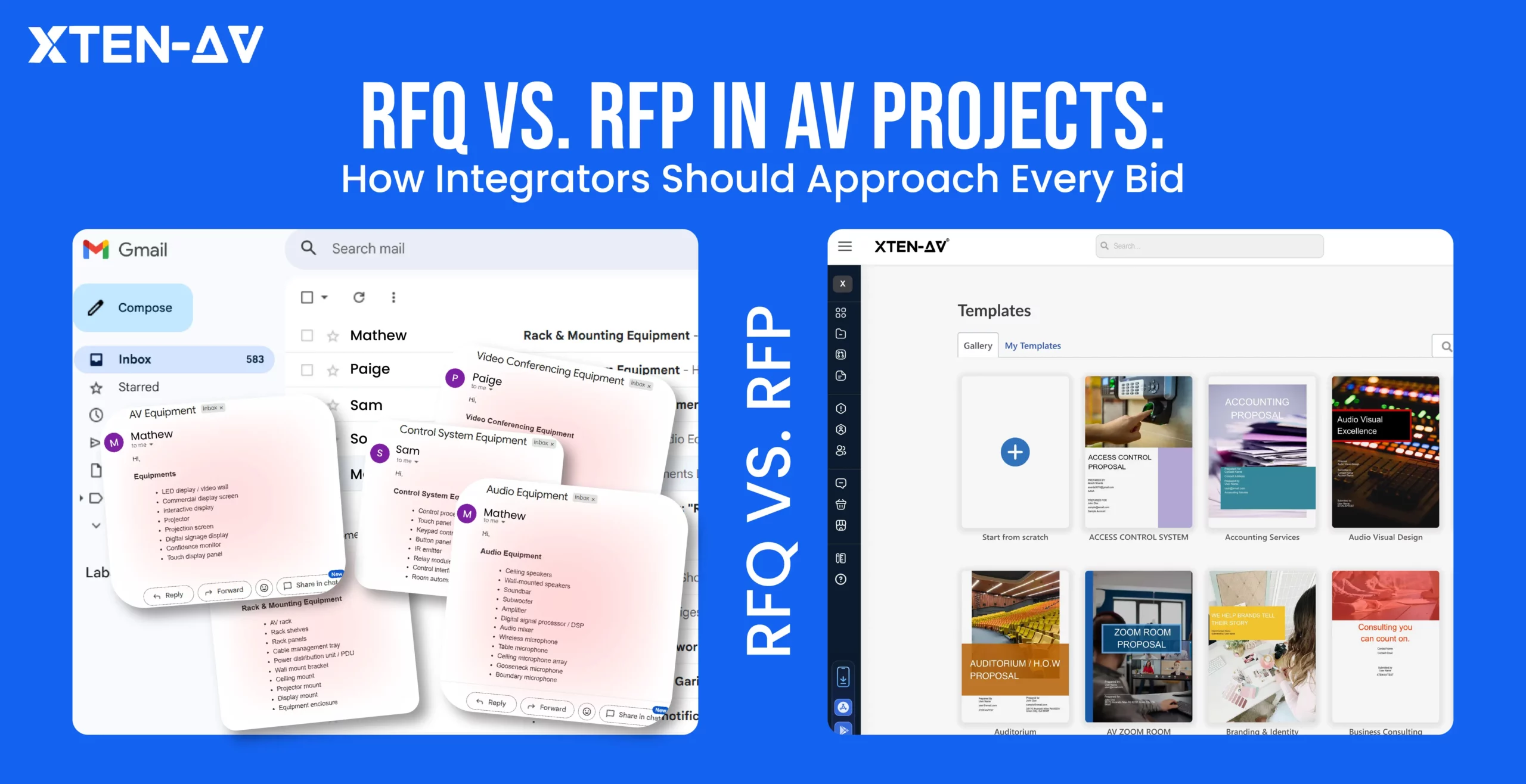


You get the email on a Tuesday. A potential client: an institution, a government department, or maybe a corporate facility manager sends you a list: laser projector, control processor, seamless switcher, touch panel, wireless mic system, amplifier, surface mount speakers. The note at the bottom says: “Please provide your best pricing.”
No room size, functional requirements, signal flow, mention of whether the space needs HDBT runs or fiber, DSP requirements, or BMS integration. Just: price this.
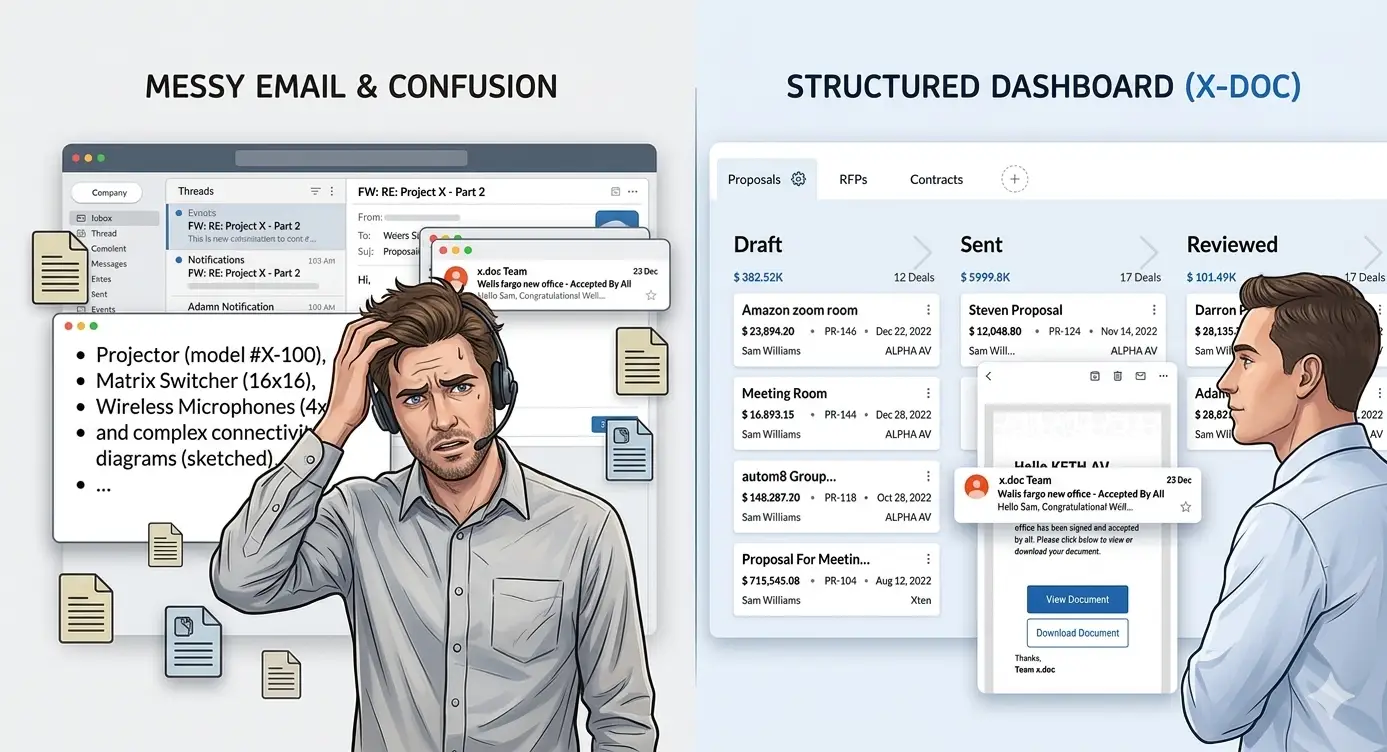
The challenge isn’t just incomplete information, it’s knowing whether you’re being asked to quote or to propose. In AV projects, the difference between an RFQ and an RFP isn’t just terminology, it directly affects your margins, your risk exposure, and your win rate.
This is where most AV firms quietly bleed margin and where an audio visual proposal software like XTEN-AV‘s X-DOC pays for itself. It gives your team a structured, repeatable proposal workflow so every bid goes out structured, complete and professional.
This guide gives you the framework to tell the difference and win more bids because of it.
Key Takeaways:
RFQ = pricing. The client provides a predefined BOM and your role requires you to create an accurate quotation while you check for missing project boundaries.
RFP = Solution exercise. The client establishes their desired outcomes which you must achieve through your design of an entire AV system solution.
Misidentification of RFQs and RFPs results in margin losses for our company. The practice of treating an incomplete RFQ as final scope leads to hidden cost expenses that occur throughout project execution.
RFPs are not won on price alone. The evaluation criteria give more importance to technical approach, design thinking and compliance than to project costs.
Scope validation is essential for both situations. The absence of cabling, commissioning and programming work leads to financial losses from profitable bids.
Structured proposal workflows improve win rates. Standardized processes guarantee that all bids maintain complete and professional appearance throughout their entire presentation.
Top AV integrators don’t just respond, they qualify. Asking the right pre-bid questions can shift you from vendor to strategic partner.
The all-in-one solution for your Audio Visual (AV) Proposal needs
Transform your audio-visual experience with XTEN-AV.
No Credit Card required
What Is an RFQ in AV Projects?
An RFQ in AV (Audiovisual) stands for a Request for Quote. The document functions as a structured procurement document which businesses use to request price quotations from AV suppliers, integrators and contractors for specific audiovisual equipment and installation and service needs.
In many AV project bidding scenarios, RFQs appear straightforward but in reality, they often lack the detail required to build an accurate and risk-free proposal.
In practice, the AV RFQ includes a BOM which contains exact SKUs and manufacturer part numbers together with a basic installation scope and a deadline for submission. The client already knows what equipment they want, they just need your pricing.
RFQ validation checklist for AV integrators:
- Is the BOM complete with exact SKUs and part numbers?
- Are cable paths, conduit runs, and infrastructure included?
- Is rack design and build-out accounted for?
- Are programming and commissioning explicitly scoped?
- Are project timelines realistic given your team’s current load?
If you’re checking ‘no’ on two or more of these, you’re not looking at a clean RFQ, you’re looking at a scope transfer in progress.
When an RFQ Makes Sense
RFQs work well for:
- small-scale installs: a single conference room, a classroom display upgrade, a boardroom mic system replacement.
- repeat or standardized deployments: where a client is rolling out the same AV kit across multiple locations using a design they’ve already locked.
- add-on work to an existing project: where the scope is tightly defined, an RFQ is often the fastest and most efficient format.
The Real Risk of RFQs
Here’s where integrators consistently get into trouble: the RFQ shifts execution risk onto the integrator. If the client’s BOM is incomplete: missing cable runs, rack accessories, signal extenders, or commissioning scope and you price exactly what’s listed, you’ll win the bid and then spend the next three months absorbing every line item that wasn’t in the original list.
That Tuesday email with the equipment list? That’s not an RFQ. That’s a shopping list with no scope attached. The moment you price it as though it were a complete specification, you’ve taken on responsibility for everything that’s missing from it.
This is exactly the scenario X-DOC is built for catching scope gaps before they become a change of orders.
What Is an RFP in AV Projects?
An RFP (Request for Proposal) in AV is a formal document created by a client to solicit detailed proposals, equipment lists, and pricing from Audio-Visual vendors for a specific event or installation. The document defines project boundaries, goals, requirements and funding needs to help assess the value of competing proposals.
In real-world AV environments, this goes beyond equipment. It includes usability, staff training, scalability, and long-term performance
The strong AV RFP clearly defines space requirements which describe how many people will use the space, what activities will take place in it, what users will experience and which activities will occur during the project. The document may establish requirements that reference AVIXA standards, require personnel to hold CTS certification, mandate adherence to HDBaseT 2.0 and Dante networking protocols.
Government and institutional clients: universities, school districts, municipal departments almost always use RFPs for any significant AV investment. If you want to serve these markets consistently, understanding how to read and respond to an RFP isn’t optional. It’s the baseline.
What evaluators actually score in AV RFPs?
Most AV integrators focus on getting the equipment list right. The evaluators on the other side are scoring something different:
- Technical compliance: 30–40%
- Project approach and design thinking: 20–30%
- Team experience and certifications: 10–20%
- Price: 20–30%
In most competitive bids, price is the smallest factor. Your technical approach and how you’ve demonstrated you understand the space, that’s what wins or loses it.
What a Good RFP Includes
A well-constructed RFP gives you
- Functional requirements: define system needs that must be present in the system.
- Project scope: includes installation commissioning, training and warranty period.
- Evaluation criteria: establish a scoring system which uses price, technical approach, past experience and team qualifications to assess submissions.
- Timeline: includes submission deadline, award date and installation window.
- Vendor qualification standards: requiring certification (CTS, Extron, Crestron, Dante), insurance minimums and licensing standards.
If you’re building from scratch, start with how to write a winning project proposal.
Government and higher education clients: universities, school districts, municipal departments almost always issue RFPs for any significant AV investment. So do large enterprise clients with IT governance processes. If you want to serve these markets, you need to know how to read and respond to an RFP.
The all-in-one solution for your AV needs
Transform your audio-visual experience with XTEN-AV.
No Credit Card required
RFQ vs. RFP in AV: Key Differences at a Glance
The difference between an RFQ and an RFP in AV projects is very clear: An AV RFQ asks for pricing. An AV RFP asks for a complete solution.
An RFQ asks: how much does this cost? An RFP asks: how would you solve this?
The distinction matters because your entire response strategy changes depending on which format you’re working with.
Factor | RFQ | RFP |
Scope Definition | Predefined by client | Defined collaboratively or outcome-based |
Integrator Role | Price provider | Solution designer & strategic partner |
Flexibility | Low, price what’s listed | High, propose best-fit design |
Risk Allocation | Integrator absorbs scope gaps | Shared; requirements are negotiated upfront |
Evaluation Criteria | Price only | Price, design quality, experience, approach |
Response Format | Equipment list + cost | Full proposal with scope, design, timeline |
Common Use Case | Simple, well-scoped installs | Complex commercial/enterprise/gov projects |
The AV bid response framework: How Should AV Integrators Respond to Each?
Knowing the difference between an RFQ and RFP is step one. Knowing how to respond to each consistently, professionally, and in a way that protects your margins, is where firms actually separate themselves.
Responding to an RFQ
Don’t just price the list. Before you submit a number, do the following:
- Validate the scope: Is this BOM complete? Does the equipment list account for signal distribution, cable infrastructure, rack build-out, and commissioning labor? If not, flag it.
- Identify scope gaps: identify missing elements which will create future responsibilities for you. The missing requirement needs to be documented as a new line item which requires specific explanation.
- Protect your margins: document your assumptions clearly to prove the validity of your pricing, this protects margins.
- Clarify before submitting: Asking 2 or 3 specific questions through email takes 20 minutes but will protect you from six months of trouble.
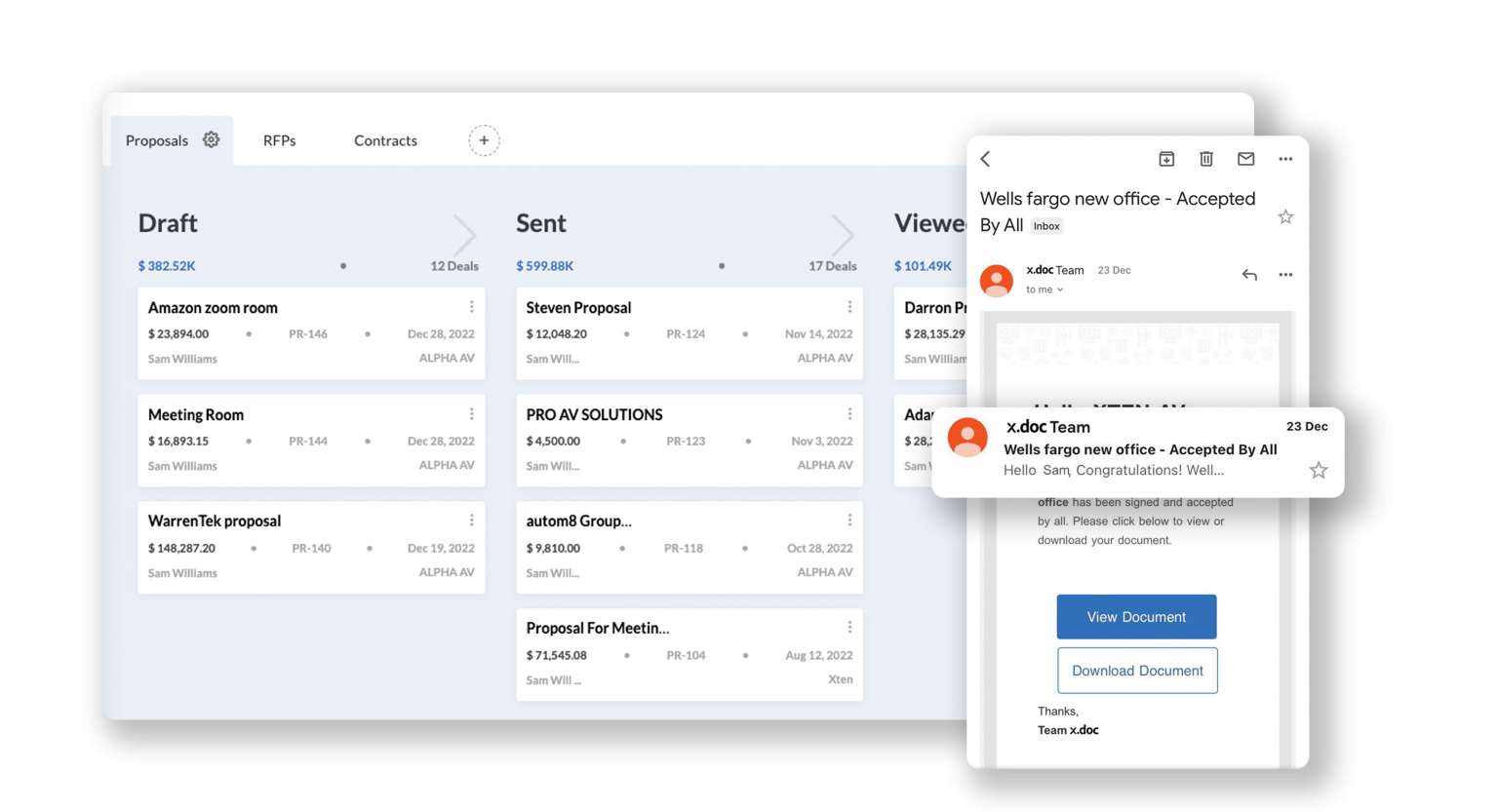
High-performing teams establish their AV proposal management workflows through standardized methods which they operate using XTEN-AV X-DOC tools to achieve proper evaluation criteria matching for all their responses.
Responding to an RFP
RFP responses require a structured approach. This is not the time for a two-page quote PDF.
- Lead with your design thinking: Before listing equipment, explain how you’ve interpreted the functional requirements and how your proposed design addresses them. This is what separates you from a commodity supplier.
- The response needs to follow this structure: provide an executive summary which needs to be followed by a proposed solution, an equipment schedule, the scope of work, project timeline, team qualifications and references.
- Align with the evaluation criteria: The RFP requires 40% of evaluation to use technical approach evaluation, so you need to dedicate 40% of your work to that aspect. Your evaluation should not focus excessively on price.
- Include programming and commissioning detail: Government and institutional clients require you to provide system performance validation methods, which needs to be proven through testing before your departure from the site.
When You Can’t Tell Which One You’re Looking At
Hybrid situations are common. A client sends a partial equipment list but also asks you to “suggest anything else we might need.” Or you receive what looks like an RFP but with no evaluation criteria and no stated functional requirements. In these cases, clarify before you respond. A single discovery call or a structured pre-bid questionnaire will tell you everything you need and it positions you as the most thorough, professional firm they’ve engaged with.
This is why many AV teams are moving toward more structured proposal workflows to ensure every response is consistent, complete, and aligned with the project requirements regardless of who is preparing it.
Common Mistakes AV Bid Managers Make in RFQ and RFP Responses
Most AV firms don’t lose bids on pricing. They lose on compliance, structure, and presentation and they rarely know it. AV Proposal process mistakes to avoid:
1. Treating an RFP Like an RFQ
Responding to a design-based RFP with a price list and a BOM is one of the fastest ways to lose a competitive bid. Institutional evaluators are often scoring your response against a rubric. If your submission doesn’t address the sections they’re scoring, you’re not losing on price, you’re losing on compliance.
2. Not Clarifying Scope Before Submitting
Every assumption you make during the bid stage becomes a risk during installation. If the RFQ doesn’t specify conduit runs, assume you’ll need them and document the assumption. If the RFP is vague about programming scope, ask. Silence is not protection, it’s liability.
3. Ignoring End-User Experience
AV proposals that focus entirely on equipment specs and skip over user experience almost always underperform. Who is using this system? How technically confident are they? What happens when something goes wrong at 8:58 AM before a 9:00 AM board presentation? If your proposal doesn’t answer these questions, your competitor’s will.
4. Poor Proposal Structure
A well-specified system loses to a better-structured proposal more often than people in this industry want to admit. Evaluators especially in government and higher education read dozens of submissions. A document that buries the technical approach on page 12, uses inconsistent formatting, or omits a cover page signals that your project management will look the same way.
5. Reusing Outdated Templates
An AV proposal template that references legacy equipment, outdated AVIXA standards, or a boilerplate scope that doesn’t match the actual project is worse than no template at all. It tells the client, you’ve copy-pasted someone else’s project into their submission. Refresh your templates every cycle. Better yet, stop treating proposals as one-off documents. Build them from live project data and they’ll never be stale.
If you recognize your team in two or more of these, the issue isn’t that your people don’t know AV. It’s that your process isn’t built to translate what they know into a winning submission, which is why it makes more sense for the leading integrators to adopt a well-structured solution, like the one offered by X-DOC.
How to Write Effective RFQ and RFP Responses with X-DOC
At this point, the gap becomes clear: AV teams do not lose their bids due to lack of expertise but because they can’t consistently translate that expertise into structured, professional proposals.
In most AV firms, proposal creation looks like this: export the BOM to a spreadsheet, copy it into Word, write the scope from scratch, export to PDF, realize something’s missing, start over. Every proposal takes longer than it should and looks slightly different from the last one.
The structured proposal workflow delivers competitive benefits to the organization because it serves as more than an internal efficiency solution.
What Structured AV Proposal Workflow Actually Looks Like
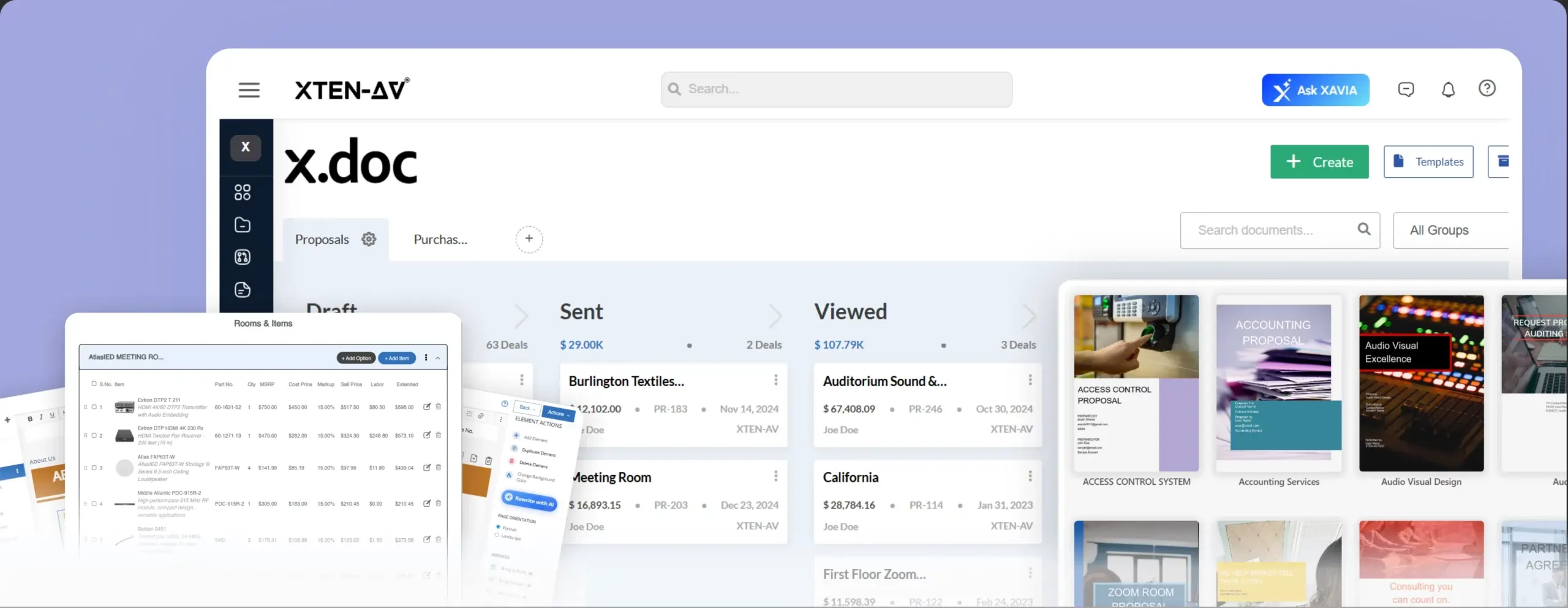
XTEN-AV’s X-DOC is built specifically for the Pro AV documentation and proposal workflow. It solves core operational problems which prevent AV companies from winning bids that they should win.
Rebuilding proposals from scratch on every project: No more starting from zero: X-DOC gives you a reusable proposal structure that’s already branded, already formatted, and built around your actual project scope, not a generic template you found online.
Inconsistent formatting across submissions: Every proposal that goes out the door looks the same: professional, structured, and aligned with the scope of the project it’s responding to.
Missed scope details: A structured documentation workflow enables complete capture of commissioning scope and training scope and warranty terms which employees would otherwise neglect during rushed word document creation.
Slow turnaround on competitive bids: Faster turnaround when it matters: When a bid deadline is 48 hours out, a proposal tool that plugs into your existing workflow isn’t a luxury, it’s how you stay in the race.
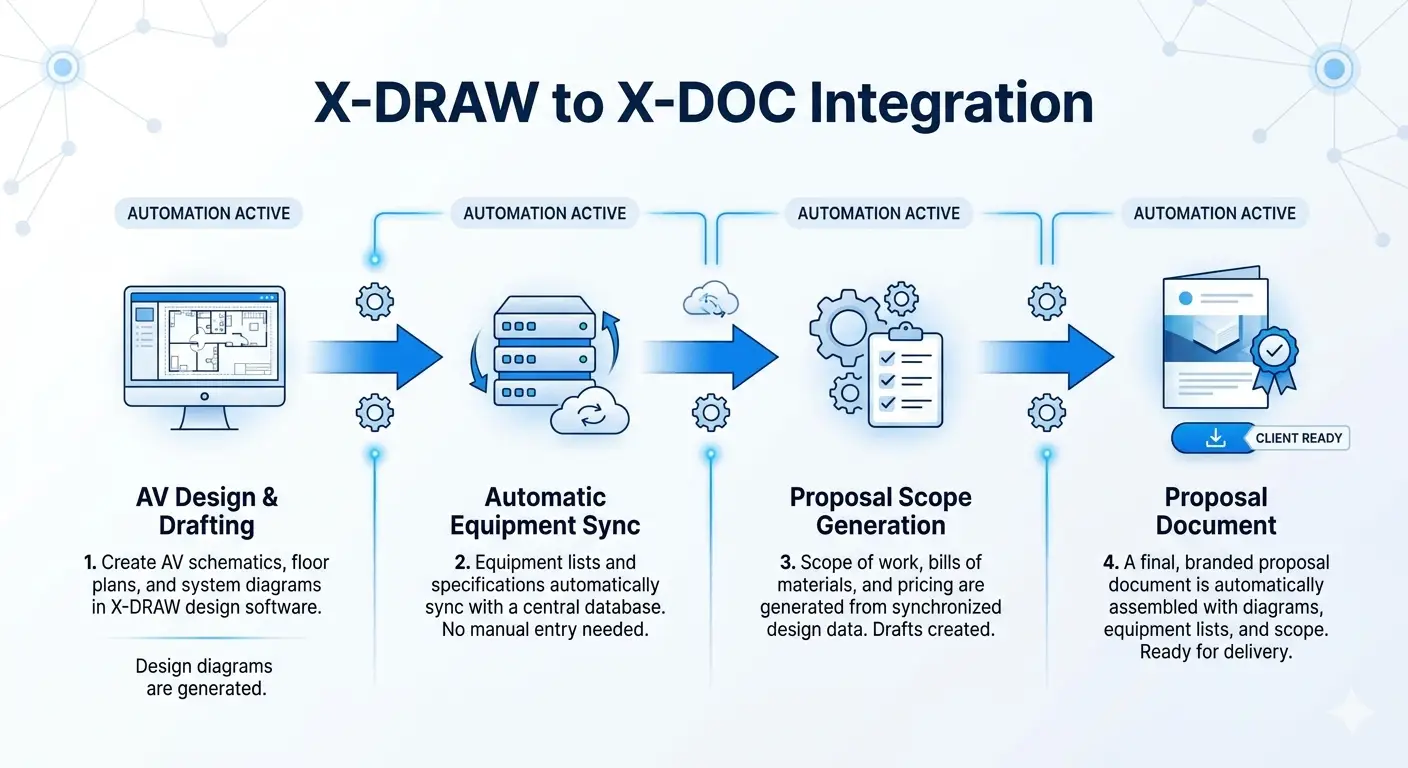
X-DRAW into X-DOC: Design-to-Proposal Continuity
One of the most common disconnects in AV project workflow is between the design phase and the proposal phase. A designer finishes signal flow diagrams and line schematics in traditional CAD tools, and then someone else has to manually translate that work into a proposal document: re-entering equipment, re-writing scope, hoping nothing gets lost in the handoff.
X-DOC integrates with X-DRAW so that the design work your team produces feeds directly into the proposal structure. The equipment you’ve specified in the design stage populates the proposal. The scope you’ve defined in the signal flow becomes the documentation. The proposal your client receives reflects the actual design, not a summarized version of it reconstructed from memory.
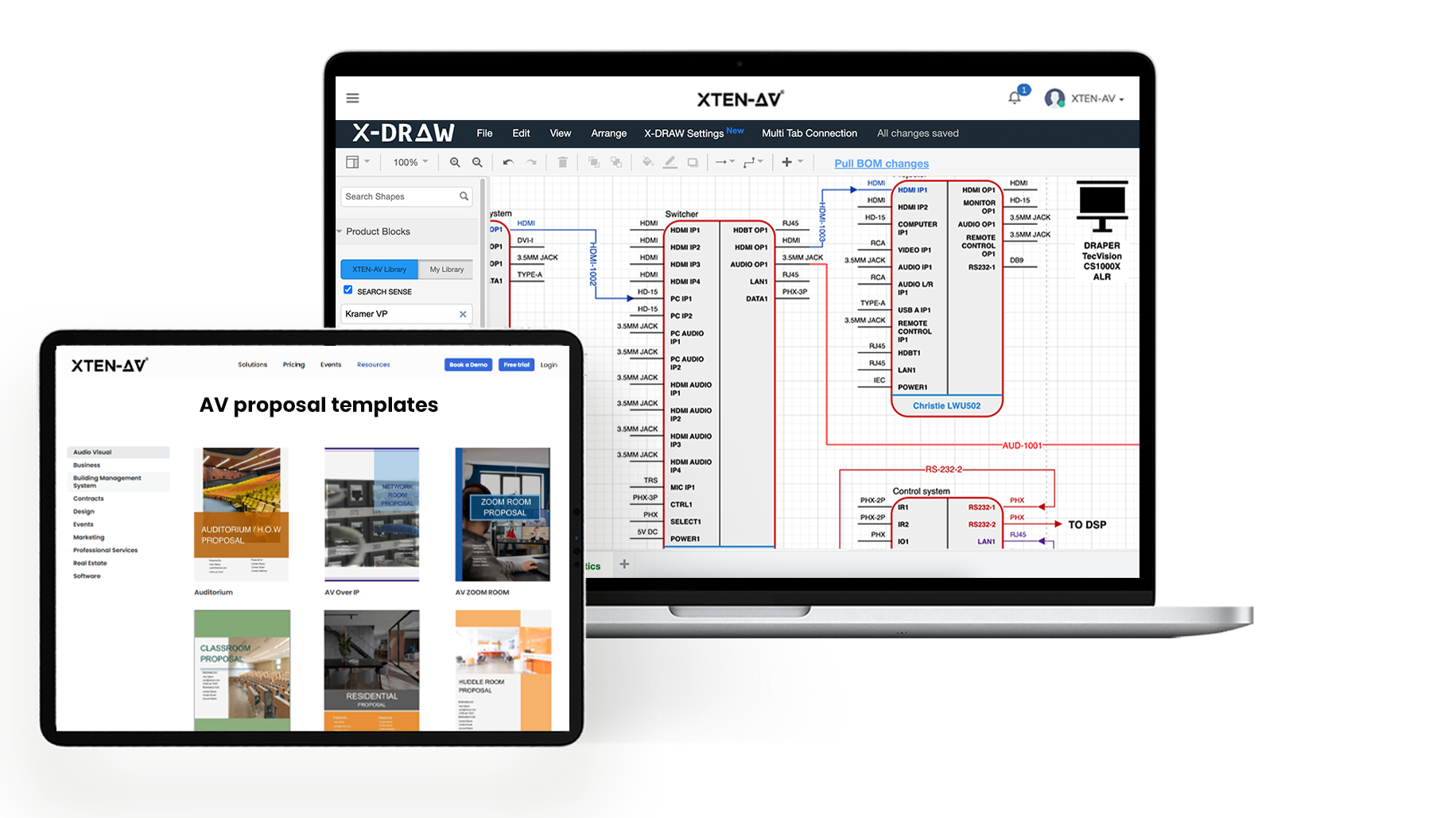
AV Design Mastery + Winning Proposals = 10x Productivity!
- ✔ Automatic Cable Labeling & Styling
- ✔100+ Free Proposal Templates
- ✔ Upload & Create Floor Plans
- ✔1.5M Products from 5200 Brands
- ✔ AI-powered ‘Search Sense'
- ✔Legally Binding Digital Signatures
Conclusion
Winning AV bids consistently isn’t just about knowing your equipment or having competitive pricing. It requires asking the right questions before the scope is locked, defining that scope clearly and completely, and presenting your solution in a way that demonstrates on paper that your firm is the most prepared, professional, and trustworthy option in front of that evaluator.
The RFQ vs. RFP distinction is the starting point. But the integrators who win the most competitive bids aren’t just the ones who understand the difference, they’re the ones who have a process that produces strong responses to both, every time, without burning out their team.
You’re not just bidding. You’re being evaluated. The proposal your company delivers shows the methods your team will use to complete the project.
If your team is still building proposals in Word and Excel, copying BOMs by hand, rewriting scope from scratch every time, hoping nothing gets missed, you’re competing against firms that have already solved this. The gap compounds with every bid.
See how X-DOC works or book a demo and walk through it with your actual project scope.
FAQ's
An RFQ in AV projects is a document where the client provides an equipment list and asks integrators to submit pricing. The system is designed to work best in situations when clients need cost estimates for their completed project designs which already have specific requirements.
An RFP (Request for Proposal) in AV is a procurement document in which the client describes the functional requirements of a project and asks integrators to propose a complete solution. The RFP requires the integrator to provide design expertise together with project scope details and a complete solution that meets all project objectives which extends beyond equipment requirements
An RFQ requests pricing information which depends on specific equipment that has been previously defined. An RFP requires a complete solution which must meet all specified functional requirements. Each system presents unique requirements for its response format and strategic approach and risk management methods.
While responding to an AV RFP, one should keep the following in mind:
- The evaluation criteria require a complete response through a structured document which must address all assessment sections.
- Your equipment list should follow your design approach and functional solution explanation.
- The project needs a defined scope of work and a complete commissioning plan together with a detailed training scope.
- Your response needs to match project objectives while you maintain professional and consistent formatting throughout your work.
The selection of the better option becomes impossible because project requirements determine which format should be used. RFQs work well for straightforward, well-scoped installations where the design is already defined. RFPs become more suitable for complex AV projects which need commercial or enterprise or government solutions when clients require integrators to provide design and solution development services.
The AV proposal needs sufficient length to communicate three essential elements which include system design, scope of work and project approach details to the reader. The typical RFQ proposal requires shorter content which concentrates on pricing details. The RFP proposal requires detailed content which follows a specific structure that varies between 10 and 30 pages based on project complexity and evaluation needs.
The AV RFP response contains an executive summary together with a proposed system design which includes equipment specifications, a complete equipment schedule, a scope of work, programming details, commissioning plan, end-user training approach, project timeline, team qualifications, certifications, past project references and total cost assessment. The response should be structured to align with the evaluation criteria stated in the RFP.
Explore more by topic
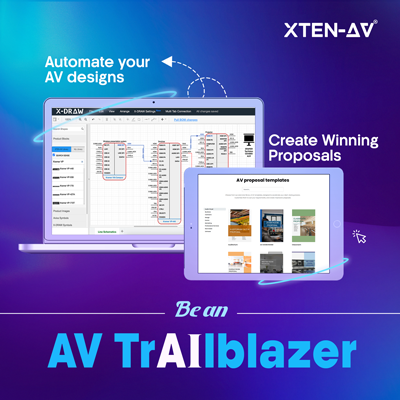
AV Design Mastery + Winning Proposals = 10x Productivity!
- Automatic Cable Labeling & Styling
- 100+ Free Proposal Templates
- Upload & Create Floor Plans
- 1.5M Products from 5200 Brands
- AI-powered ‘Search Sense'
- Legally Binding Digital Signatures
No Credit Card Required
Related Blogs
-

- Posted by Sahil Dhingra

Audio Visual 10 Best draw.io Alternatives for AV Professionals Sahil Dhingra Published...
-
- Posted by Sahil Dhingra
Audio Visual 7 Best Schematic Drawing Software for AV System Integrators Sahil...

-
- Posted by Sahil Dhingra
Audio Visual Auditorium Sound System Design: Complete Guide to Acoustics, Speakers &...