









How XTEN-AV Helped Tech Electronics Scale to 20+ Million-Dollar AV Bids Without Growing Headcount
How XTEN-AV Helped Tech Electronics Scale to 20+ $1 million AV Bids Without Growing Headcount
At a Glance
$1 million projects
Zero before XTEN-AV, eight completed last year, twenty bid this year.
Manual data re-entry
Eliminated.
Annual revenue growth
Double-digit for eight consecutive years.
Submittal package assembly
Automated.
Engineering headcount
One addition across several years of growth.
Cross-department collaboration
Strengthened across engineering, sales & operations.
There’s a breaking point most AV integration firms don’t see coming. Projects are larger. Scopes are more complex. Rebids on the same job, once rare, are now routine in the construction channel. And engineering teams, the same size they were five years ago, are expected to absorb all of it.
Most firms respond by working harder with the same tools and processes they’ve always used. That works, until it doesn’t. At some point, disconnected workflows stop being a minor inconvenience and start costing real time and real money.
Tech Electronics hit that point. Instead of scaling through headcount, they fixed the workflow underneath their team. The result: zero $1 million AV projects before, eight completed last year, and twenty bid this year, with essentially the same pre-sales engineering team.
“The ROI happens extremely fast,” says Joe Dorsey, Technology Director at Tech Electronics. “I wish I had tried this five years ago.”
Here’s how they did it.

Tech Electronics is a top AV and low-voltage integrator headquartered in St. Louis, Missouri, with seven offices across five states. They serve commercial, education, healthcare, hospitality, and transportation clients, with an AV scope spanning conference rooms, video walls, digital signage, professional audio, and mass communications, across both the construction channel and the direct end-user market.
Joe Dorsey leads product evaluation, estimating strategy, and engineering quality across the AV division. Over the past eight years, Tech Electronics has posted double-digit revenue growth annually, and their average deal size has roughly doubled. Their pre-sales engineering team has stayed nearly the same size throughout.
Tech Electronics’ challenge isn’t unique to them. AVIXA projects the global AV market will cross $400 billion by 2030, driven by hybrid workspaces, digital signage, collaboration technology, and AV-over-IP. More projects, bigger deal sizes, and more complexity are landing on engineering teams that haven’t grown at the same pace.
A few forces are compounding at once. AV-over-IP has replaced traditional matrix switching as the default design standard, meaning more sophisticated drawings and longer documentation per project.
“It’s not a maybe. It’s here” Dorsey says.
Average deal sizes are climbing as AV converges with IT and building systems. Rebids, once rare, are now common in construction, sometimes four or five times across a single project’s lifecycle, each one requiring full engineering time. And AV increasingly overlaps with fire and security systems, adding coordination overhead most teams weren’t built for.
Layer on an industry-wide shortage of experienced engineering talent, and growing project volume without proportionally growing headcount stops being a preference and becomes a necessity.
Before adopting XTEN-AV’s AV system design software, Tech’s AV design happened in one tool, estimating in another, and their ERP sat separate from both, with data manually re-entered at every stage.
“We really didn’t have any design tool that directly shared our integrated data with our ERP systems,” Dorsey says.
Beyond the re-entry burden, every project started from scratch. Repeatable system types, conference rooms, distributed audio, digital signage, got rebuilt from zero each time. Institutional knowledge lived in individual engineers’ heads instead of a shared system.
“We were starting at square one on every project,” Dorsey says. “I knew there had to be a better way.”
This isn’t unique to Tech Electronics. It’s the default state for most AV firms that built their workflows tool by tool over the years. Each tool works fine on its own. Without something connecting them, they create friction: re-entry errors, version mismatches, hours lost on data that should move automatically. Across a full year of bids, that friction adds up fast.
Tech Electronics wasn’t looking for a single tool to swap in. They needed design, estimating, procurement, and project delivery to work together, with product data flowing from engineering into procurement and ERP without manual re-entry. They needed AV estimating software that worked in tandem with documentation software, generating deliverables automatically instead of by hand. And they needed a way to start from proven, reusable designs instead of rebuilding from scratch, without forcing a rigid process onto how they already operated.
“I immediately thought there’s got to be a better way, from a business process and engineering perspective, to start at square five on repeatable projects,” Dorsey says. “I also knew there had to be a bidirectional linkage between design and build materials, design and ordering, design and project management.”
Dorsey evaluated multiple AV project management platforms before landing on XTEN-AV. He needed a cloud-based environment his team could access anywhere, design tools connected directly to estimating and ERP data with no manual bridges, and a system built to store and reuse proven designs.
He also needed a vendor willing to work the way Tech Electronics worked.
“What stood out about XTEN-AV was their willingness to adapt to our requirements and support the way we operate. They understood our workflow, our data flows, how we operate,” Dorsey says.
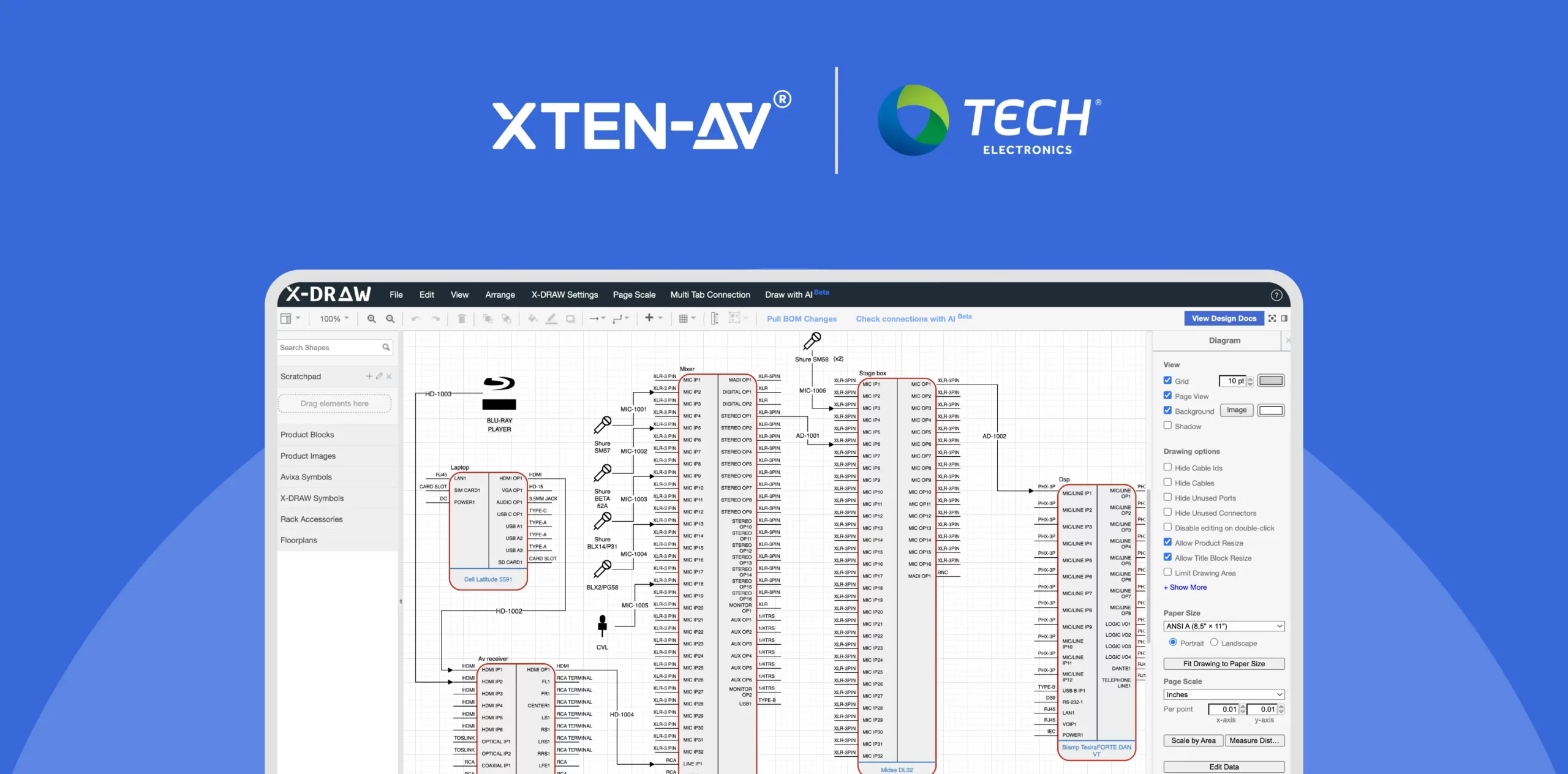
XTEN-AV is a cloud-based AV workflow automation platform for professional integrators. Its core module, X-DRAW, is a design and documentation tool that connects design outputs to estimating, real-time pricing, submittal generation, and ERP data flow, linking the entire project lifecycle in one environment instead of stitching separate tools together.
The ongoing relationship sealed it.
“You handle this like a software development organization with a rolling roadmap,” Dorsey says. “It wasn’t a one and done.”
“Starting at square six instead of square one on repeatable designs, that’s a big one” — Joe Dorsey
The result: more bids in less time, fewer errors baked into the starting point, and institutional knowledge stored in the platform instead of locked in individual engineers’ heads.
“We eliminated a lot of those roadblocks from a data flow perspective,” Dorsey says. “That alone is probably worth the investment we made.”
Less re-entry means fewer errors, and engineers spending time on engineering instead of data wrangling.
“Having that heartache, that laborious process of ensuring we have up-to-date pricing was enormous,” Dorsey says. “Now that’s on your side. The platform does that for us.”
“Your submittal module lets us quickly create all the spec sheets in the file. This saves a lot of work, and it frees up our team to focus on areas where they can add more value,” Dorsey says.
“Having the ability within our organization to collaborate a little bit better on how we got here, what products we’re using, how we explain a project, it helps us collaborate better internally,” Dorsey says.
When sales can see the engineering work, they present with more confidence. When operations understands design intent, handoffs tighten and delivery quality goes up.
Tech Electronics’ starting point wasn’t unusual. Disconnected data, manual re-entry, repeatable work rebuilt from scratch, that’s most AV integration firms today. A few principles apply broadly:
Read More
Disconnected data is a growth ceiling. When design, estimating, and ERP live in separate systems, every project carries hidden re-entry labor that compounds as volume grows.
Reusable designs are a business strategy, not a shortcut. Starting from proven templates protects institutional knowledge and makes experienced engineers more productive.
Documentation is throughput, not overhead. Submittal packages get built either way. The question is whether engineers build them by hand or a platform assembles them automatically.
Headcount isn’t always the answer. Before adding engineers, it’s worth asking whether the existing team has the infrastructure to operate at full capacity. Often the constraint is workflow, not people.
The vendor relationship matters long term. A platform embedded in daily operations has to evolve with the business. Responsiveness and sustained development matter more over time than any single feature at the point of purchase.
The clearest measure of what changed at Tech Electronics is a project count. Before XTEN-AV: zero AV projects over $1 million. Last year: eight completed.
“If you ask how many $1 million projects we did before using XTEN-AV, zero. How many did we do last year? Eight,” Dorsey says.
This happened with essentially the same pre-sales engineering team, one additional hire across multiple years of double-digit revenue growth.
Tech Electronics went from zero $1 million AV projects to twenty bid in a single year, without dramatically expanding their engineering team. They did it by fixing the infrastructure underneath the team they already had.
“The ROI happens extremely fast,” Dorsey says. “I wish I had tried this five years ago.”
If your team is spending too much time on manual documentation, disconnected systems, or rebuilding designs from scratch, that’s exactly the problem XTEN-AV was built to solve. Explore how Tech Electronics transformed AV system design. Watch the client testimonial and discover the impact firsthand.
See how XTEN-AV helps you design and deliver AV projects faster.
Scale Your AV Business Without Scaling Your Workload
See how XTEN-AV helps AV integrators streamline design, automate documentation, and handle larger projects with greater efficiency.