









Multi-room AV projects become difficult to control when the BOM is managed separately from the design. A display may belong to the boardroom, a DSP may support multiple zones, and a mount or cable may be added during revision but never assigned to the right room. When this tracking happens in spreadsheets, AV teams spend more time checking lists than designing systems.
A room-wise AV BOM gives integrators a clearer way to organize products by room, floor, or zone. Instead of managing separate Excel tabs for the lobby, boardroom, ballroom or Floor 2, AV teams can use area-based design workflows to keep equipment connected to the spaces where it will be installed.
This guide explains how room-wise AV BOM management works, why spreadsheets break down in complex projects and how X-DRAW Areas helps AV teams organize products by area directly inside the design workflow.
Key Takeaways
- AV BOM management becomes difficult when spreadsheets detach equipment data from the physical spaces where systems are actually deployed.
- A room-wise structure improves accuracy by anchoring each AV device to defined installation areas such as meeting rooms, lobbies, floors, and zones.
- Traditional spreadsheet workflows struggle with iterative design changes, often resulting in version drift, duplicated entries and unclear equipment ownership across project updates.
- Area-based design resolves this by unifying drawings, equipment schedules, and documentation within a single spatial framework that reflects real project execution.
- AI powered BOM management Platforms like X-DRAW by XTEN-AV support this approach by integrating room, zone and floor-level structuring directly into the AV design workflow.
The all-in-one solution for your Audio Visual (AV) Project Design & Documentation needs
Transform your audio-visual experience with XTEN-AV.
No Credit Card required
What Is a Multi Room-Wise AV BOM?
A multi room-wise AV BOM is a bill of materials organized by the rooms, zones, floors, or areas where AV equipment will be installed. It helps AV integrators see which displays, speakers, mounts, cables, control devices and accessories belong in each project space.
An AV BOM (Bill of Materials) is the equipment list used to document all products required for an AV installation, including displays, DSPs, microphones, speakers, control systems, racks, mounts, and cabling.
Flat AV BOM vs Room-Wise AV BOM
A flat AV BOM lists all AV products together. A room-wise AV BOM organizes equipment based on where it will be deployed inside the building.
Flat AV BOM | Room-Wise AV BOM |
10 × 98-inch Displays | Board Room → Samsung 98-inch 4K Display |
24 × Ceiling Speakers | Lobby → JBL Ceiling Speakers |
6 × Touch Panels | Training Room → Q-SYS 10-inch Touch Panel |
2 × DSP Processors | Floor 2 Conference Suite → Biamp Tesira DSP |
3 × PTZ Cameras | Classroom 201 → Cisco PTZ Camera |
A flat BOM shows what equipment is included in the project.
A room-wise AV BOM shows where each product will be installed.
Why Room-Wise AV BOMs Matter
In multi-room AV projects, equipment is deployed by room, floor, and zone rather than as one large inventory list.
For example:
- Board Room may use a Samsung 98-inch display with Shure ceiling microphones
- the Lobby may require digital signage and background audio
- the Training Room may use Epson laser projection with Q-SYS control
- Classroom spaces may share DSP infrastructure across multiple floors
Without room-level organization, AV teams often spend extra time checking spreadsheets, AV drawings, and floor plans to confirm product placement during procurement and installation.
This approach is commonly used in enterprise, hospitality, education, and government AV projects where multiple rooms and repeated layouts create more coordination complexity.
Learn how AV teams streamline equipment selection and BOM creation with automation: XTEN-AV BOM creation guide
Why Do AV Integrators Track BOMs by Room or Floor?
AV integrators track BOMs by room or floor because complex installations require room-level clarity for procurement, staging, installation, documentation, and project handoff. Without location context, teams may know what products are required but not where each product belongs.
In multi-room AV projects, every space may use a different AV setup. A Board Room may require a Cisco Room Kit with Shure MXA920 ceiling microphones, while the Lobby uses Samsung digital signage with JBL pendant speakers. Training Rooms may use Epson laser projection with Q-SYS control, while divisible Ballrooms may share Biamp DSP processing across multiple audio zones.
How Room-Wise AV BOMs Improve AV Procurement
Purchasing teams often organize AV equipment by room, floor, or zone before staging begins.
Project Space | Example AV Equipment |
Board Room | Samsung 98-inch Display with Shure MXA920 |
Lobby | Samsung Signage with JBL Pendant Speakers |
Training Room | Epson Laser Projector with Q-SYS Touch Panel |
Ballroom | Biamp DSP with Wireless Microphone System |
This makes it easier to verify accessories, stage equipment correctly, and reduce wrong-room deliveries during deployment.
How Area-Based AV BOMs Simplify Installation Handoff
Field installers work from AV floor plans, rack elevations, cable schedules, and room-wise equipment lists. Area-based BOMs help teams quickly confirm which devices belong in each room or audio zone.
For example, installers can easily verify:
- which DSP supports the Ballroom
- which touch panel belongs to the Training Room
- which speakers are assigned to the Lobby audio zone
This reduces confusion during installation and commissioning.
Why Floor-Level AV BOMs Matter in Large Buildings
Floor-level BOM organization becomes important in enterprise, hospitality, education, and government AV projects where repeated room types exist across multiple floors, wings, or departments.
Industry | Example Spaces |
Corporate | Board Room, Huddle Room, Reception |
Hospitality | Lobby, Ballroom, Meeting Room |
Education | Classroom Wing, Lecture Hall, Lab |
Government | Council Chamber, Security Room |
This structure gives project managers clearer visibility during revisions and helps clients review AV systems based on real building spaces instead of disconnected spreadsheet tabs.
Still unsure how automation improves accuracy across AV project workflows? Explore the breakdown here: AI-powered BOM automation in AV projects.
Where Do Spreadsheets Fail in Multi-Room AV Projects?
Spreadsheets fail in multi-room AV projects because they separate the BOM from the AV drawing. When designers revise products, rooms, or quantities, the spreadsheet must be manually updated, which increases the risk of outdated data, duplicate entries, unassigned products, and drawing-to-BOM mismatches.
The problem is not that Excel cannot store data. The problem is that spreadsheets do not understand the relationship between an AV device, its drawing location, its room assignment, and its installation workflow.
In real AV projects, this usually creates issues during revisions. A Crestron control processor may appear in the rack elevation but never get added to the BOM. A PTZ camera may still remain assigned to the wrong meeting space after a floor plan update. During procurement, older spreadsheet versions can also create duplicate ordering and incorrect room-level staging.
Spreadsheet-Based AV Planning vs Area-Based AV Planning
Spreadsheet Workflow | Area-Based Design Workflow |
Products tracked manually in Excel | Products organized by area inside the design |
Room tabs updated separately | Areas exist inside the design project |
Design revisions require spreadsheet edits | BOM stays tied to project areas |
Unassigned items can be missed | Unassigned products are captured for review |
Field teams cross-check multiple files | Teams review drawings and products by area |
In large AV deployments, spreadsheet workflows often lead to:
- Excel tab sprawl across rooms and floors
- manual copy-paste mistakes
- version control conflicts
- incorrect room assignments
- devices added to drawings but missing from procurement
- products listed in the BOM but missing from AV plans
These issues create extra verification work for procurement teams, project managers, and field installers during staging, installation, and commissioning.
How Does Area-Based Design Improve AV Project Documentation?
Area-based design improves AV project documentation by connecting drawings, BOM products, rooms, floors, and zones inside the same workflow. This makes it easier for AV teams to review what belongs in each area, reduce manual tracking, and hand off clearer documentation to procurement and installation teams.
This workflow turns rooms, floors, and zones into active parts of the AV design process instead of separate labels in a spreadsheet.
How Area-Based AV Project Planning Connects Drawings and BOMs
In many AV projects, room names, floor plans, and equipment schedules are managed separately. This creates gaps between AV layouts and room-level documentation during revisions.
Connected project workflows keep building spaces linked to their associated layouts, devices and equipment schedules throughout the project lifecycle.
Project Area | Connected AV Documentation |
Board Room | AV Layout + Equipment Schedule |
Lobby | Signage Plan + Audio Coverage |
Training Room | Projection System + Control Interface |
Floor 2 Meeting Suite | DSP Mapping + Room-Wise BOM |
This improves design reviews because engineering teams can validate layouts, equipment assignments, and room-level documentation inside the same project environment.
How Connected AV Project Lifecycles Reduce Manual BOM Reviews
Spreadsheet-based workflows often require teams to compare room lists, AV drawings and equipment schedules after every revision.
Connected design structures reduce that manual effort by keeping products linked to their assigned rooms and zones throughout the project.
This helps teams:
- identify unassigned products faster
- avoid duplicate entries
- maintain alignment between layouts and BOMs
- reduce spreadsheet review time during revisions
How Structured AV Documentation Supports Project Handoff
Procurement teams and field installers require clear room-level documentation during deployment.
Structured AV documentation makes it easier to:
- stage equipment by room or floor
- review installation layouts by area
- verify room-specific equipment schedules
- support cleaner commissioning and delivery
This becomes especially important in hospitality, enterprise, education, and government AV deployments where repeated room types increase coordination complexity across multiple spaces.
How Can X-DRAW Organize Products by Board Room, Lobby, Floor 2 or Zone?
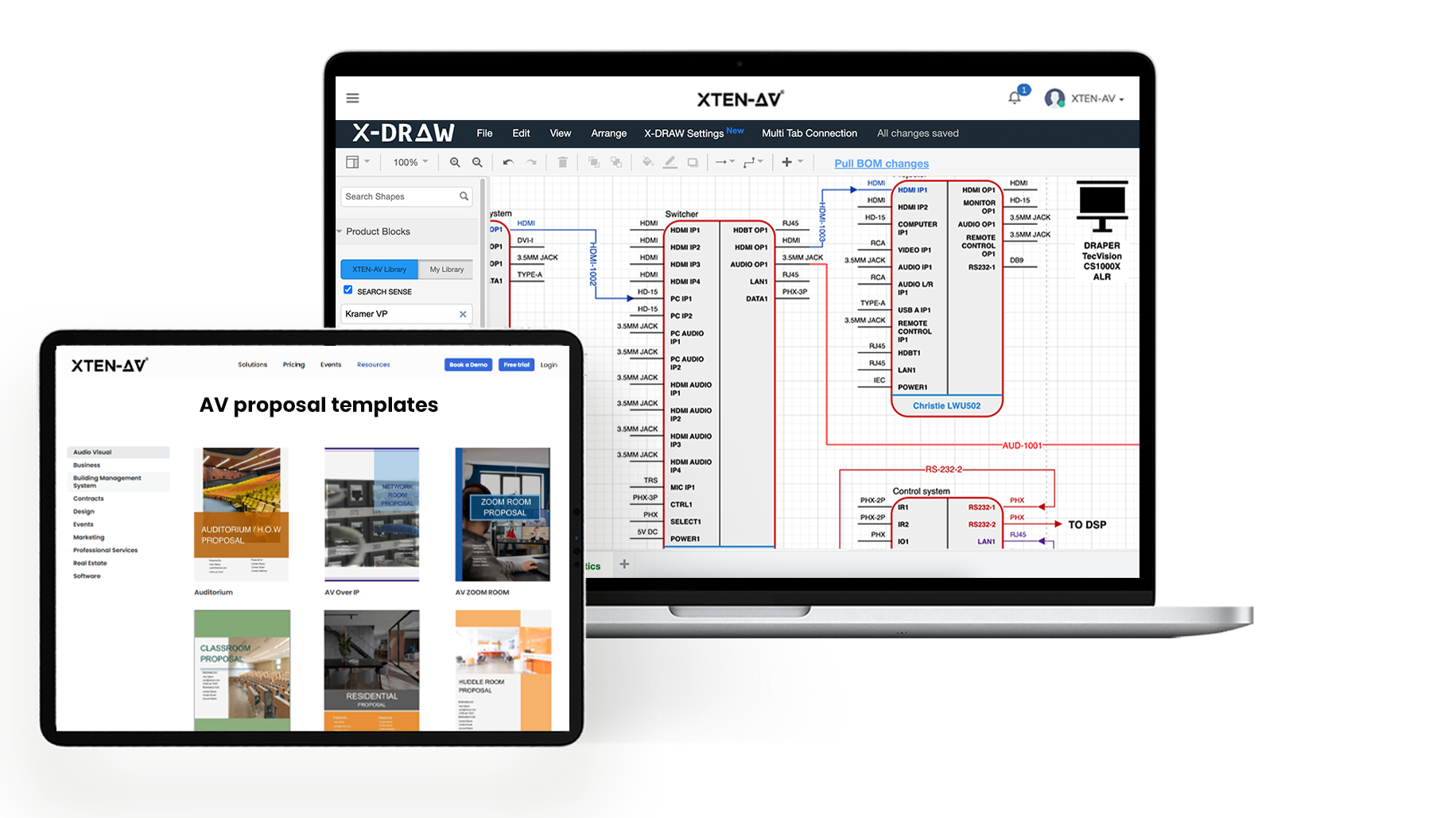
X-DRAW Areas lets AV procurement teams create named areas such as Board Room, Lobby, Floor 2, Training Room or Ballroom inside a single design project. Products in the BOM can be organized by areas and the design can convert into a multi-tab view where each area has its own drawing canvas.
- Create Areas Around Real Project Spaces
Define rooms, floors and zones directly inside the AV design instead of managing separate Excel tabs for each space.
- Assign AV Products by Room or Zone
Organize displays, DSPs, speakers, microphones, mounts and control devices based on where they will actually be installed.
- Keep Drawings and BOMs Connected
Room structures, AV drawings, and BOM assignments stay aligned during revisions without manual spreadsheet tracking.
- Capture Unassigned Products Before Handoff
Identify products added during revisions that are not mapped to a room or floor before procurement or installation begins.
- Review Each Area Through Dedicated Drawing Tabs
Automatically convert the project into a multi-tab view where every room or zone has its own drawing canvas for easier review.
Want to stop managing room-wise AV BOMs in Excel? Organize your AV BOM by area inside X-DRAW!
What Happens to Unassigned AV Products During Project Revisions?
Unassigned AV products are products that exist in the design or BOM but have not been mapped to a specific room, floor, zone or area. In multi-room AV projects, these products can create procurement confusion or installation mistakes if they are not reviewed before handoff.
When Do Unassigned Products Appear in AV Projects?
Unassigned products commonly appear during revisions when teams add:
- cables
- mounts
- endpoints
- control devices
- extenders
- additional displays
For Example:
A client may request a new lobby display and an extra touch panel in the training room. If those products are added to the BOM without being assigned to the correct area, procurement teams may order them without room-level context.
Why Do Revisions Create Room-Level Documentation Gaps?
In spreadsheet-based workflows, room assignments are often updated manually. During scope changes, products can sit between the AV drawing, BOM, and installation plan without clear ownership.
This can lead to:
- missing accessories
- room-wise BOM mismatches.
- procurement clarification delays.
- installation coordination issues.
How Does X-DRAW by XTEN-AV Help Review Unassigned Products?
X-DRAW Areas captures unassigned products before the BOM is finalized. This creates a quality-control step that helps AV teams identify products not connected to the correct room, floor or zone before procurement and installation begin.
How Does Area-Based BOM Management Improve Procurement and Installation?
Area-based BOM management improves procurement and installation by showing which products belong in each room, floor or zone before equipment is ordered, staged or installed. This helps AV teams reduce room-level confusion, improve staging accuracy, and hand off clearer documentation to field crews.
In many multi-room AV projects, procurement works from one flat BOM while installers work from room-level drawings. As revisions increase, accessories, mounts, extenders, and control devices can lose room-level context, creating avoidable coordination gaps during staging and installation.
Workflow Stage | How Area-Based BOM Management Helps |
Design Review | Designers validate products by room, floor, or zone |
Procurement | Purchasing teams see which products belong in each area |
Staging | Equipment can be grouped into room-wise installation packets |
Installation | Field crews know which devices and accessories belong where |
Revision Review | Unassigned products can be reviewed before handoff |
Client Documentation | Room-level project details are easier to review and explain |
This approach helps reduce the risk of missing accessories, improve staging accuracy, simplify client reviews, and provide project managers with better oversight across complex AV deployments.
X-DRAW by XTEN-AV supports this workflow by connecting named areas, room-level BOMs, unassigned product review, and dedicated drawing canvases inside the same AV design and documentation environment.
Best Practices for Managing AV BOMs by Room, Zone and Floor
The best way to manage AV BOMs by room, zone, and floor is to define project areas early, assign products as the design develops, review unassigned items during revisions, and keep drawings and BOMs connected before procurement or installation begins.
In multi-room AV projects, most documentation gaps happen when room assignments, equipment lists, and floor plans are managed separately. A structured area-based workflow helps teams maintain clearer coordination across procurement, staging, revisions and installation.
Define Project Areas Before Detailed Design:
Create rooms, floors, and zones early in the AV design workflow. Structuring the project around real installation spaces reduces room-level confusion later during revisions and procurement reviews.
Use Clear Room Naming Across the Project:
Generic room labels create coordination issues across procurement, staging, and installation teams.
Bad Naming | Better Naming |
Room 1 | Board Room – Floor 2 |
Lobby AV | Main Lobby – Level 1 |
Conf | Conference Room 301 |
Training | Training Room – East Wing |
Hall | Ballroom A |
Clear naming improves room-wise BOM reviews, installation packets and client-facing documentation.
Avoid Managing Rooms in Separate Spreadsheets:
Spreadsheet-based room tracking becomes difficult to maintain as projects scale across multiple floors or repeated room types. Keeping room assignments inside the AV design workflow reduces manual BOM sorting and revision tracking effort.
Assign Products as They Are Added:
Displays, DSPs, microphones, mounts, endpoints, and extenders should be mapped to rooms as they are added to the design. This improves procurement planning and staging accuracy.
Review Unassigned Products Before BOM Approval:
Products added during revisions can remain disconnected from the correct room or floor. Reviewing unassigned products helps reduce missing accessories, procurement clarification delays and installation coordination issues.
Keep AV Drawings, Floor Plans and BOMs Connected:
Room-level AV documentation works best when drawings, floor plans, and BOMs stay aligned throughout the project lifecycle. This improves project manager visibility and gives field teams clearer installation guidance.
When Should AV Procurement Teams Move from Spreadsheet BOMs to Area-Based Design Software?
AV teams should move from spreadsheet BOMs to area-based design software when projects include multiple rooms, repeated room types, floor-level equipment planning, frequent revisions, or separate teams for design, procurement, and installation. These conditions make manual spreadsheet tracking harder to control.
Signs Your AV Project Lifecycle Is Outgrowing Spreadsheets
- The project includes more than 3–5 rooms or zones
- Designers manage multiple Excel tabs for room-wise equipment
- Procurement teams repeatedly ask for room-level clarification
- Products added during revisions are not assigned to a space
- Field crews need extra installation clarification
- Drawings and BOMs are reviewed in separate tools
- The project includes repeated room types across floors or buildings
These issues usually indicate that the project has outgrown flat BOM management and requires a more structured room-level documentation workflow.
Why AV Teams Shift to Area-Based Design Software
Area-based AV design software helps teams organize products, drawings, floor plans, and revisions around actual installation spaces instead of disconnected spreadsheets.
Automated AV CAD drawing platforms such as X-DRAW by XTEN-AV help AV integrators manage room-level BOMs, area-based drawings, and project documentation inside a connected AV design workflow.
If your AV team is managing room-level BOMs in Excel, X-DRAW Areas offers a cleaner way to organize products by room, floor, and zone within the design workflow.
The all-in-one solution for your AV needs
Transform your audio-visual experience with XTEN-AV.
No Credit Card required
Audio Visual System Design Mastery + Winning Proposals = 10x Productivity!
- ✔ Automatic Cable Labeling & Styling
- ✔100+ Free Proposal Templates
- ✔ Upload & Create Floor Plans
- ✔1.5M Products from 5200 Brands
- ✔ AI-powered ‘Search Sense'
- ✔Legally Binding Digital Signatures
Conclusion
Managing AV equipment across rooms, zones, and floors is more reliable when the workflow is structured around physical spaces instead of spreadsheet tracking. Assigning products directly to their installation areas keeps documentation aligned with actual project layouts and reduces confusion during design updates. It also improves coordination between design, procurement, and installation teams in multi-room projects where changes happen frequently. A cloud-based AV design and diagramming platform like X-DRAW streamlines this process by organizing equipment within defined project spaces and maintaining clarity across design and execution.
Book a demo of XTEN-AV and move your AV BOMs from spreadsheets to an area-based workflow.
Schedule a Demo!
FAQ's
A room-wise BOM is a structured AV bill of materials where every device is mapped to a specific space such as Boardroom, Training Room, or Reception. It ensures each display, cable, DSP and accessory is tied to its installation location, reducing errors during procurement and on-site execution.
A flat BOM lists all equipment at project level without location context. A room-wise BOM organizes the same items by space, making it easier for AV teams to stage, verify, and install equipment accurately across multi-room environments.
Spreadsheets work for small AV installations, but they break down in multi-room projects. Version duplication, manual mapping errors, and unclear ownership between design and procurement lead to misalignment during installation and project handover.
A ghost item is an equipment entry added during design revisions but not assigned to any room or zone. It creates execution gaps because installation teams cannot trace its placement, leading to delays and site coordination issues.
No, even mid-sized deployments such as corporate offices, universities, or training centres benefit from room-based structuring. The key factor is workflow complexity across design, procurement and installation teams not project size.
Shared systems such as DSPs or AV processors are assigned to a primary location like a rack room or AV head-end. Their connected rooms are documented separately to maintain clarity without duplicating ownership across zones.
No, It enhances them by adding location intelligence. The product list, specifications, and quantities remain unchanged, but every line item is mapped to a defined space, improving accuracy in procurement, staging and installation.
Explore more by topic

AV Design Mastery + Winning Proposals = 10x Productivity!
- Automatic Cable Labeling & Styling
- 100+ Free Proposal Templates
- Upload & Create Floor Plans
- 1.5M Products from 5200 Brands
- AI-powered ‘Search Sense'
- Legally Binding Digital Signatures
No Credit Card Required
Related Blogs
-

- Posted by Sahil Dhingra

Audio Visual AV Cables Guide: Types, Connectors, Uses and Wiring Diagrams for...
-
- Posted by Sahil Dhingra
Audio Visual Courtroom Audio Visual (AV) Systems: A Complete Guide for Courts...

-
- Posted by Sahil Dhingra
Audio Visual 10 Best draw.io Alternatives for AV Professionals Sahil Dhingra Published...