




Courtroom Sound Systems: Design, Components and Speech Clarity Explained

Author Image

Sahil Dhingra

Published 02 NOV 2026
Courtroom Sound Systems Design, Components and Speech Clarity Explained
Summarize with:

 Courtroom sound systems are specialized audio systems built to capture, process, amplify, record and distribute speech clearly during legal proceedings. They combine microphones, loudspeakers, digital signal processors (DSPs) and recording equipment to maintain speech intelligibility. These systems help judges, attorneys, witnesses and other participants communicate clearly while supporting official proceedings, legal recording and evidence presentation.

However, poor microphone placement, excessive reverberation, uneven sound coverage and background noise can ruin speech intelligibility. These challenges can result in inaccurate official transcripts and compromised judicial outcomes.

To address these issues, AV integrators should ensure speech clarity through strategic microphone placement, distributed speaker zoning and room acoustic treatment.

This guide covers courtroom sound system components, acoustics, testing, commissioning and the role of AV design software in system planning. 

  • A well-planned courtroom sound system ensures clear speech intelligibility, accurate audio recording and effective communication during legal proceedings.
  • DSPs, microphones, amplifiers, recording equipment and loudspeakers work together to capture, distribute and preserve courtroom audio.
  • XTEN-AV’s X-DRAW helps AV integrators plan courtroom audio systems through equipment placement, automated signal flow diagrams and synchronized BOMs.
  • Thorough testing and commissioning, including STI/STIPA measurements, DSP calibration and recording verification, ensure consistent courtroom audio performance.

What Are Courtroom Sound Systems and Why Are They Important?

A courtroom sound system is an integrated audio solution designed to capture, process, amplify, distribute and record speech during critical legal proceedings. It usually includes boundary microphones, digital signal processors (DSPs), audio recording equipment, control interfaces, loudspeakers and amplifiers. These specialized components ensure judges, attorneys, witnesses, jurors and other participants can hear and understand every spoken word clearly while maintaining reliable audio records. 

Here’s why courtroom sound systems play a critical role in judicial proceedings: 

Accuracy of the Official Record: Modern digital audio systems capture every spoken word and integrate with recording tools to create reliable transcripts, minimizing the risk of missed or misinterpreted testimony. 

Clear Speech Intelligibility: Confirm spoken testimony, legal arguments and judicial instructions remain completely understandable across all zones of a courtroom.

Effective Hybrid Hearings: Multichannel audio systems and dedicated microphone feeds support two-way communication between in-person and remote participants, helping remove overlapping voices and maintain clear recordings.

Accessibility and Equal Participation: Integrate assistive listening systems and language interpretation channels so courtroom participants with hearing difficulties can follow judicial proceedings.  

What Are the Key Components of a Courtroom Sound System?

A courtroom sound system consists of six primary components: microphones, digital signal processors, loudspeakers, amplifiers, control system and audio recording equipment. Each component captures speech, equally distributes and preserves courtroom audio. 

Here are the key components of a courtroom sound system:

Microphones

A courtroom microphone system usually includes gooseneck, boundary, and wireless microphones that can be strategically placed at the judge’s bench, counsel tables, witness stand, and lectern for clear voice pickup.

Digital Signal Processors

Audio DSPs enhance courtroom speech clarity by automatically attenuating inactive microphones channels to limit feedback and background noise. They utilize automatic mixing, equalization, gain control and acoustic echo cancellation (AEC) to ensure clear communication with remote participants during video hearings.

Loudspeakers

Ceiling-mounted or wall-mounted speakers distribute sound evenly throughout the courtroom, allowing judges, jurors and public gallery attendees to hear proceedings clearly without strain.

Amplifiers

Power amplifiers boost low-voltage DSP signals to drive loudspeakers without distortion. Dedicated amplifier channels help distribute audio at appropriate levels across jury and public gallery zones.

Control Systems

Centralized interfaces or touch panels used by court clerks to mute or unmute microphones and manage audio feeds. This can help maintain consistent audio quality throughout courtroom proceedings.

Audio Recording Equipment

Electronic court recording (ECR) systems or digital servers that capture courtroom proceedings for transcription and official recordkeeping. Multichannel recording systems can preserve individual microphone feeds, allowing authorized personnel to review testimony.

What Are the Key Components of a Courtroom Sound System

How Do Courtroom Acoustics Affect Speech Clarity?

Courtroom acoustics determine whether legal proceedings are heard clearly or lost in translation. When a courtroom suffers from high reverberation and a high noise floor, the most advanced audio systems cannot overcome the muddying effects of sound reflections and ambient noise. Proper acoustic design helps control sound reflections and maintain proper communication. 

Here’s how courtroom acoustics influence speech clarity: 

High Reverberation and Echo

Courtrooms usually include high ceilings, vaulted shapes and hard reflective surfaces like plaster, stone and wood paneling. These surfaces bounce sound waves repeatedly, creating a long reverberation time that makes words run together. Sound-absorbing materials and acoustic panels can control these reflections.

Microphone and Speaker Placement

Improper positioning can increase feedback and capture excessive room reflections. A properly configured audio system ensures that every word spoken in a trial is captured with absolute precision, preventing critical testimony from being lost to room echo.

Room Layout and Sound Distribution

Courtroom architecture determines whether critical dialogue reaches the key participants clearly or gets lost in a wash of noise. The vast physical distances between the judge, witness and jury box create distinct sound distribution zones that are easily disrupted by hard and sound-reflecting materials. If left untreated, these surfaces can create late reflections that blur spoken syllables.

Background Noise

HVAC equipment, hallway activity, footsteps and external noise can interfere with courtroom proceedings, making it difficult to hear testimony clearly. Excessive ambient noise ruins audio clarity by muddying speech, masking quiet nuances and forcing speakers to change how they talk. Sound insulation and quieter ventilation systems help control unwanted noise and improve speech quality throughout the courtroom. 

How Do You Test and Commission a Courtroom Sound System?

Testing and commissioning a courtroom sound system confirm that the installed system meets approved design specifications. AV integrators first test individual components and signal paths, then commission the complete system by validating overall system performance under realistic courtroom conditions.

The following table outlines the key testing and commissioning procedures for courtroom audio systems:

Testing Area
Commissioning ProcedureExpected Result
Microphone PerformanceTest input gain, microphone pickup patterns, signal-to-noise ratio and coverage in a courtroom setting.Clear speech capture with no excessive background noise or clipping.
DSP ConfigurationVerify signal routing against the AV cable wiring diagram, equalization, gain structure, automatic microphone mixing and acoustic echo cancelation, where required.Stable audio processing without feedback, incorrect routing and feedback.
Loudspeaker CoverageEvaluate sound pressure levels (SPL) and coverage across the bench, jury box and public gallery.Consistent, intelligible audio throughout listening spaces.
Audio RecordingCheck multichannel recording, channel isolation, recording-level monitoring and playback.Accurate, retrievable recordings with clearly identifiable speech.
Control and AccessibilityVerify an AV commissioning checklist to verify microphone muting, assistive listening systems (ALS), remote hearing audio interfaces and control presets.All functionalities are working correctly and consistently.
Speech IntelligibilityMeasure STIPA at representative listener positions.Speech intelligibility meets the required clarity standards.
Courtroom AcousticsMeasure ambient noise levels, reverberation time (RT60).Acoustics measurements verify that a space satisfies design requirements.

How Can AV Design Software Help Plan Courtroom Sound Systems?

AV design software helps engineers plan, map and document complex courtroom audio systems within a centralized design environment. It centralizes technical drawings and equipment details, making it easier to coordinate system design, procurements and installation.

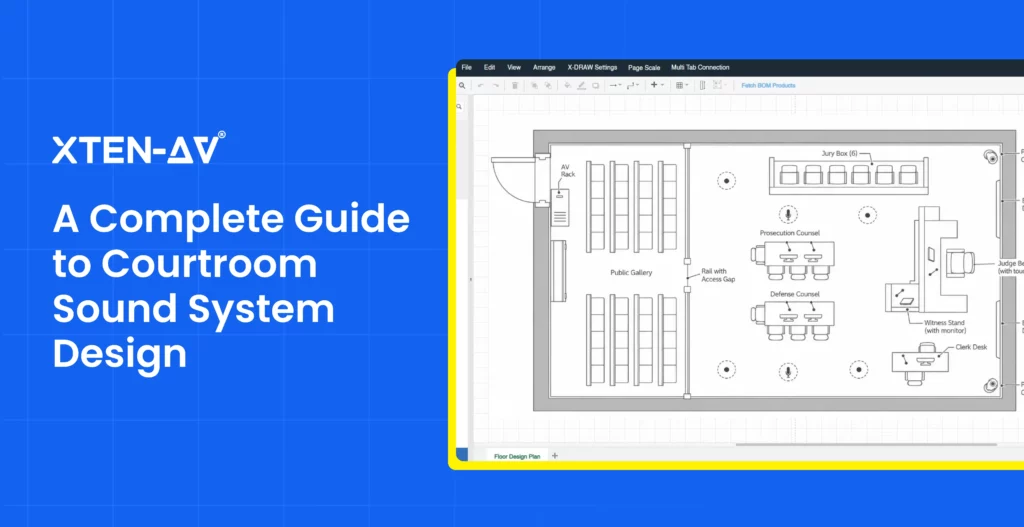
Simplify Courtroom Sound System Design with X-DRAW

It is a cloud-based AV design software platform that helps system integrators and engineers plan courtroom sound systems with greater accuracy and efficiency. With a library of 1.5 million AV products from 5,200+ brands and drawing capabilities, the software enables professionals to visualize microphone and loudspeaker placement, map DSP connections, organize audio equipment and keep designs aligned as requirements change.

Automate Courthouse AV System Design and Diagrams With X-DRAW-Courtroomblog

X-DRAW capabilities for courtroom sound system planning include:

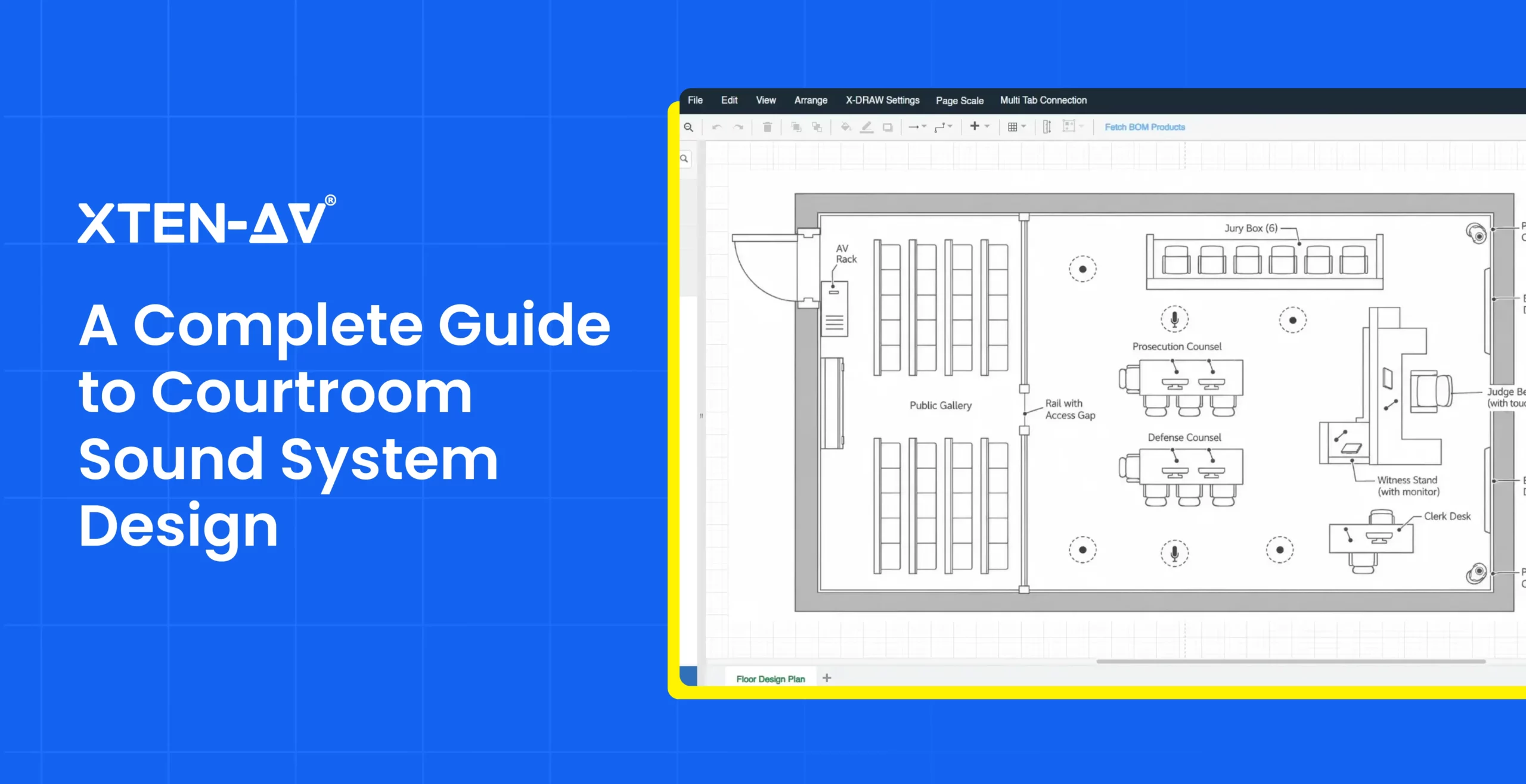
Courtroom Floor Plan Design: Import existing AutoCAD or Visio floor plans, position microphones, loudspeakers, DSPs and control devices across the judge’s bench, witness stand, public gallery and counsel tables.

Audio Signal Flow Diagram: Create signal flow diagrams showing DSP connections, microphone inputs, recording feeds for proper visualization of how audio travels between courtroom devices.

AV Product Library: Access a library of 1.5 million AV products from 5,200+ brands to select compatible microphones, audio processors, loudspeakers and amplifiers for courtroom recordings, communication and presentation systems.

Automated Ceiling Speaker Layouts: Plan ceiling speaker layout to support audio coverage across designated listening areas.

Synchronized Design and BOM: Automatically generate equipment BOMs from the courtroom audio design, keeping product quantities, pricing and specifications aligned with equipment selection.

Ready to Plan Courtroom Sound Systems with Greater Accuracy?

Conclusion

A well-designed courtroom sound system helps ensure clear communication, consistent audio coverage and dependable recording during legal proceedings. From microphone placement and DSP configuration to room acoustic and loudspeaker coverage, every design element contributes to reliable audio performance.

For AV integrators, planning these interconnected systems requires accurate equipment selection, clear signal routing and coordinated system designs. XTEN-AV’s X-DRAW simplifies this process with its centralized design capabilities. Book a demo to see how XTEN-AV helps integrators plan courtroom sound systems more efficiently while supporting consistent audio quality, dependable recording and accessible communication throughout judicial proceedings.  

Audio Visual System Design Mastery + Winning Proposals = 10x Productivity!

  • ✔ Automatic Cable Labeling & Styling
  • ✔ 100+ Free Proposal Templates
  • ✔ Upload & Create Floor Plans
  • ✔ 1.5M+ Products from 5200 Brands
  • ✔ AI-powered 'Search Sense'
  • ✔ Legally Binding Digital Signatures
Laptop Mockup

FAQs

A courtroom sound system ensures accurate audio recording, clear speech communication and equal sound distribution during hearings.

Proper microphone placement, controlled reverberation, DSP processing and balanced loudspeaker coverage helps maintain clear and understandable speech.

RT60 represents the time required for sound energy to decay by 60 dB after the sound source stops. It helps assess room reverberation, which can affect speech intelligibility. 

Courtroom audio systems use acoustic echo cancellation (AEC), audio routing and conferencing interfaces to enable clear communication between in-person and remote participants.

Multichannel recording captures separate microphone feeds, making it easier to identify speakers and review testimony accurately.

AV integrators should assess room acoustics, microphone locations, loudspeaker coverage, audio routing and recording requirements before installation.

STI is the Speech Transmission Index, an objective measure of speech intelligibility. STIPA is a specific simplified measurement method used for assessing speech transmission in installed sound systems.

XTEN-AV

Manage Multiple Audio Visual (AV) Projects with XTEN-AV

Share Article

Explore more by topic

Related Blogs
Courtroom Sound Systems Design, Components and Speech Clarity Explained
  • Sahil Dhingra
  • Posted by Sahil Dhingra
November 2, 2026

Audio Visual Courtroom Sound Systems: Design, Components and Speech Clarity Explained Sahil...

AV Commissioning Checklist & Best Practices for Integrators
  • Sahil Dhingra
  • Posted by Sahil Dhingra
October 27, 2026

Audio Visual AV Commissioning Checklist & Best Practices for Integrators Sahil Dhingra...

AV Cybersecurity Best Practices Securing Networked Audiovisual Systems
  • Sahil Dhingra
  • Posted by Sahil Dhingra
October 26, 2026

Audio Visual AV Cybersecurity Best Practices: Securing Networked Audiovisual Systems Sahil Dhingra...

AV Design Mastery + Winning Proposals = 10x Productivity!

No Credit Card Required

Sahil Dhingra
Sahil Dhingra
Sahil Dhingra is Co-Founder and CEO of XTEN-AV, a cloud-based Audio Visual (AV) system design & integration software for system design, proposals, project management, and post-installation service. With 10+ years of experience in software development, business analysis, and product leadership at companies including Apple, HP, and Cisco, Sahil leads XTEN-AV’s product vision for connected AV project lifecycle management. He focuses on building AI-assisted SaaS workflows that help AV teams reduce manual effort across system design, BOM creation, proposals, documentation, project delivery, reporting, and after-sales service.

Leave a Reply

Your email address will not be published. Required fields are marked *

This website stores cookies on your computer. Cookie Policy