








7 Best Wiring Diagram Software for AV System Integrators

Sahil Dhingra
Published 6 OCT 2026
AV wiring drawings provide installers with a clear reference for device connections, port assignments, signal paths and cable labels. During rack wiring, equipment setup and deployment, these details help technicians follow the intended design and confirm components are linked correctly.
As AV systems incorporate more interconnected hardware, maintaining revision control, drawing consistency and accurate design updates becomes increasingly important. Different platforms meet these requirements with varying levels of automation, editing controls, and project coordination capabilities.
In this guide, we compare the best wiring diagram software options, whether free or paid, based on AV-specific features, usability, limitations, pricing, platform compatibility and export support.
Key Takeaways
- Leading wiring diagram software options include XTEN-AV (X-DRAW), draw.io, AVSnap, D-Tools, Vectorworks ConnectCAD, Microsoft Visio and SmartDraw. Each addresses various AV requirements.
- AV Integrators must assess port details, cable IDs, connector data, custom equipment, multi-page support, export formats and revision control.
- AV connection drawings show how specific device ports are linked for accurate wiring. Meanwhile, cable route plans map pathways through trays, conduits, ceilings, racks and designated AV spaces.
- Free and paid AV platforms vary in automation, cable scheduling, compatibility checks, file editing and export capabilities.
- XTEN-AV (X-DRAW) is a cloud-based AV CAD design and diagramming platform built for professional AV projects. Its drawing automation and AI-assisted capabilities support proper device connectivity, cable labeling and signal routing.
What Is Wiring Diagram Software?
Wiring diagram software is a digital tool for creating and labeling AV equipment connections. It captures source and destination ports, cable IDs, signal types and connector details. This allows AV installation teams to trace links between sources, DSPs, switchers, amplifiers, displays and control devices. Modern wiring plan software can also function within an AV platform with automation or AI-assisted capabilities for connection checks and design validation.
A connection drawing identifies which devices and ports are connected, while a cable route drawing maps cable pathways through trays, conduits, ceilings, walls, racks and equipment rooms. Capabilities vary across AV tools. Some applications may calculate cable lengths or check device and port compatibility, while others focus primarily on creating connection diagrams.
Why Do AV Integrators Need Wiring Diagram Software?
AV system integrators need clear connectivity details through various project stages. Software for wiring diagrams organizes device connections, cable specifications, equipment data and revisions in a structured format.
Following capabilities are essential for accurate AV wiring and cable planning:
1. Map Exact I/O Assignments
Specify input and output ports for DSPs, switchers, amplifiers, displays, control processors and other AV equipment. Precise mapping shows where each signal originates and terminates.
2. Standardize Cable Identification
Assign a unique ID to every cable, along with its type, connector and endpoint details. Consistent identification makes individual connections easier to locate across schematics, schedules and equipment locations.
3. Produce Installer-Ready Drawings
Organize equipment tags, port references, cable identifiers and signal routing into clear technical sheets. Installers can quickly interpret the required connections during rack assembly and onsite deployment.
4. Maintain Accurate Change Records
Capture port reassignments, hardware replacements and cabling modifications as the project progresses. Current records provide a dependable reference for troubleshooting, service and future upgrades.
Building a home theater where every connection needs to work together? Explore our home theater wiring diagram for practical tips on cabling, connections, and signal paths.
Which Wiring Diagram Software Fits Your AV Project?
AV projects differ in engineering depth, cabling requirements, automation, and software environment. A wiring diagram builder must match the required level of connectivity detail, cable management and technical output.
Here are seven tools and their best-fit applications for professional AV projects:
| Tool | Best-Fit AV Use Case | Free Plan or Trial | Cable Capabilities | Main Limitation |
| XTEN-AV (X-DRAW) |
AV projects require drawing automation, cable labeling, styling, and AI-powered connection checking. | Free trial available. | Cable IDs, schedules, wiring diagrams, line schematics and signal flow diagrams. | May offer more functionality than required for basic drawings. |
| draw.io | Simple AV connection diagrams created manually. | Free web and desktop apps. | Connectors, labels, custom shapes and editable diagrams. | No dedicated AV cable-management automation. |
| AVSnap | AV schematics requiring cable routing, labeling, and reporting. | Free download available. | Cable routing, properties, labels, and reports. | Windows-focused desktop software. |
| D-Tools | AV projects requiring connected system design, schematics, and project data. | Trial and demo options vary by product. | Cloud offers interconnect diagrams and port-level schematics; SI provides detailed engineering drawings through Visio and AutoCAD. | Capabilities differ between D-Tools Cloud and SI. |
| Vectorworks ConnectCAD | Complex AV projects requiring schematic design and physical cable planning. | Free trial available. | Circuit routing, cable paths, calculated lengths, and reports. | Requires the Vectorworks environment. |
| Microsoft Visio | Manually created AV diagrams within a Microsoft-based environment. | Trial available. | Connectors, shape data, templates, and custom symbols. | Lacks dedicated Pro AV engineering automation. |
| SmartDraw | Basic wiring diagrams using ready-made templates and symbols. | Free trial available. | Connecting lines, labels, symbols and layers. | General-purpose rather than AV-focused. |
What Are the 7 Best Wiring Diagram Software Options for AV Integrators?
The best software for wiring diagrams varies by project scope, drawing complexity, equipment data requirements, and technical deliverables. Some platforms focus on AV-specific design, while others offer flexible diagramming for a wider range of applications.
Here are the seven wiring diagram software options covered in this guide:
XTEN-AV (X-DRAW)
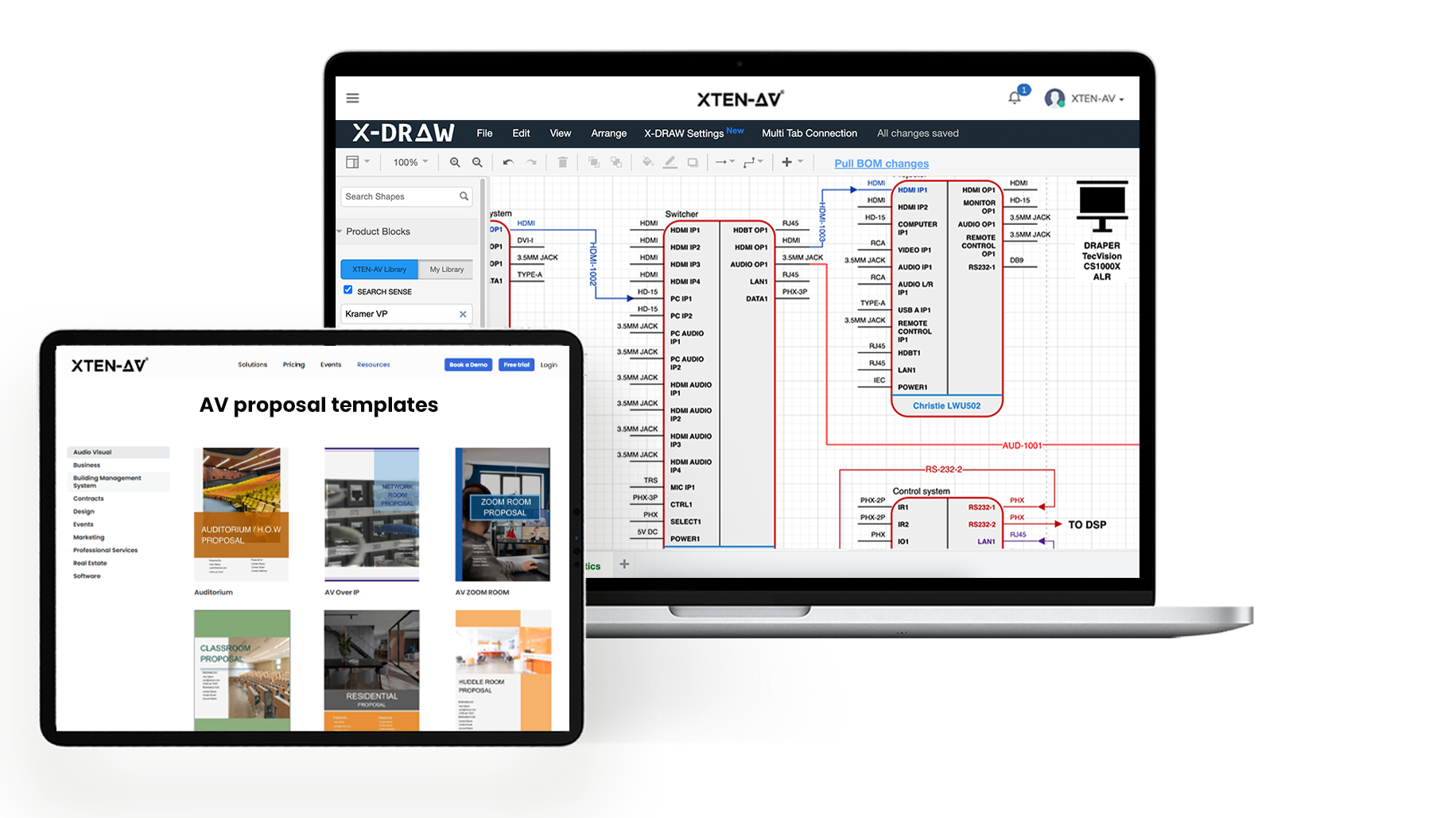
X-DRAW by XTEN-AV is a cloud-based AV CAD design and diagramming platform for professional system planning and documentation. Its wiring diagram maker enables design engineers to create accurate wiring diagrams, line schematics, and signal flow diagrams. Drawing automation speeds up repetitive tasks, while a product library with 1.5M+ AV products from 5,200+ brands streamlines equipment selection. AVIXA-standard symbols, cable labeling, rack layouts and cable schedules keep technical drawings clear and consistent.

Best For:
AV design engineers and system integrators seeking drawing automation, wiring diagrams, schematics, cable schedules and rack elevations. The unified AV platform also supports equipment selection and system planning.
Key Features of X-DRAW:
- AI connection check to identify potential issues with device connectivity.
- Automatic cable labeling and styling for clear identification and structured cable schedules.
- Automated line schematics showing device connections, signal paths, and cable routing.
- 12 types of AV design documents automatically generated, including AV BOMs, rack elevations, signal flow diagrams, cable schedules, line schematics and floor plans.
- Pre-designed AV templates for residential, commercial, classroom, auditorium, meeting room, huddle room, retail, and other spaces.
- Floor plan upload and creation with support for AutoCAD and Visio drawings.
- AVIXA-standard device blocks with accurate equipment dimensions.
- 1.5M+ product library featuring equipment from 5,200+ AV brands.
- AI-powered Search Sense for faster equipment discovery based on project requirements.
- Custom product library for preferred and non-catalog equipment.
Need help choosing the right tool for your AV CAD drawing requirements? Explore our guide to the best AV single-line diagram software to compare your options.
Main Strengths:
- Minimizes manual drafting across complex AV projects.
- Accelerates project delivery by streamlining routine tasks.
- Improves consistency across recurring project types and deliverables.
- Supports installation planning with structured, professional outputs.
- Centralizes project details in a cloud-based environment, minimizing reliance on multiple generic tools.
Practical Limitations:
New users may experience a short learning curve when getting familiar with the AV-specific wiring diagram capabilities.
User Reviews:
Users praise XTEN-AV (X-DRAW) for automating AV drawing tasks, simplifying schematic design and making complex AV diagrams easier to create and manage.
Platform Compatibility and Export Formats:
- Platform: X-DRAW is a cloud-based platform accessible on both Windows and macOS. Users can access their AV designs from any device, anywhere, anytime.
- Export: X-DRAW supports PDF, PNG, JPEG, SVG, Visio, HTML, XML and AutoCAD (DWG) formats.
XTEN-AV Pricing Plans:
- Free Trial
XTEN-AV offers a 15-day free trial. - Basic
$104.25/user/month, billed annually. - Business
$111.75/user/month, billed annually. - Enterprise
$126.75/user/month, billed annually. - X-PRO Add-On
$16.88/user/month, billed annually. Available as an optional add-on.
Source and Verification Date:
- Source:
https://xtenav.com/x-draw/ - Verification Date:
September 30, 2026
draw.io
draw.io is a general-purpose diagramming platform that AV designers and system integrators can use as free wiring diagram software for creating equipment connection layouts, signal paths and technical visuals. Its flexible canvas, customizable shapes and formatting options allow users to build project-specific drawings without relying on specialized AV design software. It is available through a web browser and as a desktop application.
Best For:
Quick system sketches, connection mapping, technical concepts and straightforward AV project diagrams.
Key Features of draw.io:
- Infinite canvas with grids, rulers and positioning guides for arranging complex technical layouts.
- Extensive shape libraries covering network infrastructure, floor plans, circuit diagrams, rack diagrams, and other technical applications.
- Custom shape libraries for creating reusable representations of AV equipment and frequently used components.
- Smart connectors that can be manually adjusted or automatically rerouted as layouts change.
- Layers and tags to organize detailed drawings and manage different elements within a project.
- Built-in templates for starting common diagram types and maintaining repeatable layouts.
- Auto-layout options for automatically arranging supported flowchart and tree structures.
- AI diagram generation that creates schematic diagrams from text descriptions.
- Real-time collaboration with synchronized editing and shared cursors through supported integrations.
Main Strengths:
- Free access for creating technical visuals without a subscription.
- Custom shape libraries for developing reusable symbols and components.
- Wide application range across network layouts, flowcharts, floor plans and other technical use cases.
- Flexible file handling for importing, exporting, storing, and sharing work.
- Cross-platform access through web and desktop applications.
- Collaborative editing for shared reviews and real-time changes.
Practical Limitations:
- General-purpose functionality lacks specialized capabilities for detailed audiovisual planning.
- Manual symbol creation may be necessary when suitable equipment shapes are unavailable.
- Limited product data does not include a dedicated manufacturer database for AV specifications.
- Greater manual effort may be required for intricate layouts.
- Basic outputs do not include specialized deliverables such as rack elevations, cable schedules or AV BOMs.
User Reviews:
Users prefer draw.io for its ease of use, customization options, extensive shape libraries, templates and free access. However, some reviewers have also noted challenges with auto-layout, snapping and connector positioning when creating more detailed layouts.
Platform Compatibility and Export Formats:
- Platform: draw.io is available as a web-based platform and desktop application for Windows and macOS. Users can create and access diagrams online or offline.
- Export: draw.io offers PDF, PNG, JPEG, SVG, WebP, HTML, XML and JSON export formats.
draw.io Pricing Plans:
- Standalone Version
Pricing: Free
Create diagrams online or offline with the desktop app and access essential templates and shape libraries. - Confluence and Jira Integration
Pricing: Paid plans based on user count
Bring draw.io into Atlassian platforms with built-in collaboration and documentation capabilities. - Data Center Deployment
Pricing: Subscription-based
Deploy draw.io in a self-hosted environment with enterprise-level administration and support.
Can a general diagramming tool handle detailed AV connections? Compare draw.io vs. XTEN-AV to see how they differ in device libraries, cable labeling and drawing automation.
Source and Verification Date:
- Source:
https://www.drawio.com/ - Verification Date:
September 30, 2026
AVSnap
AVSnap is a free AV design application for creating system diagrams, routing cables, arranging equipment, and developing rack layouts. It can serve as a wiring diagram program free option for teams working on equipment connections and installation drawings. Its AV libraries, cable lists, material lists and reusable product symbols add practical functionality for structured project design.
Best For:
AV designers and integrators creating equipment connection diagrams, cable layouts, and rack elevations. It suits projects that require structured installation drawings and organized equipment information.
Key Features of AVSnap:
- System diagrams for mapping AV sources, destinations, equipment, and connections.
- Cable routing to create and adjust connections between AV devices.
- Rack layouts for arranging equipment within rack-based installations.
- Cable labels for identifying individual connections and generating labels across a project.
- Cable lists for organizing connection details, including cable types and associated devices.
- Material lists for compiling components used throughout a project.
- Manufacturer libraries with reusable AV symbols and configurable product information.
- Custom libraries for creating and reusing equipment symbols based on project requirements.
- Project mode for managing multi-page designs, views, page sizes, and project information within a single project.
Main Strengths:
- AV design functionality covers common requirements for audiovisual system design and installation.
- Free standard access provides core functionality without a recurring subscription.
- A flexible project structure supports multiple drawing types and project views within the same application.
- Reusable components make frequently specified equipment easier to represent consistently across projects.
- Design and installation coverage connects system layouts with equipment placement and installation details.
- Equipment communication lets you test and control compatible devices from the application.
Practical Limitations:
- New users may need some time to become familiar with the interface and available functionality.
- Creating and maintaining custom product symbols can require additional effort for equipment not included in the standard library.
- Some advanced capabilities are available separately from the standard free offering.
- Users familiar with newer cloud-based design applications may find the interface less intuitive.
User Reviews:
Users like AVSnap for its system design capabilities, rack layouts, and AV-specific features, but some have highlighted a learning curve and limited suitability for temporary event setups.
Platform Compatibility and Export Formats:
- Platform: Offered as a free Windows desktop application with no native macOS version available.
- Export: Includes PDF handling for organizing project pages, along with generated cable lists and material lists.
AVSnap Pricing Plans:
- Free Version
Pricing: Free
Design AV systems, create schematics, and build wiring diagrams with essential AV design tools. - Professional Licensing
Pricing: Contact Altinex for pricing
Explore additional licensing options and features for advanced AV design requirements.
Need more control over device connections and cable details? Explore AVSnap substitutes to find a tool that fits your AV wiring requirements.
Source and Verification Date:
- Source:
https://avsnap.com/ - Verification Date:
September 30, 2026
D‑Tools
D-Tools is system integration software that combines AV design, estimating, proposals, engineering documentation, and project management in one platform. Its capabilities include wiring diagrams, single-line layouts, schematics, rack elevations, and plan views. Product data and equipment details can also connect with project costing, making it a practical wiring diagram builder for AV integration firms handling complex installations.
Best For:
AV integrators create detailed equipment layouts, system connections and installation drawings for complex projects.
Key Features of D-Tools:
- Single-line diagrams for mapping equipment and signal relationships.
- Wiring diagrams for documenting device connections and interconnects.
- Schematics for detailing technical relationships between components.
- Rack elevations for showing equipment placement within racks.
- Plan views for positioning devices across rooms and spaces.
- Visio and AutoCAD integration for detailed engineering drawings.
- BOM synchronization for keeping selected equipment aligned with drawings.
- Product library with specifications, pricing, and related equipment data.
- Wire schedules and labels for organizing connection information.
Main Strengths:
- Connects engineering data with estimating and AV proposals.
- Provides detailed product information for equipment selection and pricing.
- Works with established CAD applications for engineering teams.
- Covers sales, design, project management, and service needs in one unified platform.
- Suits AV integration firms managing large and complex installations.
Practical Limitations:
- The wider feature set may take time to configure for specific AV requirements.
- Product catalogs and equipment data require regular maintenance as specifications change.
- Existing CAD standards may require additional setup when adopting the platform.
- Installation notes, tasks and schedules may require configuration to match established processes.
- Teams looking only for wiring and engineering drawings may find the platform broader than necessary.
User Reviews:
Users consider D-Tools for its project tracking, equipment management, technical drawings, and proposal capabilities, but have raised concerns about setup, maintenance, task management, scheduling and support.
Platform Compatibility and Export Formats:
- Platform: D-Tools Cloud is browser-based and works on Windows and macOS. System Integrator is Windows-based and has no native macOS support.
- Export: System Integrator supports project and connection data in formats such as CSV, Excel, XML and JSON. It also integrates with Visio and AutoCAD for engineering drawings.
D-Tools Pricing Plans:
- D-Tools Cloud – Single
Pricing: $89/month billed annually
Designed for individual users managing AV sales, proposals, and project documentation. - D-Tools Cloud – Duo
Pricing: $161/month billed annually
Supports small businesses with additional users and collaboration features. - D-Tools Cloud – Team
Pricing: $314/month billed annually
Built for growing businesses managing multiple users and AV projects. - D-Tools Cloud – Company
Pricing: $584/month billed annually
Offers expanded user capacity and advanced business management features. - D-Tools Cloud – Enterprise
Pricing: $1,079/month billed annually
Designed for larger organizations with higher user and operational requirements. - D-Tools System Integrator (SI)
Pricing: Starts at $1,800/user/year (5-user minimum)
Available as hosted or on-premises software for larger AV integration businesses.
Is D-Tools the right fit for your wiring plans? Compare D-Tools alternatives to find a better match for your drawing needs and budget.
Source and Verification Date:
- Source:
https://www.d-tools.com/ - Verification Date:
September 30, 2026
Vectorworks ConnectCAD
Vectorworks ConnectCAD is built for AV professionals who need more than basic connection diagrams. It combines schematic planning with 2D and 3D design, cable routing, rack layouts and project documentation, giving integrators a structured way to manage complex AV connectivity from initial planning through final deliverables.
Best For:
System integrators coordinating signal paths, equipment connections, rack elevations and cable schedules across complex AV designs.
Key Features of Vectorworks ConnectCAD:
- Schematic diagrams for mapping devices, sockets, circuits, and signal paths.
- Cable routing for planning physical paths through spaces and models.
- Cable length analysis for estimating routing requirements.
- Rack and console layouts for organizing equipment placement.
- Riser diagrams for documenting cable pathways, ducts, and conduits.
- Custom device and socket configuration for project-specific equipment.
- Automatic labeling and numbering for connectivity documentation.
- Connection checking for identifying errors before installation.
- Worksheets and reports for equipment, cables, circuits and installation data.
Main Strengths:
- Combines AV connectivity with 2D and 3D spatial planning.
- Calculates cable lengths, conduit sizes, and material requirements during routing.
- Built-in checks can identify missing connections and incompatible equipment.
- Custom symbols and templates support project-specific AV requirements.
- Generates structured circuit reports, device lists, and cable schedules for project handoffs.
Practical Limitations:
- New users may need time to become familiar with the Vectorworks interface and ConnectCAD features.
- Setting up project standards and custom equipment content can require additional preparation.
- The 2D and 3D capabilities may be more than needed for simple wiring diagrams.
- Teams moving from basic diagramming software may need time to adjust to the broader Vectorworks environment.
- ConnectCAD is available through Vectorworks Spotlight or Design Suite, not as a standalone application.
User Reviews:
Users prefer Vectorworks for its flexibility and design capabilities, but have raised concerns about the learning curve and setup time.
Platform Compatibility and Export Formats:
- Platform: Available on Windows and macOS through Vectorworks Spotlight or Design Suite.
- Export: Supports PDF, DWG/DXF and DWF for sharing drawings, with worksheets and reports available for project information.
Vectorworks ConnectCAD Pricing Plans:
- Free Trial
Pricing: Available
Try ConnectCAD features before choosing a subscription. The trial lets users explore AV system design, schematic creation and documentation capabilities. - ConnectCAD with Spotlight
Pricing: $204/month
Get ConnectCAD included with Vectorworks Spotlight for creating AV system designs, signal flow diagrams, and documentation. - ConnectCAD with Design Suite
Pricing: Contact Vectorworks for pricing
Use ConnectCAD with Vectorworks Design Suite for expanded design capabilities and advanced documentation needs.
Note:
ConnectCAD is an AV system design module available with Vectorworks Spotlight or Design Suite and is not sold as a standalone product.
A well-planned AV rack keeps equipment accessible and cabling organized. Explore rack diagram software to map device placement, ventilation gaps and space for future expansion.
Source and Verification Date:
- Source:
https://www.vectorworks.net/en-US/connectcad - Verification Date:
September 30, 2026
Microsoft Visio
Microsoft Visio is diagramming software with templates and stencils for electrical diagrams, network layouts, floor plans, and technical schematics. Its customizable shapes and CAD file support make it a useful electrical wiring diagram maker for AV system integrators. It can also be used to create connection layouts and technical drawings.
Best For:
Teams creating electrical schematics, signal layouts, floor plans and technical drawings with customizable diagram elements.
Key Features of Microsoft Visio:
- Electrical diagrams for circuit and wiring schematics.
- Network diagrams for mapping physical and logical connections.
- Floor plans for equipment placement and room layouts.
- Custom shapes and stencils for specialized technical diagrams.
- AutoCAD file support for importing existing DWG drawings.
- Shape data for adding equipment details to diagram elements.
- Data linking for connecting diagrams with external information.
- Ready-made templates for technical and engineering diagrams.
- Collaboration features for sharing and co-authoring diagrams.
Main Strengths:
- A familiar Microsoft interface can minimize the learning curve for existing Microsoft 365 users.
- A large template and stencil library supports different technical documentation needs.
- Flexible customization makes it easier to adapt diagrams to company standards.
- Integration with other Microsoft applications supports information sharing across teams.
- Broad application scope makes it suitable for projects beyond AV documentation.
Practical Limitations:
- Visio is a general-purpose diagramming application rather than AV-specific software.
- Specialized AV symbols may require custom shapes or additional setup.
- Advanced capabilities are limited to higher-tier plans.
- Detailed AV documentation can require more manual configuration than dedicated AV software.
- The desktop application is available for Windows, while macOS users use the web version.
User Reviews:
Users prefer Visio for its templates, flexibility and Microsoft integration, but some have raised concerns about pricing and the learning curve for advanced functionality.
Platform Compatibility and Export Formats:
- Platform: Visio for the web is available on Windows and macOS. The desktop application is available for Windows.
- Export: Supports PDF, SVG, PNG and DWG, with additional formats depending on the diagram and version.
Microsoft Visio Pricing Plans:
- Free Trial
Pricing: 1-month free trial
Test Visio features before subscribing. Explore templates, collaboration options, and core tools to evaluate the platform. - Visio Plan 1
Pricing: $5/user/month (billed yearly)
Create and share diagrams online with essential templates, shapes, and browser-based editing. - Visio Plan 2
Pricing: $15/user/month (billed yearly)
Access advanced features in both desktop and web apps to create detailed business visuals. - Visio Standard 2024
Pricing: $309.99 one-time purchase
Build professional visuals using desktop tools, standard templates, and built-in shapes. - Visio Professional 2024
Pricing: $579.99 one-time purchase
Create complex visuals with advanced templates, data linking, and enhanced customization options.
Moving beyond basic shapes for AV wiring diagrams? Explore our Microsoft Visio alternatives guide to see how specialized software compares.
Source and Verification Date:
- Source:
https://www.microsoft.com/en-us/microsoft-365/visio/ - Verification Date:
September 30, 2026
SmartDraw
SmartDraw is a web-based diagramming platform for wiring diagrams, electrical plans, floor plans, network diagrams, and technical layouts. It combines templates, standard symbols, intelligent connectors, and collaboration features for creating technical drawings without the complexity of a full CAD environment.
Best For:
AV professionals handling schematic layouts, wiring documentation, reusable symbols, and browser-based project access.
Key Features of SmartDraw:
- Wiring diagram templates with electrical and technical symbols.
- Intelligent connectors that maintain links when shapes are repositioned.
- Layers for organizing information within detailed drawings.
- Custom libraries for project-specific symbols.
- Visio file and stencil import for existing content.
- PDF import for using existing plans as references.
- Shape data for adding information to diagram elements.
- Comments and version history for design reviews.
- Cloud storage integration with OneDrive, SharePoint, Google Drive, Dropbox, and Box.
Main Strengths:
- Browser access removes the need for a traditional desktop installation.
- Intelligent connectors minimize manual adjustments when layouts change.
- Visio compatibility can simplify migration from existing files.
- Cloud storage integrations fit established document-sharing processes.
- Built-in review features support feedback during project development.
Practical Limitations:
- It does not offer the engineering depth of full CAD applications.
- Complex technical drawings may require more manual customization.
- Larger diagrams can affect performance.
- Some symbol placement and connection tasks may require additional adjustment.
- Subscription pricing may be a consideration for smaller firms or occasional users.
User Reviews:
Users consider SmartDraw easy to use, flexible, and suitable for quick diagram creation, while feedback highlights limitations in advanced drafting, precision and handling complex schematic drawings.
Platform Compatibility and Export Formats:
- Platform: Browser-based and available on Windows, macOS, and Linux.
- Export: Supports PDF, PNG and SVG, along with Visio file import and export.
SmartDraw Pricing Plans:
- Free Trial
Pricing: Free trial available.
Best for testing SmartDraw before purchasing an annual subscription. - Individual Plan
Pricing: $9.95/month (billed annually).
Includes diagram creation, templates, and drawing features for individual users. - Team Plan
Pricing: $8.95/user/month (billed annually).
Includes team collaboration, shared folders and administrative controls. - Enterprise Plan
Pricing: Contact SmartDraw for pricing.
Includes enterprise features such as SSO, multiple shared folders, and organization-level support.
Wondering how to manage the design demands of boardrooms, meeting spaces and large installations? Explore our commercial AV software for capabilities tailored to complex environments.
Source and Verification Date:
- Source:
https://www.smartdraw.com/ - Verification Date:
September 30, 2026
Which Free Wiring Diagram Software Can Handle Your AV Project?
For proper AV applications, wiring diagram free software must support more than basic connection drawings. Editable files, export formats, equipment and port details, cable schedules, as well as access limits determine its suitability for professional use.
Following options are evaluated for editable files, export formats, AV equipment and port labeling, cable schedules, document limits, also access duration:
Free Options
- draw.io
Saves editable files for later revisions and exports to PDF, PNG, JPEG, SVG, WebP, HTML, XML and JSON. Custom shapes and labels can represent AV equipment and ports. Free access does not expire, but dedicated cable scheduling is not included.
- AVSnap
Supports editable AV projects, custom product libraries, input/output details, and cable lists with cable names, connector types, lengths, and connected equipment. Cable lists can be transferred to Excel. It is available without a time-limited trial.
Paid or Trial-Based Options
- XTEN-AV (X-DRAW)
Saves AV CAD designs and exports to PDF, PNG, JPEG, SVG, Visio, HTML, XML, and AutoCAD. It includes AVIXA-standard symbols, manufacturer-specific equipment, port details, cable labeling, styling, and automated cable schedules. A 15-day trial is available. - D-Tools
Supports AV equipment, connection, and wire data, with reports available in PDF, Excel, CSV, HTML, RTF, and TXT. Wire and connection reports provide detailed cable and terminal information. Access is license-based. - Vectorworks ConnectCAD
Supports editable AV/ICT schematics, equipment and connection data, custom symbols and system reports. It is a paid product with trial access. - Microsoft Visio
Supports editable diagrams and exports to PDF, PNG, JPEG, SVG, and EMF. Custom shapes and labels can represent AV equipment and connections. Dedicated cable schedules are not included, while free access is trial-based. - SmartDraw
Supports editable diagrams, custom shapes and labels, with exports including PDF, PNG, SVG, and Microsoft Office formats. AV-specific cable scheduling is not a core capability, so cable information may require separate documentation. Free access is trial-based.
For AV projects, the key consideration is whether the software supports detailed connection documentation with less manual effort.
What Should You Check Before Choosing Wiring Diagram Software?
Selecting an AV wiring diagram generator involves more than comparing drawing features. The software should support accurate connectivity, structured cable information, equipment data and the technical deliverables required for proper project execution.
Following table outlines the key factors to consider when evaluating wiring diagram software for professional AV projects:
| Wiring Diagram Software Criteria | Why It Matters for AV Projects |
| Port-Level Connectivity | Maps input/output assignments, connector details, and signal paths between specific devices. |
| Cable Schedules | Organizes cable IDs, types, endpoints, and labels for installation reference. |
| AV Product Data | Provides manufacturer details, specifications, dimensions, and reusable equipment information. |
| Rack Elevations | Shows equipment placement within racks, along with relevant connectivity references. |
| Signal Flow Diagrams | Represents audio, video, control, and network paths across the AV system. |
| Design Automation | Automates labeling, connection checks, or schematic generation to minimize repetitive drafting. |
| Revision Control | Tracks changes to equipment, connections, cable assignments, and drawing versions. |
| Export Formats | Supports PDF, DWG, DXF, Visio, or other files required for project handoff. |
| Platform Compatibility | Matches Windows, macOS, browser-based, or desktop requirements within the existing environment. |
| AV Project Requirements | Supports the required level of detail, from basic connection drawings to complex multi-room AV documentation. |
Complex signal paths can quickly become difficult to trace. Explore our top signal flow diagram software guide to compare options for clearer system documentation.
Which Wiring Diagram Software Should You Choose?
Creating an AV wiring diagram starts with selecting equipment, mapping device connections, and defining signal paths for accurate system planning. XTEN-AV (X-DRAW) can be preferred by AV designers as wiring drawing software for creating detailed schematic designs with AVIXA standard symbols, port-level connections, cable labeling and AI connection-check capabilities.
Key Steps to Create an AV Wiring Diagram:
1. Add Equipment and Device Identifiers
Place AV equipment into the drawing workspace. Assign identifiers to displays, sources, DSPs, switchers, control devices and other system components for clear equipment referencing.
2. Map Device Connections
Identify source and destination ports to define signal routing between connected endpoints. Assign connection types for audio, video, control and network signals.

3. Define Signal Paths and Cable Labels
Map signal routes between connected AV devices and add cable labels to identify each connection clearly during installation and troubleshooting.

4. Add Cable Details
Assign cable IDs, cable types and installation notes to maintain clear cable references and support accurate implementation.
5. Validate Connection Details
Check device connections and cable information to identify mismatches before finalizing the AV design.
6. Export Final AV Drawing Files
Export the completed schematic design with revision control to track design changes, maintain version accuracy and share updated files with project stakeholders.

Turn Complex AV Connections into Clear Wiring Diagrams.
Conclusion
Finding the right wiring layout software starts with your AV documentation needs. Compare the listed tools on device-level port mapping, signal path clarity, cable identification and revision handling. Integrators who need schematics, rack elevations, cable schedules and BOMs within one centralized platform may prefer XTEN-AV (X-DRAW). Book an XTEN-AV demo to see how it fits your CAD drawing and project documentation requirements.
Audio Visual System Design Mastery + Winning Proposals = 10x Productivity!
- ✔ Automatic Cable Labeling & Styling
- ✔ 100+ Free Proposal Templates
- ✔ Upload & Create Floor Plans
- ✔ 1.5M+ Products from 5200 Brands
- ✔ AI-powered 'Search Sense'
- ✔ Legally Binding Digital Signatures
FAQs
Popular AV wiring diagram software options include XTEN-AV (X-DRAW), AVSnap, D-Tools, Vectorworks ConnectCAD, Visio, draw.io and SmartDraw. Compare them based on AV line schematics, port-level connections, cable labeling, signal flow diagrams, schematic layouts and system drawings.
The best option depends on the project requirements and AV design complexity. Famous choices include XTEN-AV (X-DRAW), AVSnap, D-Tools and Vectorworks ConnectCAD, with capabilities varying across wiring diagrams, line schematics, cable schedules, AV BOMs and rack layouts.
For basic AV connection diagrams, draw.io and AVSnap is a practical free option. For design engineers working on complete AV layouts, XTEN-AV (X-DRAW) is worth considering for line schematics, rack elevations, floor plans, ceiling speaker layouts and other schematic design documents.
For beginners, draw.io offers a simple drag-and-drop experience. XTEN-AV(X-DRAW) can be preferred for AV-specific design with a 1.5M+ product library and AVIXA standard symbols.
Free wiring diagram software may suit simple AV setups, but professional installations often require manufacturer-specific equipment data, AVIXA-standard symbols and predesigned AV templates.
Wiring diagram software shows device connections and cable routing, while schematic drawing software maps signal paths and AV system architecture.
A wiring diagram generator can automate connection mapping, but AV professionals still define equipment selection and signal paths. XTEN-AV (X-DRAW) can be considered for AI-assisted connection checks and AV drawing automation.
Yes, free online tools can create basic connection drawings and equipment layouts. Professional AV projects often require advanced design features, accurate product data and scalable drawing capabilities.
Note:
Product details, pricing and user feedback are based on official websites, G2, Capterra and Reddit. Prices may vary by region or change over time. All trademarks belong to their respective owners.

Explore more by topic
Related Blogs
-

- Posted by Sahil Dhingra

Audio Visual Courtroom Audio Visual (AV) Systems: A Complete Guide for Courts...
-
- Posted by Sahil Dhingra
Audio Visual 10 Best draw.io Alternatives for AV Professionals Sahil Dhingra Published...
-
- Posted by Sahil Dhingra
Audio Visual 7 Best Schematic Drawing Software for AV System Integrators Sahil...