








7 Best Schematic Drawing Software for AV System Integrators

Sahil Dhingra
Published 12 OCT 2026
AV system designs can become difficult to execute when device connections, signal paths and cable details are not clearly documented. As systems include more sources, displays, speakers, amplifiers, network devices and control processors, AV designers and system integrators need accurate drawings that show how every component connects and how audio, video, control and network signals move through the system.
This is where schematic drawing software becomes important. It helps turn complex device connections into clear AV schematics and connection diagrams that support design reviews, deployment, troubleshooting and future system changes. Depending on project complexity, AV professionals may use anything from a simple schematic drawing program to specialized AV design software with product libraries, port-level connections, cable documentation and automated drawing capabilities.
In this blog, we compare the free and paid AV schematic drawing software options for system integrators, covering key features, pricing, platform support, pros and limitations to help you choose the right schematic drawing program for your requirements.
Key Takeaways
- AV schematic drawing software maps device connections, signal paths and cable details, helping AV designers and installation crews plan, deploy and troubleshoot systems with fewer errors.
- The best tools for AV projects support port-level connections, signal flow mapping, cable labeling, equipment libraries and technical documentation.
- The right AV design software depends on project complexity, budget, platform preference and required design deliverables.
- Accurate AV connection diagrams help designers trace signal paths, verify connections and check potential issues before deployment.
- Detailed cable schedules and labels give installers clear source, destination, cable type and connection references for installation and troubleshooting.
What Is Schematic Drawing Software?
Schematic drawing software is used to create technical diagrams that show how devices, ports and signals connect within an AV system. These technical drawings map out the exact path audio, video, control and network signals follow as they travel from source devices to processors, amplifiers, displays and speakers.
Unlike floor plans or equipment layouts, AV schematics focus on system logic and signal flow rather than physical placement. For example, a schematic documents how a source connects through a switcher and processor to a display, while a floor plan or equipment layout shows where those devices are positioned within the room.
AV schematics can include line schematics, wiring diagrams and block diagrams. An AV single line diagram shows signal flow from source to destination, while a block diagram presents the functional relationship between major system components. Wiring diagrams provide more detailed information about ports, cables and equipment interfaces.
These drawings are intended for system-level AV connections. Circuit-level components and electrical wiring are documented separately using electrical schematics. For that use case, explore our guide to the best free electrical schematic drawing software.
Why Do AV Integrators Need Schematic Drawing Software?
Designing complex AV systems needs more than selecting the right equipment. Commercial AV integrators require detailed blueprints that map out signal flow, equipment connections and cable paths. Schematic drawing software creates detailed AV schematics that make system design easier to understand and execute.
Here are the key reasons AV integrators use schematic drawing software:
Simplify Port Identification and Device Connections
AV systems include multiple devices, making input and output ports difficult to track without proper documentation. Using software for drawing schematic diagrams, labelling every input, output and connection point becomes easier. This helps installation teams understand exactly where each cable connects and how signals move between different components. It also helps designers verify equipment compatibility and confirm that the deployed system follows the engineering design.
Improve Signal Tracing Across Complex AV Systems
Large AV environments involve multiple sources, conversion points and distribution paths. An accurate AV connection diagram provides a visual representation of how audio, video, control and network signals move from source devices through processors, distribution equipment to final endpoints. With proper AV schematics, integrators can quickly trace signal flow, identify potential connection issues and make design adjustments before physical work starts.
Create Accurate Cable Labels and Wiring Details
Effective AV cable documentation is critical for reliable AV installations. An AV project may include hundreds of cables carrying HDMI, audio, control, network and power connections. With no proper labelling and records, identifying the correct cable path or connection point can become time-consuming. Software for drawing schematic diagrams defines cable types, source, destination points, connector information and labeling details within the design. Accurate cable details provide clear references for cable termination, rack connections and device connectivity that eliminates confusion during deployment.
Improve Installation and Maintenance Documentation
Detailed commercial AV installation documentation ensures that AV systems are installed correctly and post-deployment maintenance and future upgrades easier. Whether creating simple diagrams with free schematic drawing software or developing complex designs using advanced AV design software, structured documentation helps maintain consistency between the planned design and the final system.
Which Schematic Drawing Software Fits Your AV Project?
Here’s a quick comparison of schematic drawing software options to help you identify the right fit for your AV projects:
| Tool | Best-Fit AV Use Case | Free Access | Mac Availability | Main Limitation |
| XTEN-AV (X-DRAW) | AV system design and automated design deliverables. | Free trial available. | Accessible on macOS via a web browser. | Advanced features require a paid plan. |
| draw.io | Professional AV diagram creation and visual system planning. | Free web and desktop apps. | It is available on macOS. | AV-specific equipment symbols, libraries and documentation require customization as it is not purpose-built for AV system design. |
| AVSnap | The platform supports architectural drawings, AV rack elevation diagrams, cable routing and system diagrams. | Free version available. | No native macOS version. | AI-driven drawing and prompt-based automation are not available. |
| Vectorworks ConnectCAD | Complex AV and event or stage projects that need detailed schematics, rack layouts and connected system documentation. | Free trial available. | Native macOS support is available. | ConnectCAD is a part of a broader Vectorworks CAD environment rather than a simple standalone diagramming tool. |
| D-Tools | AV system design, proposal and project documentation. | Free demo available, while trial options vary by plan. | D-Tools cloud version is available on Mac via web browser. | Broader AV project platform rather than a schematic only tool. |
| Microsoft Visio | Professional diagrams and enterprise documentation. | Free trial available. | No native desktop application for macOS. | Requires customization for AV-specific symbols, equipment libraries and documentation. |
| AutoCAD | Technical CAD drawings and detailed layout design. | Free trial available. | Dedicated macOS version available. | Requires CAD expertise. |
Free schematic drawing software can be advantageous for creating basic AV connection diagrams, signal flow drawings and system documentation without an upfront software investment. Users looking for a schematic drawing program free of recurring costs should compare platform support, AV product libraries, port-level connections, cable details and automation capabilities before choosing a tool.
What Are the 7 Best Schematic Drawing Software Options for AV Integrators?
Schematic drawing software enables AV designers and system engineers to document complex audio visual systems by mapping device connections, signal flow and equipment relationships. For users looking for AV design software free options, some platforms provide permanent free access, while others offer trials that allow AV professionals their drawing capabilities before subscribing.
Here are schematic drawing software platforms AV designers and integrators can compare based on AV documentation needs, project complexity and technical requirements:
XTEN-AV (X-DRAW)
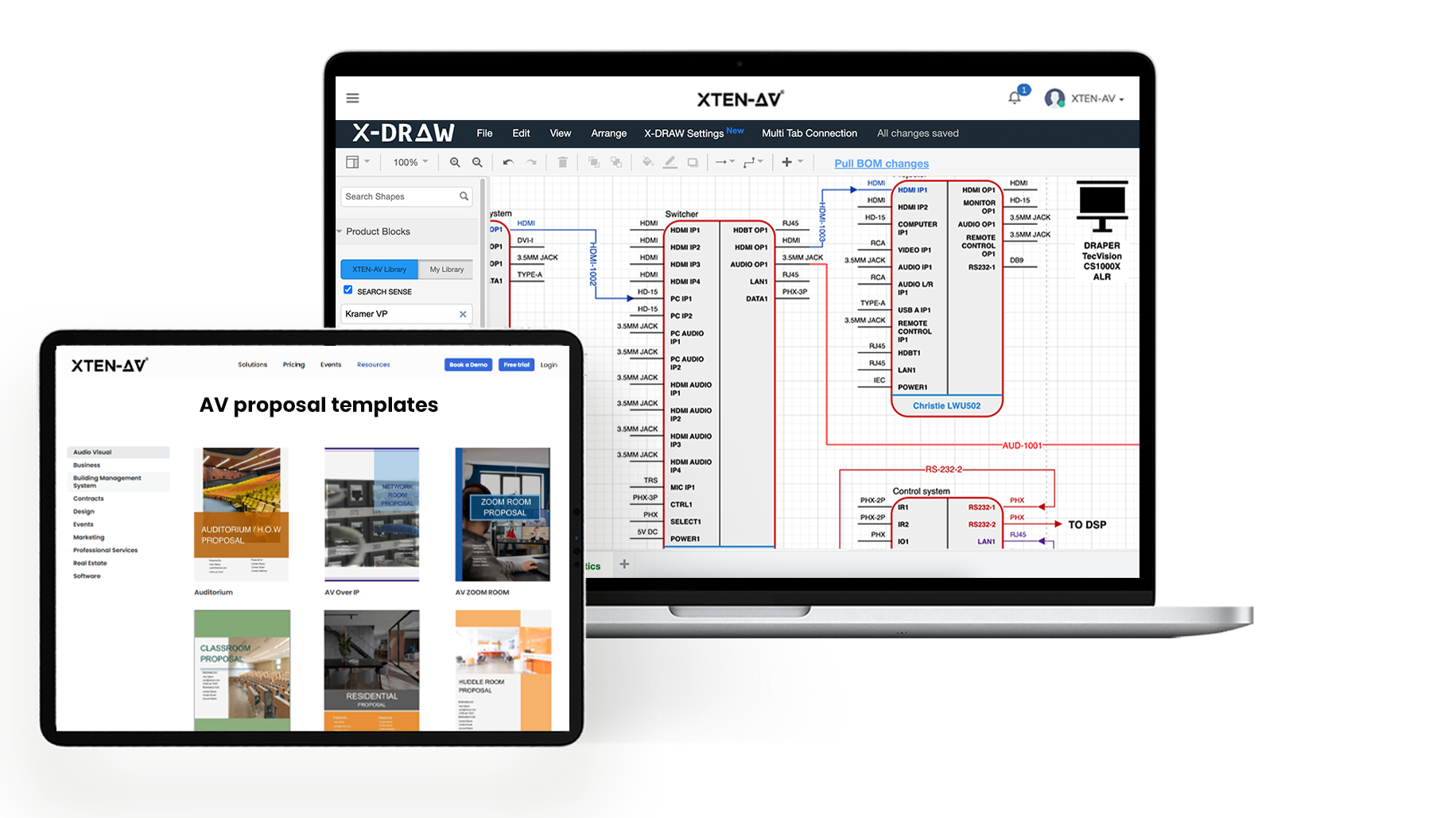
X-DRAW is a cloud-based AV schematic drawing platform built for AV professionals. It helps AV designers create signal flow diagrams, line schematics, floor plans, AV rack design and technical documentation in a single unified environment.

Best For:
A good choice for AV designers and system engineers who need an AV-native design platform to create automated line schematics, signal flow diagrams, rack layouts and documentation from a single AV system design.
Key Schematic Features:
- Automated line schematic drawings with exact device connections, signal paths and cable routing.
- Port-level connection details for clearer signal flow planning.
- Organized cable schedules that provide clear references for deployment and system commissioning.
- Automated cable labeling, styling and scheduling.
- Product library with 1.5M products from 5,200+ brands.
Pros:
- Cloud-based access keeps drawings accessible across locations and supports centralized project documentation.
- Automatically generates key AV deliverables from a single design.
- Supports the upload of existing AutoCAD or Visio floor plans for editing and customization within X-DRAW.
- Highly intuitive and easy to use interface.
Cons:
- Users looking only for simple flowcharts may find dedicated AV features unnecessary.
XTEN-AV Pricing Plans:
- Free Trial
XTEN-AV offers a 15-day free trial. - Basic
$104.25/user/month, billed annually. - Business
$111.75/user/month, billed annually. - Enterprise
$126.75/user/month, billed annually. - X-PRO Add-On
$16.88/user/month, billed annually. Available as an optional add-on.
Platform Support:
A cloud-based AV system design, drawing and diagram platform that runs directly on Windows and macOS through a web browser, no separate desktop application required.
Source and Verification Date:
- Source:
https://xtenav.com/x-draw/ - Verification Date:
September 30, 2026
User Review:
AV professionals prefer XTEN-AV (X-DRAW) for its intuitive interface, automated design capabilities and ability to create detailed AV documentation more efficiently.
Review Source:
https://www.capterra.in/software/1048780/xten-av
draw.io
draw.io is a free, open-source, security-first block-diagramming tool that supports various technical drawings. It gives users flexibility over where diagram files are stored and can be used whenever needed.
Best For:
Users looking for a free and flexible diagramming tool for creating basic AV connection diagrams and system drawings.
Key Features:
- Built-in shapes, flowcharts and custom shape libraries for basic block diagrams, rack layouts and signal flow charts.
- Professional diagramming capabilities without the enterprise price tag.
- Floating connectors that reroute automatically when users move shapes and switch to fixed anchor points.
- Global libraries, or import custom/open-source icon sets for hardware components.
Pros:
- Maintains compatibility with older diagram files, allowing users to access and edit previous work without concerns about file obsolescence.
- Open-source format allows anyone to access and edit files across different platforms.
- Embed diagrams in docs, wikis or applications and export to PNG, SVG or keep them editable.
Cons:
- Lacks advanced features found in specialized software.
draw.io Pricing Plans
- Standalone Version
Pricing: Free
Includes online diagramming and a desktop app for offline use. - Confluence and Jira Integration
Pricing: Paid plans based on user count
Includes Atlassian integration and collaborative diagramming features. - Data Center Deployment
Pricing: Subscription-based
Deploy draw.io in a self-hosted environment with enterprise-level administration and support.
Platform Support:
draw.io is available either as an online tool in your web browser or as a desktop application for Windows and macOS.
Source and Verification Date:
- Source:
https://www.drawio.com/ - Verification Date:
September 30, 2026
User Review:
Users value draw.io for its simple interface, browser-based access and quick creation of flowcharts, process maps and technical diagrams. Reviewers also praise its templates and extensive shape library.
Review Source:
https://www.capterra.in/software/166985/draw-io
AVSnap
AVSnap is a system integration and design software developed by Altinex, Inc. used for creating audio visual system diagrams. It also includes cable schedules, material lists, PDF management and device-function capabilities for detailed AV documentation.
Best For:
AV system designers who need free design software for creating AV drawings, rack layouts and cable documentation.
Key Features:
- Architectural drawings and rack elevations for proper AV system planning.
- Cable labeling and routing for structured installation documentation.
- Library mode for creating product symbols, defining inputs and outputs and configuring connection points.
- System control and communication tools for configuring or troubleshooting AV equipment.
Pros:
- Supports reusable product libraries with custom symbols, inputs, outputs and connection points.
- Provides real-time design sharing through AVSnap Meeting for collaboration with clients and team members.
- Free access to standard features without recurring subscription costs.
Cons:
- Does not include dedicated proposal, estimation and quotation management capabilities.
AV professionals comparing similar platforms can also explore AVSnap alternatives based on schematic capabilities, automation, platform support and documentation requirements.
AVSnap Pricing Plans:
- Free Version
Pricing: Free
Design AV systems, create schematics and build wiring diagrams with necessary design tools. - Professional Licensing
Pricing: Contact Altinex for pricing
Explore premium features for advanced AV design requirements.
Platform Support:
Natively built for the Microsoft Windows platform and no native version available for macOS.
Source and Verification Date:
- Source:
http://avsnap.com/ - Verification Date:
September 30, 2026
User Review:
Users appreciate AVSnap for its ease of use, short learning curve and flexibility across different AV design needs.
Vectorworks ConnectCAD
Vectorworks ConnectCAD is a specialized AV design platform that is focused on helping event-focused AV professionals create system layouts, document connections and manage complex audiovisual requirements efficiently.
Best For:
AV designers, consultants and engineers who need CAD-based AV schematic creation, rack documentation and detailed system design capabilities.
Key Features:
- Create AV schematic drawings.
- Live error checking.
- Create well-structured and detailed reports.
- Customizable templates and symbols.
- Rack layout diagrams.
Pros:
- Gives a hybrid 2D/3D design environment for AV system planning.
- Built specifically for AV design with schematic creation, device connections and system documentation capabilities.
- Live error checking and detailed reporting tool validates connections.
- Includes manufacturer libraries to support equipment-based AV drawings.
Cons:
- The CAD-based environment may require additional learning time for users new to Vectorworks.
Vectorworks ConnectCAD Pricing Plans:
- Free Trial
Pricing: Available
Try ConnectCAD features before choosing a subscription. - ConnectCAD with Spotlight:
Pricing: $204/month.
Get ConnectCAD included with Vectorworks Spotlight for creating AV system designs, signal flow diagrams and documentation. - ConnectCAD with Design Suite:
Pricing: Contact Vectorworks for pricing
Use ConnectCAD with Vectorworks Design Suite for expanded design capabilities and advanced documentation needs.
Note : Vectorworks ConnectCAD is available as an add-on with Vectorworks Spotlight or Design Suite and is not sold as a standalone product.
Platform Support:
Vectorworks Spotlight and Vectorworks Design Suite run natively on both Windows and macOS.
Sources and Verification Date:
Source:
https://www.vectorworks.net/en-GB/connectcad
Verification Date:
September 30, 2026
User Review:
Users generally value Vectorworks ConnectCAD for detailed AV system drawings and flexible design tools.
D-Tools
D-Tools is an AV business software platform that combines AV system design, engineering documentation and project data management. D-Tools System Integrator (SI) provides detailed engineering documentation capabilities for AV projects and can be hosted either on-premises or through a hosted environment.
AV professionals comparing design platforms can also review D-Tools SI vs X-DRAW to compare their AV design, documentation and drawing capabilities.
Best For:
AV companies that need detailed design documentation connected with estimating and project management.
Key Features:
- Line diagrams and engineering drawings for detailed AV system documentation.
- Product catalog integration for linking equipment information with project designs.
- Rack elevation and equipment layout creation for structured system planning.
- BOM-connected documentation to align drawings with project equipment data.
Pros:
- Drawings, equipment data and connected devices aligned with the design process.
- Supports detailed engineering drawings.
- Available with flexible deployment options, including cloud-based and on-premises environments.
Cons:
- Initial setup and adoption may take time.
- Less intuitive user interface.
D-Tools Pricing Plans:
- Free Trial / Demo
D-Tools offers a free demo, while trial options vary by plan. - D-Tools Cloud – Single
Plan starts at $89/month, billed annually. - D-Tools Cloud – Duo
Plan starts at $161/month, billed annually. - D-Tools Cloud – Team
Plan starts at $314/month, billed annually. - D-Tools Cloud – Company
Plan starts at $584/month, billed annually. - D-Tools Cloud – Enterprise
Plan starts at $1,079/month, billed annually. - System Integrator (D-Tools SI)
Starts at $1,800/user/year with a minimum of 5 users. Available as a hosted or on-premises solution.
Platform Support:
D-Tools Cloud runs in a web browser on both Windows and macOS, while D-Tools System Integrator is designed for Windows and does not offer native macOS support.
Source and Verification Date:
- Source:
https://www.d-tools.com/ - Verification Date:
September 30, 2026
User Review:
Reviewers value D-Tools for supporting system design, quoting and shared project access within a broader business platform.
Review Source:
https://www.capterra.com/p/152733/System-Integrator-SI-2016/#reviews
Microsoft Visio
Microsoft Visio is a general-purpose diagramming software used to create technical drawings, flowcharts, network layouts and system deliverables. With customizable templates, shapes and collaboration features, making it better for basic AV schematics and connection diagrams.
AV professionals who need more AV-specific drawing capabilities can also compare Microsoft Visio alternatives for schematic creation and AV design.
Best For:
AV designers and engineers who already use Microsoft 365 and need flexible technical drawings using customizable templates and shapes.
Key Features:
- Collaboration capabilities through Microsoft 365 integration for sharing and reviewing diagrams.
- Diagram creation tools for building technical drawings, flowcharts, network diagrams and connection layouts.
- Data-linked diagrams to connect visual drawings with structured information.
Pros:
- Customizable shapes and symbols can be used to represent AV equipment and connections.
- Familiar interface for Microsoft users, reducing the learning curve for teams already using Microsoft tools.
- Supports multiple diagram types, including flowcharts, network diagrams, process maps and technical layouts.
Cons:
- Requires manual creation or import of AV-specific symbols and equipment libraries.
- Not specifically designed for AV system engineering or signal flow documentation.
Microsoft Visio Pricing Plans:
- Free Trial
Visio offers a 1-month free trial. - Visio Plan 1
Starts at $5/user/month (billed annually). Includes web-based diagramming capabilities. - Visio Plan 2
Starts at $15/user/month (billed annually). Includes both desktop and web applications. - Visio Standard 2024
$309.99, one-time purchase.
Includes desktop diagramming tools with standard templates and shapes. - Visio Professional 2024
$579.99, one-time purchase.
Includes advanced diagramming features and templates
Platform Support:
Visio for the web is accessible on both Windows and macOS, while its desktop version is supported only on Windows.
Sources and Verification Date:
Source:
https://www.microsoft.com/en-us/microsoft-365/visio
Verification Date:
September 30, 2026
User Review:
Microsoft Visio is valued for professional technical diagrams and Microsoft 365 integration.
AutoCAD
AutoCAD is computer-aided design (CAD) software developed by Autodesk used to draft floor plans, equipment elevations, rack layouts and technical deliverables.
Best For:
Experienced AV designers and engineers who need precise 2D layouts, highly customizable CAD drawings for equipment layouts, detailed rack elevations.
Key Features:
- Reusable parametric blocks for inserting symbols for displays, cameras, speakers and other equipment.
- Precision architectural drafting, 2D/3D physical layout, and floor plan coordination.
- Native DWG format makes sharing files with architects and MEP engineers seamless.
Pros:
- Extensive customization using blocks, templates and layer standards.
- Supports both 2D drawings and 3D models.
- Includes specialized add-ons for architecture, electrical design and MEP coordination.
- High drafting accuracy for detailed technical documentation.
Cons:
- Complex geometries and highly detailed drawings can cause significant software lag, freezing, or slow render times.
- AV-specific drawings often need custom blocks and manual setup.
AutoCAD Pricing Plans:
- Free Trial
Let users use AutoCAD features before subscribing. - AutoCAD Subscription
Pricing: $2,095/year.
Includes 2D and 3D CAD tools, specialized toolsets, desktop, web and mobile access. - AutoCAD LT
Pricing: $540/year.
Includes 2D drafting and documentation features.
Platform Support:
AutoCAD is available as a desktop application for Windows and macOS, while AutoCAD Web can be accessed through supported browsers and mobile devices.
Source and Verification
- Source:
https://www.autodesk.com/products/autocad/overview - Verification Date:
September 30, 2026
User Review:
AutoCAD is often chosen for precise 2D drafting and its flexibility when working with architectural and engineering files.
Review Source:
https://www.capterra.in/software/174021/autocad
What Should AV Integrators Check Before Choosing Schematic Drawing Software?
When choosing a schematic drawing tool for AV projects, it is important to look for features that support device connections, signal paths, cable documentation and professional AV deliverables.
Here are the key features to consider when selecting a free schematic design software for AV projects:
AV-Specific Library
A good schematic drawing tool should include an AV product library with equipment from leading manufacturers and accurate symbols for real-world devices. Access to detailed product data minimizes manual specification searches and makes it easier to add components such as displays, cameras, DSPs, amplifiers and switches instead of creating generic shapes manually.

Port-Level Connections and Signal Flow Mapping
AV systems depend on accurate device connections. The software should allow designers to define input and output ports and visually map how audio and video signal paths travel through the system. System engineers and commissioning teams can create detailed AV connection diagrams that clearly show how each component works together.
Automatic Cable Labeling and Styling
A useful schematic drawing program should help document cable types, connection points and labels within the drawing. This eliminates manual cable management and installation crews get accurate and labeled schedules, making deployment and troubleshooting easier.
Easy-to-Use Interface
A schematic software should be simple enough for designers to create professional AV system drawings without investing a lot of time learning complicated software. An intuitive interface with drag-and-drop functionality, searchable components and easy editing options helps users focus more on creating professional system designs.
AV Design Templates
Pre-built templates can speed up the design process by avoiding the need to start the project from scratch. Reusable templates for boardrooms, auditoriums, classrooms and other higher education AV systems can help maintain consistency across projects.
Collaboration and Cloud Access
AV projects often involve multiple stakeholders, including designers, installers, consultants and clients. Cloud-based collaboration allows users to access updated drawings, review changes and maintain a single version of the design. This becomes easier as all drawings are stored centrally in the cloud, accessible anytime, anywhere and support team collaboration.
For a deeper look at the challenges caused by fragmented project tools, read our whitepaper on the Hidden Cost of Disconnected AV Tools.
Turn AV System Designs Into Clear Schematics.
How Do You Create an AV Connection Diagram?
A well-structured AV connection diagram serves as a pre-deployment simulation that helps prevent costly errors such as signal mismatches or port shortages, to name a few. AV designers and installers understand how equipment communicates and ensure the final installation matches the intended design.
Following points explain how an AV connection diagram is developed, from adding equipment to generating complete system documentation:
Add AV Devices to the Design
Start by selecting the required equipment and placing devices into the drawing. For example, a conference room AV setup may include a laptop, display, camera, AV switcher, DSP processor, speakers, microphones and control processor. With X-DRAW, designers can drag products directly from its library.
Define Ports and Signal Connections
Once devices are added, it’s time to turn raw equipment blocks into an engineered blueprint. Establishing connection paths and signal direction between devices ensures proper system logic, signal integrity and functionality.
For example,
Laptop HDMI Output
↓
AV Switcher HDMI Input
↓
Display HDMI Input
In this path, the laptop acts as the video source. Its HDMI output connects to an HDMI input on the AV switcher, which routes the signal to the display. The schematic makes the source, intermediate device and destination clear.
Microphone Output
↓
DSP Input
↓
Amplifier Output
↓
Speaker Connection
Here, the microphone sends the audio signal to the DSP for processing. The processed signal then moves to the amplifier, which provides the required output to the speaker. Mapping each connection helps designers verify the complete audio path before deployment.

Add Cable Details and Labels
Cable information is a crucial part of an AV connection diagram. X-DRAW automates cable schedule, showing complete cable with source, destination, cable type and label. This helps create clear wiring documentation for installers.
Generate Complete AV Documentation
After completing the design, X-DRAW can automatically generate technical documents, including line schematics, signal flow diagrams, BOM, rack layout, floor plans, front elevation drawings, scope of work, spec sheets, cable schedules, asset management, plates & panels. This helps AV integration firms maintain accurate documentation from planning through installation and service.

Which Schematic Drawing Software Should You Choose?
Choosing the right software for drawing schematic diagrams depends on your AV project requirements, documentation needs, budget and preferred working environment. AV-specific platforms offer dedicated features such as equipment libraries, signal flow documentation and automated drawings.
Here’s a quick way to compare your options based on AV design needs, budget and platform preferences:
- For AV-specific design and documentation
Choose X-DRAW, AVSnap or D-Tools System Integrator if you need dedicated AV capabilities such as signal flow diagrams, rack elevations, cable schedules, equipment libraries and structured project documentation. - For free or low-cost schematic creation
draw.io and AVSnap are suitable options for creating basic AV connection diagrams and system drawings without a significant software investment. These tools work well for smaller projects or users who need essential diagramming capabilities. - For CAD-based AV documentation
Vectorworks ConnectCAD and AutoCAD are better suited for complex projects requiring detailed drafting, customization, 2D/3D design capabilities and engineering-level documentation. AV professionals looking for 3D schematic drawing software can consider these platforms based on project requirements and existing CAD experience. - For Microsoft-based environments
Microsoft Visio is a practical choice for organizations already using Microsoft 365 and needing general diagramming capabilities with templates, shapes and collaboration features. - For platform requirements
Consider whether you need a cloud-based platform for accessing project information across locations or a desktop CAD application for detailed drawing control. Tools like X-DRAW provide browser-based access, while AutoCAD, Vectorworks ConnectCAD and AVSnap are primarily desktop-focused applications.
Before selecting a tool, evaluate your project complexity, available budget and whether you need AV-specific automation or a flexible general-purpose drawing environment. Professionals working with circuit-level diagrams can also compare the best electrical schematic drawing software for electrical design and wiring documentation.
Conclusion
Choosing schematic drawing software is ultimately about how well the platform supports the way an AV system is designed, documented and handed off for deployment. For larger commercial AV projects, relying on basic shapes and lines quickly becomes unmanageable. Instead, specialized AV design software is required to handle port-level connections, cable documentation, product libraries and coordinated technical drawings.
System integrators should evaluate tools based on project complexity, required deliverables, platform compatibility and the level of AV-specific functionality they need. For professionals who need an AV-focused design environment, X-DRAW is built around AV system engineering rather than generic diagramming. Book a Demo to see how X-DRAW can support schematic design, documentation and project handoff from a single system design.
Audio Visual System Design Mastery + Winning Proposals = 10x Productivity!
- ✔ Automatic Cable Labeling & Styling
- ✔ 100+ Free Proposal Templates
- ✔ Upload & Create Floor Plans
- ✔ 1.5M+ Products from 5200 Brands
- ✔ AI-powered 'Search Sense'
- ✔ Legally Binding Digital Signatures
FAQs
Schematic drawing software such as X-DRAW, draw.io, Visio, AutoCAD and AVSnap can be used to document device connections, signal paths, equipment relationships and cable information.
AV schematics are visual diagrams that show how audio, video, control and network signals travel through the system.
Start by identifying the AV devices, ports and signal paths, then use schematic software to map connections with clear symbols and lines. Label devices and connections consistently so the AV schematic communicates signal flow and system architecture clearly.
A schematic drawing shows connections between components, while a diagram represents the real-world placement and exact distances.
Schematic drawing software helps AV designers create visual representations of device connections, signal paths and system layouts.
Some schematic drawing tools offer free access for basic AV schematics and connection diagrams, while others provide free trials to evaluate more advanced AV design capabilities before purchasing. Users searching for AV schematic drawing software free can compare these options based on platform support, AV-specific features and other system detail requirements.
Browser-based tools such as draw.io can be used on macOS for basic AV diagrams. X-DRAW also works through Mac browsers but is offered as a free trial rather than permanently free software.
Some schematic tools support importing or working with DWG and Visio files, while others require file conversion or manual recreation.
AV schematics show device connections and signal flow, while electrical schematics focus on circuit-level electrical components and wiring.
3D schematic tools are useful for complex AV projects requiring equipment visualization, but many AV schematics and connection diagrams can be documented effectively in 2D.

Explore more by topic
Related Blogs
-

- Posted by Sahil Dhingra

Audio Visual Courtroom Audio Visual (AV) Systems: A Complete Guide for Courts...

-
- Posted by Sahil Dhingra
Audio Visual 10 Best draw.io Alternatives for AV Professionals Sahil Dhingra Published...
-
- Posted by Sahil Dhingra
Audio Visual 7 Best Schematic Drawing Software for AV System Integrators Sahil...